


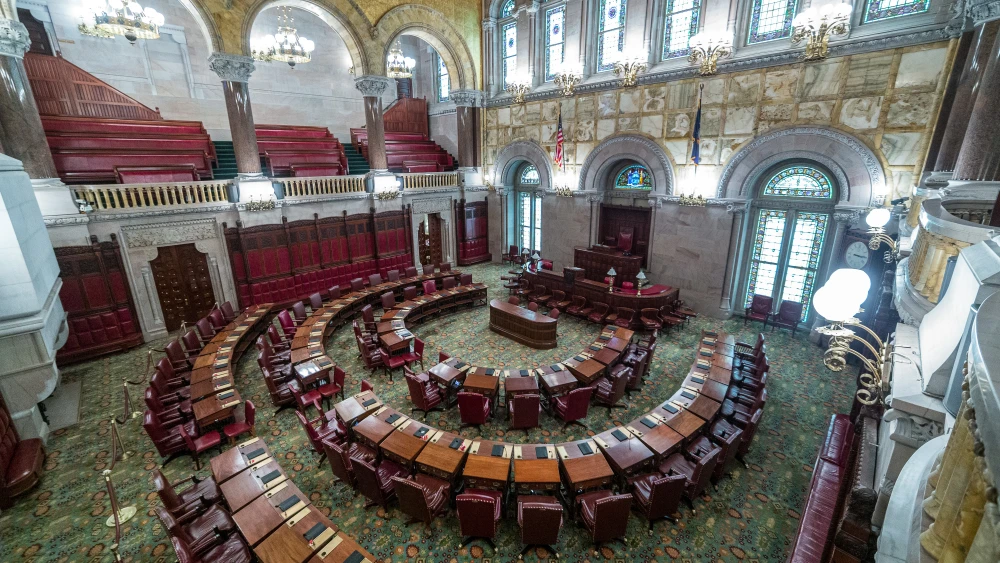
Most Orthodox Jews only count men for a minyan, a prayer quorum of 10, but if one sets that aside, there is about to be a metaphorical such continent of Orthodox Jews representing the state in Albany, according to David Greenfield, CEO and executive director of the Met Council.
“We may have a minyan of state legislators who are Orthodox in New York,” he wrote at 10 p.m. on Tuesday night, as election results continued to arrive.
“Assembly: Simcha Eichenstein (Brooklyn), Kalman Yeger (Brooklyn), Joey Cohen Saban (Brooklyn), Sam Berger (Queens), David Weprin (Queens), Pesach Osina (Queens), Aron Wieder (Rockland), Ari Brown (Nassau),” he wrote. “Senate: Sam Sutton (Brooklyn) and Lisa Vider (Nassau).”
Berger, a state Assembly member who represents Queens, told JNS that “I know many Jews are feeling scared right now amid the increasingly hostile political rhetoric.”
“But against that backdrop, seeing so many Orthodox Jews represented in Albany is a source of real strength and encouragement,” he said. “At a time when some are trying to silence our community, we have a voice at the table.”
“Make no mistake,” he told JNS. “We intend to use it.”
Brown, a state Assembly member who represents parts of Nassau County, told JNS that “as the first yarmulke-wearing Republican ever elected to the New York state legislature, I respect all my colleagues.”
“Being Orthodox alone doesn’t define effective representation,” he said. “Securing funding for an institution or an ambulance is a short-term victory, but the bigger picture matters.”
“When your party aligns with Mamdani, Ocasio-Cortez, Chevalier, El-Sayed and Omar, you must ask whether party loyalty is coming before protecting the Jewish community and all Americans,” he told JNS.
New York City Mayor Zohran Mamdani, Rep. Alexandria Ocasio-Cortez (D-N.Y.), N.Y. congresswoman-elect Darializa Avila Chevalier, Michigan senator-elect Dr. Abdul El-Sayed and Rep. Ilhan Omar (D-Minn.) are all frequent and harsh critics of the Jewish state.
“We need to look beyond short-term political victories and consider the long-term consequences,” Brown told JNS.
Greenfield told JNS that “for decades, the Orthodox community was treated as a voting bloc to be courted every few years.”
“Today it is a community that governs,” he said.
Vider’s election marks the first time that an Orthodox woman will serve in the New York state Senate, according to Greenfield, who served on the New York City Council for nearly eight years.
“This is a historic day for New York,” the executive of the nation’s largest Jewish organization that fights poverty, told JNS.
The group of 10 that Greenfield described spans multiple Orthodox communities and political affiliations.
“They are Chassidic, Sephardic and Modern Orthodox. They are Democrats and Republicans,” he told JNS. “They come from Borough Park and Midwood, from Far Rockaway and Kew Gardens Hills, from Monsey and the Five Towns.”
“For the first time, they include an Orthodox woman in the state Senate,” he said. “That diversity is the real story.”
Lisa “Malkie” Vider told JNS that “as the first Orthodox Jewish woman to serve in state Senate, it is deeply meaningful to be part of a growing Orthodox presence in Albany.”
“Serving in the Senate majority gives me an opportunity to help shape decisions that affect our community and turn our priorities into meaningful results,” she said. “From combating antisemitism, ensuring our security and protecting religious freedom to supporting our schools and making life more affordable, it all begins with us having a seat at the table.”
“This special opportunity also gives us a responsibility to build relationships beyond our own community, understand our neighbors’ needs and find common ground,” she told JNS. “I want to be both a strong voice for our community and a necessary bridge to others, because those relationships make us all more effective advocates for everyone we represent.”
Greenfield told JNS that “the Orthodox community is among the fastest-growing parts of New York Jewry.”
“It votes, it organizes and it shows up for its neighbors of every background,” he said. The 10 Orthodox legislators bound for Albany “were elected by Orthodox voters but also by the neighbors, who share their districts and trust them to deliver,” he added.
The election results reflect a changing relationship between the Orthodox community and political representation in New York, he thinks.
“Orthodox New Yorkers are no longer asking for a seat at the table,” he told JNS. “They are helping set it, and every New Yorker will be better for it.”


