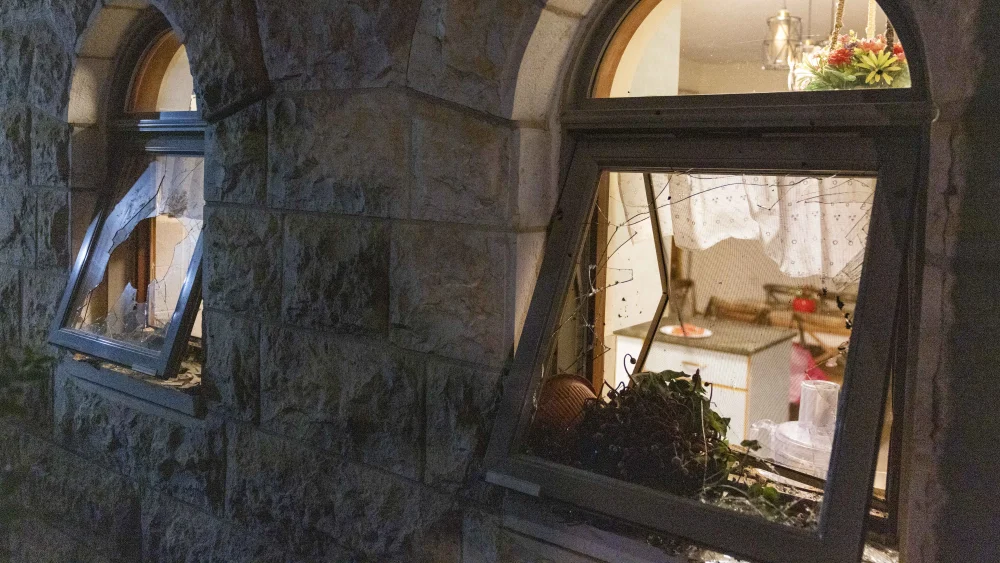
Israeli Prime Minister Benjamin Netanyahu on Wednesday condemned ultra-Orthodox rioters who attacked the home of Supreme Court Justice Noam Sohlberg.
After speaking with Sohlberg, who serves as the court’s deputy president and is widely regarded as one of its more conservative justices, Netanyahu reiterated his “strongest condemnation” of the attack on the judge and his family.
“The prime minister inquired after the well-being of Justice Sohlberg and his family and made it clear that he expects law enforcement authorities to take a hard line against the rioters,” according to the statement from the Prime Minister’s Office.
Sixty-two Haredim were detained after trying to break into the 64-year-old judge’s private residence in the Judea community of Alon Shvut.
Pictures from the scene showed shattered windows, broken flowerpots and a car with a smashed windshield. Israeli flags bearing a swastika in place of the Star of David were also left behind by the anti-Zionist rioters.
A Magen David Adom medical team was called to the Sohlberg home after the justice reported feeling unwell, according to Ynet. Sohlberg and his wife were both home at the time of the incident.

“A Jew taking a stone and throwing it at another Jew’s home is something tragic, intolerable and incomprehensible,” Meira Sohlberg told reporters following the attack.
She added, “There is always a minority that carries out severe provocations. We are not afraid, but we are saddened. It would be good if people lowered the flames—from every direction, every side and every sector. We cannot fight one another when we have so many enemies around us. Disagreement is fine, but destruction? How is that possible?”
The ultra-Orthodox Shas and Degel HaTorah (part of United Torah Judaism) factions subsequently issued a joint statement saying they were “pained and shocked by the ongoing persecution and trampling of Torah students by Supreme Court justices.
“We warned that these measures would lead to radicalization and anarchy and, unfortunately, we are seeing those fears materialize,” the parties said, while emphasizing that violence is “contrary to the Torah and completely unacceptable.”
Israel’s coalition government in March moved to pass the 2026 state budget without a highly debated draft exemption law, which was temporarily shelved.
“We are now putting aside controversial issues that are not suitable for wartime,” said Israeli Finance Minister Bezalel Smotrich, citing both the legislation that would exempt Haredi yeshivah students from Israel Defense Forces service as well as several unspecified proposed reforms.
The enlistment bill that was under consideration reflected Israeli Prime Minister Benjamin Netanyahu’s attempt to forge a compromise with his ultra-Orthodox political partners.
However, in April, the Supreme Court, sitting as the High Court of Justice, ordered the government to take a series of measures against draft dodgers, in response to petitions accusing the state of contempt of court for failing to enforce existing conscription laws.
The decision came in the wake of a November ruling ordering the state to formulate sanctions to enforce military conscription, stressing that state benefits should not be granted to those evading service.
Israel’s ultra-Orthodox sector generally considers national service a distraction from Torah study and a threat to their way of life. However, Hamas’s Oct. 7, 2023, onslaught on Israel and the ensuing War of Redemption have heightened demands by the general public that Haredim contribute to the Jewish nation’s defense.
Between 63,000 and 66,000 young Haredi men studying in yeshivahs are legally required to serve. Since the Hamas-led terrorist attacks in southern Israel, more than 1,000 Haredim have voluntarily enlisted, and a similar number have volunteered for civilian national service.