


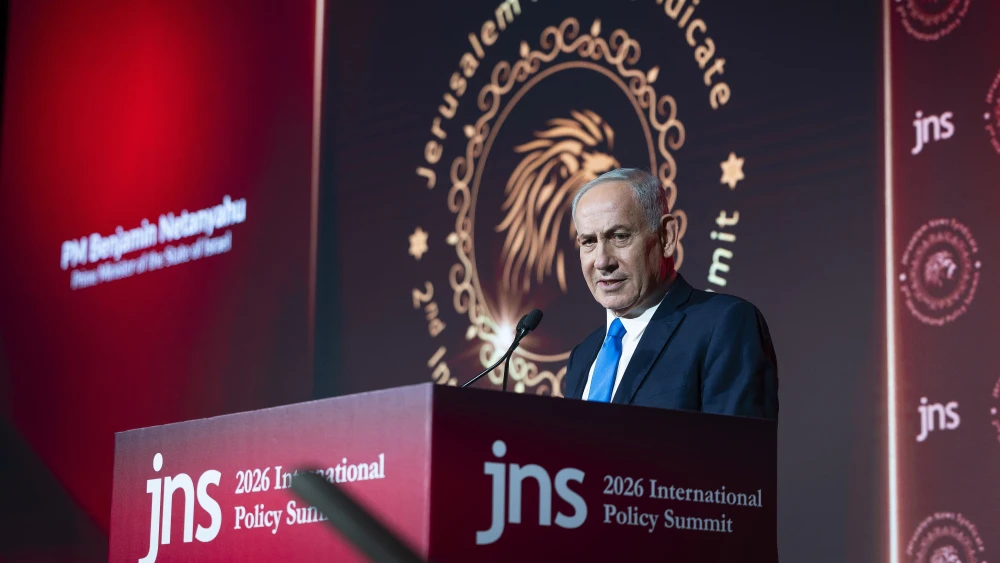
The joint U.S.-Israeli campaign against the Islamic Republic has created the conditions for the regime to fall, Israeli Prime Minister Benjamin Netanyahu said on Sunday night, addressing the 2026 JNS International Policy Summit at Jerusalem’s Waldorf Astoria.
“Together with our American friends, the American air force, the American military, we carried out the largest airstrike in our history,” Netanyahu said.
“Had we not acted in ‘Operation Rising Lion’ and in ‘Operation Roaring Lion,’ Iran would have had atomic bombs, and ... they would have used them,” he said. “That’s what we prevented.”
In “Operation Roaring Lion,” the United States and Israel launched a massive surprise attack against the Islamic regime between Feb. 28-June 17, decimating its leadership, including its Supreme Leader Ali Khamenei, wiping out its remaining ballistic missile capability, sinking its navy and severely degrading its military-industrial base.
It followed “Operation Rising Lion,” a 12-day air campaign conducted mainly by Israel between June 13-24, 2025, which eliminated 30 senior Iranian military leaders, Islamic Revolutionary Guard Corps commanders and nuclear scientists within the first four minutes. The operation gained key U.S. military support when, on June 22, seven B-2 bombers struck three Iranian nuclear facilities.
“We destroyed Iran’s nuclear infrastructure. We knocked out 20 of their top nuclear scientists, 12 in ‘Rising Lion,’ another eight in ‘Roaring Lion.’ And when you take out the scientists, it’s very hard to make a nuclear weapon, exceedingly hard,” Netanyahu said.
The cumulative damage inflicted on the regime’s economy is “counted in hundreds and hundreds of billions of dollars, and it will take them a long time to recover,” he added.
“They may not recover, because once you deal these blows and once the rift between the regime and the people is so deep, you cannot tell when such a regime will fall,” he said.
The prime minister added, “I think we created the conditions for its future fall; that is what will be the real triumph, when the Iranian people take their own destiny in their hands, and they knock out this brutal regime that is terrorizing them and terrorizing the rest of the world.”
The Israeli premier highlighted other achievements under his leadership as the Jewish state clawed its way back from the Oct. 7, 2023, Hamas-led attack on southern Israel to deliver blow after blow against its enemies.
It is not just the Iranian regime, but its terror axis throughout the Middle East that Israel has thrown back, Netanyahu said. “We took out [Hamas leader Yahya] Sinwar. We took out [Hamas Political Bureau Chairman Ismail] Haniyeh. We took out [Hamas military commander Mohammed] Deif. We took out tens of thousands of terrorists. And despite those who said it couldn’t be done, we brought back to Israel every single hostage.”
Netanyahu highlighted Israel’s accomplishments in Lebanon, referring to what has become known as “Operation Grim Beeper,” in which Israel booby-trapped thousands of pagers and hundreds of walkie-talkies used by the terror group Hezbollah.
“We decimated Hezbollah’s military machine. We destroyed over 90% of the 150,000 rockets and missiles that Hezbollah amassed against us,” he said, also praising Israel’s targeted assassination of Hezbollah leader Hassan Nasrallah.
Israel has now established security zones on multiple fronts, including in Lebanon, he said.
‘What would America do?’
The Israel Defense Forces will remain in Southern Lebanon “as long as we need to protect our people” from Iranian-backed Hezbollah terrorists, he stressed. “The reason is perfectly understood; no country would be asked to do otherwise.”
“Now, you imagine the United States, across the border, you have thousands, an army of thousands of terrorists who pellet your cities and your towns with rockets and ballistic missiles and killer drones. They kill your soldiers, they kill your citizens, they kill your children. And they threaten them every day. Well, what would America do?
“Would it say, ‘Well, there’s nothing we can do; let’s hold our fire?’ Is that what America would say? No. You know damn well what America would do. It would cross the border, create a security zone, kill the terrorists and protect its people until the threat is removed,” he said. “That’s exactly what we are doing.”
Regarding the care Israel takes when targeting terrorists hiding among civilian populations, Netanyahu said “no country” would do a better job in Lebanon. The ratio of terrorists to noncombatants slain in the war has been as low as 5 to 1, despite Hezbollah’s use of human shields, which is “unheard of, because no army goes to such lengths as the Israeli army, who target terrorists and minimizes civilian casualties. We should be commended for it.”
But Israel’s greatest achievement, according to Netanyahu, was “to break through the barrier of fear.” Israel overcame the longstanding belief among naysayers that it was too dangerous to strike inside Iran. Israeli warplanes filled Iran’s skies, hitting missile production sites, terror targets and nuclear facilities.
“We changed Israel’s security doctrine. We initiate. We attack. We surprise. And we attack those enemies that seek our destruction, that seek to kill us—we attack them before they have a chance to do so,” he said.
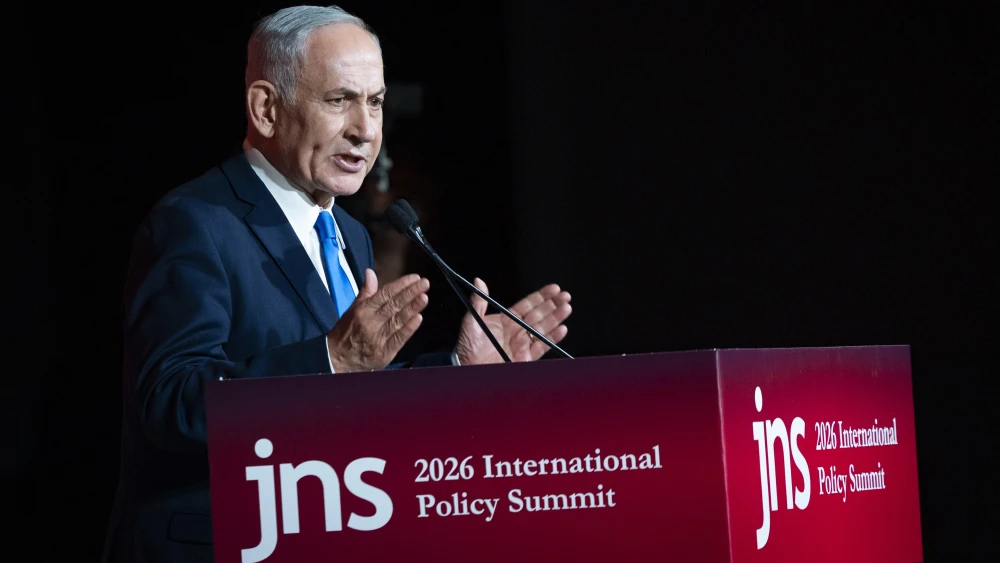
Addressing reported disagreements with Washington over his policies on Iran and Lebanon, Netanyahu said he and U.S. President Donald Trump “respect each other’s sovereignty, leadership and commitment to our people.”
“In the United States, they say that President Trump does everything I ask him to do, and in Israel, they say that I do everything that he wants me to do. Well, neither is true,” Netanyahu said. “We’re leaders of independent and proud countries. We stand for our interests; I stand for the interests of Israel, and for its security. Often we see eye to eye; sometimes we don’t.”
Netanyahu noted that this year marks the 50th anniversary of the 1976 Entebbe Raid, considered the most daring rescue operation in modern history, in which Israeli commandos led by Netanyahu’s elder brother, Lt. Col. Yonatan Netanyahu, rescued Israeli hostages in Uganda. Netanyahu’s brother was killed during the raid.
Netanyahu had come directly to the JNS conference from Mount Herzl, where he had been visiting his brother’s grave.
“Entebbe showed that a free people, if they mobilize their courage and muster their strength and their will, they could overcome the worst tyrannies,” the prime minister said.
The 2026 JNS International Policy Summit, which was preceded by a weekend VIP gathering and tours around Judea, comes one year after the inaugural JNS Summit held in Jerusalem.
The three-day conference will include addresses and panels on U.S.-Israel relations, the war with Iran, Israel’s military, diplomatic and legal battles, the wave of global antisemitism in the wake of the Oct. 7, 2023, Hamas-led attack, as well as relations with the Christian world.


