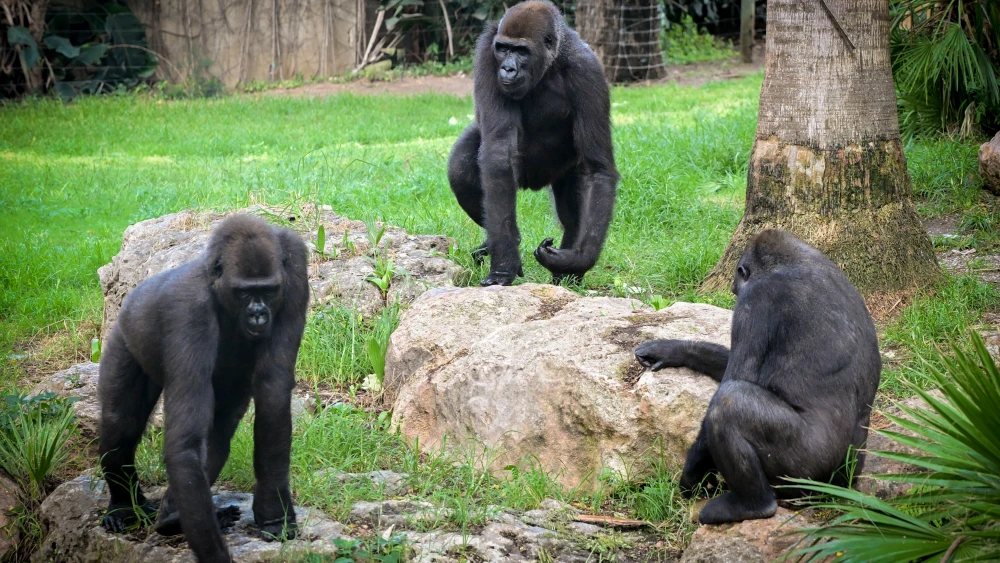
Researchers from Tel Aviv University at the Ramat Gan Safari captured a rare moment of voluntary cooperation between two adult female gorillas, who formed a “living ladder” to reach inaccessible vegetation, the school said in a statement on Monday.
Three different events of the same nature took place in 2021, 2024 and 2025, and were described in a study published in the journal Primates last month.
The incidents involved the same half-sisters, Amelia and Lisha, each performing the same role: Lisha provided a stable platform, while Amelia climbed on her back and reached for leafy branches.
The study, led by Michael Levitzky and Professor Israel Hershkovitz, stresses that the western lowland gorillas’ actions were spontaneous and did not involve training.
“Our observations reveal how two gorillas can join forces and assume complementary roles to solve a problem that neither can solve on her own,” Hershkovitz was quoted as saying.
“These observations are important for understanding human evolution because they offer an explanation, albeit a partial one, for how we survived on the savanna—through social support and a high level of cooperation that can occur even without language or preplanning,” he added.
The most significant case of cooperation happened in September 2024, when keepers noticed the two females peacefully eating bark and leaves from a large branch that they could not climb to directly because of an electric barrier, according to the study.
To discover how they had obtained the food, staff reviewed security camera footage.
The material revealed that Amelia climbed onto a rock beneath the Peltophorum dubium (yellow poinciana) tree. Lisha then joined her and stood firmly on all fours on the rock. Amelia climbed onto Lisha’s back, stood upright, and stretched upward to grasp and break off a branch approximately 4.5 meters above the ground. Their complementary roles enabled Amelia’s access to the branch.
A similar event of cooperation took place in 2025, but this time, Amelia did not share the vegetation with Lisha.
According to the study, this difference indicates that cooperating to obtain a resource and subsequent sharing are separate aspects of social behavior.
The researchers were not able to establish via the footage whether the gorillas communicated through vocalizations or subtle gestures or planned their actions in advance.
Yehonatan Samocha, head of the Primate Section at the Ramat Gan Safari, said, “Particularly among great apes, including gorillas, we repeatedly encounter behaviors that demonstrate high intelligence, learning ability, problem-solving, complex communication, and cooperation,” according to the university.
He noted that for this reason the researchers were “so thrilled, though not necessarily surprised,” by Amelia and Lisha’s cooperation. Samocha added that the study allows researchers to enhance their “knowledge of gorillas, their social world, and their cognitive abilities.”
Levitzky, who initiated and led the study, remarked, “For years, gorillas were considered less cognitively sophisticated than other great apes. As more observations like these accumulate, we will be able to deepen and refine our understanding of their social and cognitive abilities.”
He added that future studies with systematic documentation and audio recordings could help understanding better how gorillas coordinate with each other, and perhaps teach something about the “roots of cooperation in our own species.”