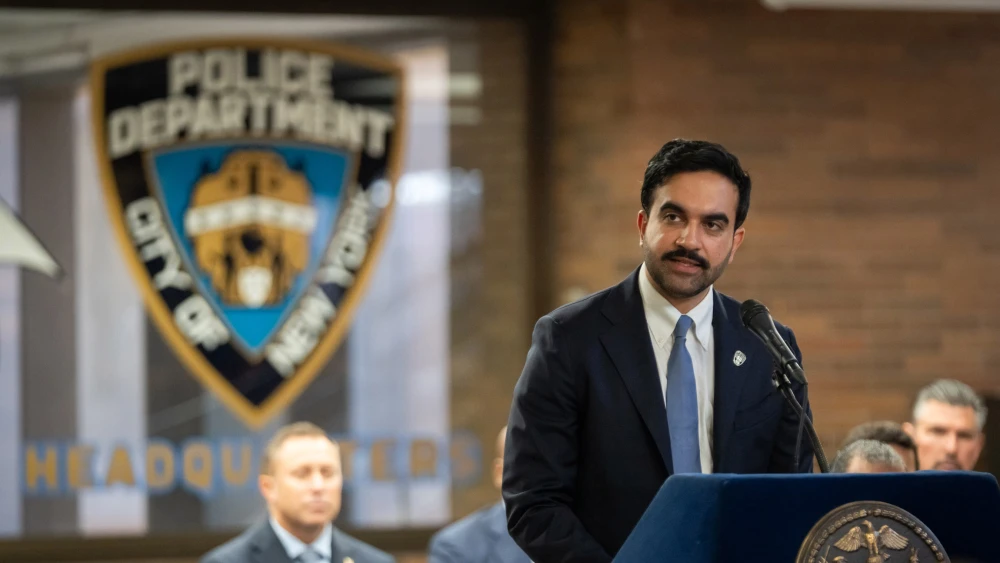
New York City Mayor Zohran Mamdani drew widespread criticism on Monday after he announced that he would dissolve the specialized New York City Police Department counterterror unit, which also manages crowds during protests, and replace it with a civilian-led “community dialogue and de-escalation division” and a “First Amendment support team.”
City Hall called the de-escalation division a “first-of-its-kind” and said that it “will not have weapons or arrest powers.”
“During our campaign, I promised New Yorkers that we would disband the Strategic Response Group and separate counterterrorism from protest response, and today we are delivering on that promise,” Mamdani said.
“New Yorkers exercising their constitutional right to protest should not be met with the same police response as a terrorism threat,” he said. “We are establishing a new, civilian-led approach that prioritizes dialogue, engagement and de-escalation.”
The NYPD Strategic Response Group was formed in 2015.
Police officers can still be “called upon to come make arrests, including for those engaging in civil disobedience,” Mamdani said.
The new civilian-led unit will “not have weapons or arrest powers,” and the NYPD support team “will consist of 30 uniformed officers trained in communication and de-escalation,” according to City Hall. It added that police won’t be allowed to use tear gas or pepper spray during “First Amendment activities,” and that “kettling,” a crowd-control tactic in which officers confine protesters to a restricted space, will end.
NYPD Commissioner Jessica Tisch said that she “would never support changes that diminish the NYPD’s ability to protect New Yorkers or that put our officers in a position where they lack the resources necessary to confront a serious threat.”
“These changes will make us a stronger, more effective department,” she said.
Inna Vernikov, a member of the New York City Council and co-chair of its bipartisan task force on Jew-hatred, told JNS that “by disbanding the SRG, Mamdani is also unleashing a monster on Jewish New Yorkers.”
“Our community has already endured violent protesters attacking Jewish-owned businesses, intimidating congregants at synagogues and threatening Jewish students on university campuses,” she said. “Apparently, that’s not enough.”
“What’s another target painted on the backs of New York’s Jews for this mayor?” Vernikov told JNS.
Evan R. Bernstein, CEO of B’nai B’rith International, told JNS that the mayor’s decision is “a dangerous and ideological betrayal of public safety especially for New York’s Jewish community.”
“At a moment when Jews remain the city’s most targeted group for hate crimes, the SRG has been one of the few specialized units capable of rapidly containing violent, antisemitic protests that have repeatedly targeted synagogues, Jewish institutions and ordinary New Yorkers,” he said.
“Replacing trained officers with an unarmed, civilian ‘dialogue’ division that has no arrest powers is not reform. It is willful blindness,” Bernstein said. “Dialogue does not stop mobs chanting for intifada or blocking streets outside of Jewish neighborhoods.”
Mandani’s decision follows calls from anti-Israel groups, which have staged protests outside synagogues and Jewish institutions across the big Apple, to nix the NYPD unit.
In May, an anti-Israel protest outside a Brooklyn synagogue led to multiple arrests, and an NYPD officer was hospitalized after anti-Israel protesters tried to remove barriers outside Park East Synagogue in Manhattan.
The city recorded an 182% increase in anti-Jewish hate crimes in January, in Mamdani’s first month as mayor, and since then, more than half of the city’s hate crimes have targeted Jews, who make up about 10% of New Yorkers.
Last month, 57.8% of hate crimes in New York City targeted Jews, according to city data. Jewish leaders in the city and nationwide have told JNS that the mayor’s rhetoric, including his frequent and widespread criticism of Israel, has made Jews less safe.
Chaim Steinmetz, senior rabbi of Congregation Kehilath Jeshurun, a Modern Orthodox synagogue on Manhattan’s Upper East Side, told JNS that the mayor’s decision will have a negative impact on Jews.
“At issue is not protest as free speech. That must be sacrosanct,” the rabbi said. “What is of deep concern to the Jewish community is protest as intimidation.”
At recent demonstrations outside the UJA building and Park East Synagogue, protesters intimidated Jews, according to Steinmetz.
“Zohan Mamdani is acting like the protester-in-chief, not the mayor of New York,” he told JNS. “Because of that, there will be many more events like Park East Synagogue.”
“When there is violence,” he said, “it will be Mamdani’s fault.”
The World Jewish Congress told JNS that it has “every confidence” in the NYPD’s ability to protect Jews despite the changes.
“Politics must never get in the way of protecting Jewish lives,” it said.
Moshe Davis, former executive director of the mayor’s office to combat Jew-hatred under Mayor Eric Adams, told JNS that “we need more cops and faster responses when mobs target our community.”
“I hope this fancy video and rebrand won’t change that,” Davis, who leads the Protecting Worship coalition, told JNS. “If the mayor’s new de-escalation unit can convince his own allies to stop targeting houses of worship, we’ll all welcome it.”
Jim Geraghty, senior political correspondent at National Review, addressed the Mamdani decision on his podcast “Three Martini Lunch.”
“You’ve basically announced this is your permission slip,” he said. “This doesn’t work in other cities. Why it would work in New York is completely beyond me, but it feels very on brand for Mamdani to say, ‘I’m going to do everything I can to make my city feel more chaotic and more like an angry mob is really in control.’”