


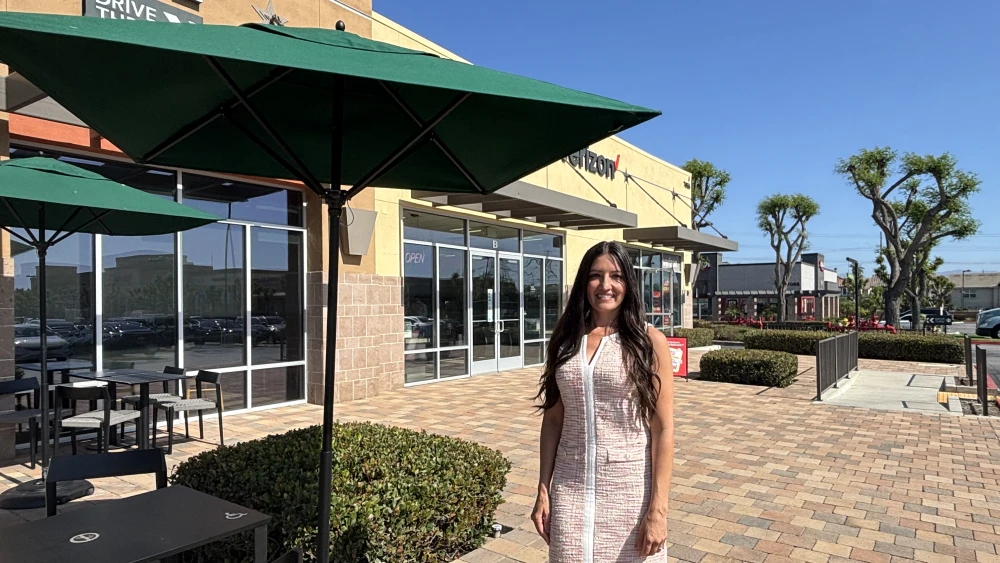
An older woman came up to Sonja Shaw at a Starbucks in Chino, Calif., some 35 miles east of Los Angeles. “We voted for you,” the teacher told the school board president of Chino Valley Unified School District, who is running for state superintendent.
“She’s one of our good teachers, really good teachers,” Shaw told JNS at the coffee shop earlier in the month. “She was the one that everyone wanted.”
Shaw has been president of the school board, which oversees a district with more than 26,000 students across 37 schools, since 2023. She is slated to square off against Richard Barrera, president of the San Diego Unified School District Board of Education, for the superintendent position, which leads the state’s Department of Education.
Shaw told JNS that she decided to run for superintendent of public instruction this election cycle at the urging of Bill Essayli, who at the time was a Republican member of the state Assembly and is now the first assistant U.S. attorney for the Central District of California.
She had been “hitting walls” during her tenure as school board president, because “we kept getting attacked by the state,” Shaw told JNS.
“The state keeps attacking us for something that we’re doing best,” she said. “We don’t have all these culture issue wars in our district, and when we do have those, we shut them down very quickly.”
Shaw believes that ethnic studies is a “gateway” to divisive ideologies like antisemitism and gender ideology and that it should be cut altogether.
“We don’t need it,” she told JNS. “We need to teach real, honest history, real honest things about how we did things wrong, the horrifying things of the Holocaust, exactly what we do in Chino Valley. That needs to be in every curriculum across California.”
“Ethnic studies is literally, in my eyes, the Trojan horse for everything we don’t want and need here in California,” she said.
Shaw thinks that there is a “clear contrast” between her and Barrera.
“I want reading, writing, math, parents to be involved. I don’t want ideologies in the classroom,” she told JNS. “He’s about ethnic studies. He even says CRT. I mean, the guy wants everything that is failing our kids,” she said of critical race theory.

‘Poked the wrong bears’
Shaw didn’t pay attention to politics until schools were shut down during the Covid pandemic in 2020. Before then, she owned a small fitness business and focused on being a full-time mother, she told JNS. California Gov. Gavin Newsom, a Democrat, “poked the wrong bears, the mama bears,” Shaw told JNS.
Shaw became involved in online parent groups, became president of a grassroots parent group and started going to school board meetings.
“I quickly realized after very nicely asking for a seat at the table, they didn’t want to give parents a seat at the table,” she told JNS.
Union leadership “hijacked” the school board at that time, Shaw said. She uses the term “union leadership,” because “we have activists in the classroom and then we have good teachers, and I definitely do not put those two things together.”
She ran for one of the two open school board seats in 2022 and won “despite all the odds and the money spent against us.” She beat a candidate whom the current state superintendent of public instruction backed, she said.
The school district has “no tolerance” for antisemitism, and there have been no reported instances of Jew-hatred in the district during her tenure on the board, she said. Ethnic studies has not been allowed to enter the district’s classrooms, she told JNS.
“All kids can walk in and say, ‘I feel safe here,’” she said. “There’s no hate being put in the classroom.”
Shaw noticed in 2023 that anti-Israel protesters were pushing for resolutions calling for a ceasefire in the Gaza war at city councils and school board meetings. She thought that they were acting in a “very, very aggressive” manner and predicted that protesters would likely do the same thing at upcoming school board meetings.
After working with the board’s attorney and secretary, Shaw opted to cut the microphones of anti-Israel protesters when they tried to speak during public comment, she told JNS.
“I got flipped off a couple times and they never stepped foot in our board meeting again,” Shaw said. “That’s why I’m telling you, you need somebody up there with proven results, not just someone who talks the talk.”
Shaw also tackled the issue of flags.
The board implemented a policy banning all flags except for the U.S., California and military flags, due to concerns about Palestinian, Israeli, LGBTQ+ and other flags causing division in classrooms.
The principal must approve other flags to be displayed in the classroom, and those flags have to be relevant to the curriculum being taught, according to Shaw.
She said she heard horror stories of groups fighting about such displays. “We said, cut it,” she told JNS. “Classrooms need to be a neutral learning environment, where every child can go in there, feel safe and learn.”
The local teachers union challenged the flag policy before the California Public Employment Relations Board, which required the district to revise its policy.
The board “usually protects unions’ working rights,” Shaw told JNS. “How does a flag protect their working rights?”
She believes the ban should be a statewide policy.

‘Knowing it’s a problem’
Shaw accused Barrera of watering down an antisemitism resolution that the San Diego school board passed in 2021.
“He wouldn’t allow, from my opinion and from what I saw, the resolution to be put into their ethnic studies class,” Shaw told JNS. “Why? Why, knowing it’s a problem?” (JNS sought comment from Barrera’s campaign.)
The resolution condemned antisemitism and recognized the International Holocaust Remembrance Alliance’s working definition of Jew-hatred. But the San Diego school board removed provisions from it stating that the district has a “robust ethnic studies program” and supports “the use of unbiased and politically neutral materials on issues like the Israeli-Palestinian conflict.”
At the time, Barrera didn’t think that the resolution should be included in ethnic studies and that the district would be able to adequately train teachers on being able to discuss the conflict in the classrooms, according to reporting from a local CBS affiliate.
In a May virtual forum for state superintendent candidates that Jewish California hosted, Barrera defended the resolution after Shaw criticized it.
“We brought everybody together and created a policy that we all believe in,” he said. He added that the resolution balanced “strong protections against antisemitism with protection of academic freedom in the classroom.”
He also said at the forum that ethnic studies is “part of the solution.”
“If you’re a young person growing up in this country and you yourself are experiencing discrimination every day and you see your family experiencing discrimination, you want to understand why that is and you want to understand that you actually can be part of positive change,” he said.
When the candidates were asked during the forum if they would commit to enforcing AB 715, California’s recent law addressing Jew-hatred in K-12 schools, Barrera said that he couldn’t commit to opposing efforts to address “issues that create real problems in our classrooms and problems for our classroom educators.”
“We shouldn’t even need laws to protect basic human rights,” Shaw told JNS. “This is an antisemitism law. This shouldn’t be anything controversial.”
Shaw believes that the complaint process under the law needs to be streamlined and that parents need to know that their reports are being handled.

‘Need a good plan’
Shaw is a “big advocate” for school choice, she told JNS.
She put her children in a charter school during the pandemic, before eventually returning them to public school. She believes that “the money should follow the child” and that school choice “keeps public school systems on their toes.”
“If you provide a good product, by default, public schools should not be afraid of people leaving their schools, because they’re providing a good product and by default, the majority of parents automatically put their kids into public schools,” Shaw said. “It’s free. It’s local. It’s convenient.”
If elected state superintendent, Shaw would “have to see what is available to us” in terms of how she would promote school choice, she told JNS.
“We would need a good plan to be able to bring forward to the voters,” she said.
She is unsure what Barrera’s stance on school choice is, but the California Teachers Association, the largest teachers union in the state, has opposed school choice legislation and endorsed Barrera.
The California Charter Schools Association has endorsed Barrera as well. Shaw thinks it did so because of legislation “aggressively” targeting charter schools.
“If you start supporting the majority, or you just shut up, they feel like—and I’ve seen it—they feel like, OK, they’re not going to aggressively come after us right now,” she said.
“I don’t think their members are good with it. I know people who are in charge of charter schools—they don’t agree with their decision,” she said. “But it’s just kind of the same thing like with teachers and their unions. They don’t agree with their unions’ direction but they’re part of it.”
‘Spokesperson of education’
The legislature, which Shaw thinks is the root of the issues that the state has faced regarding education, is considering a bill that would remove the superintendent from being director of the California Department of Education. Instead, it would create a new commissioner, whom the governor would appoint to oversee the department.
Under the bill, the state superintendent would be “an independent evaluator and cross-sector coordinator for public education.”
Shaw is opposed to the bill, but if it becomes law, “you’re going to see me as the spokesperson of education in this state,” she said.
She would be “going to every district and showing the things that they’re showing kids that shouldn’t be shown, the antisemitism that they shouldn’t be doing, the things in the classroom that are not reading, writing, math and pathways to success,” she told JNS.
Shaw understands that going against the union is going to be “tough,” because it has “unlimited resources.”
“Six million dollars and upwards spent on this race and that was just the primary,” she told JNS. “I can’t compete with that.”
The way to beat the union is through people and parents, Shaw told JNS.
The union has money” and members to vote, according to Shaw.
“But people have a choice. They can vote for the same failure, or they can vote for someone who has the blueprint and a track record for success that’s desperately needed,” she told JNS. “At the end of the day, I think the people, if they show up, regardless of feeling like elections are stolen, this, that and the other, we can win it.”
Shaw said that the teacher who interrupted the interview to tell her that she voted for her, “that was a teacher who—her union said I was bad.”
“Over four years, I built the trust and showing I’m advocating for you to get the money in the classroom,” Shaw told JNS. “I don’t want these special interests to get the money. I want you to get the money, because it goes directly to the student learning.’
“I just have to prove the same thing, at a bigger level, she said.


