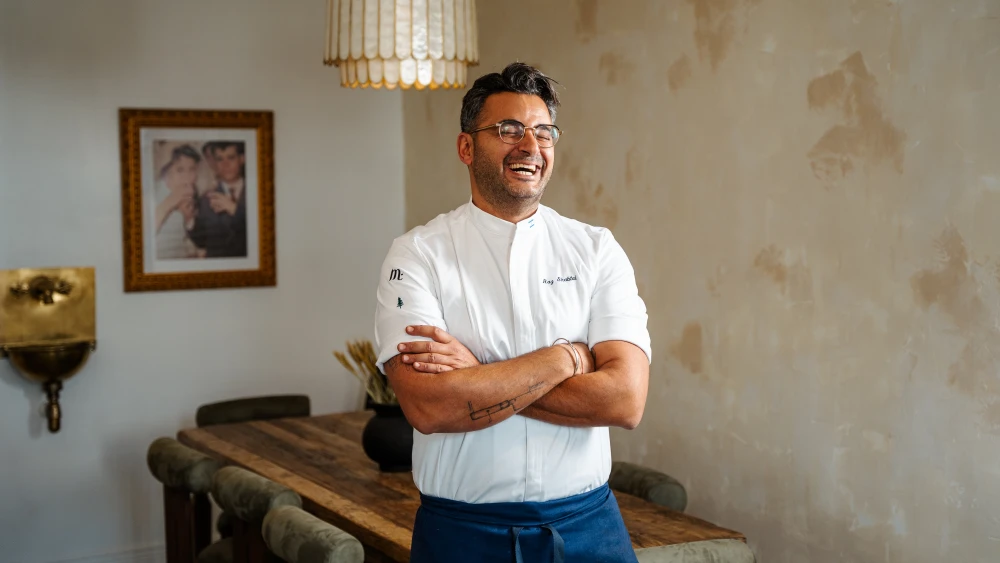
Israeli-born chef Raz Shabtai learned that his restaurant Mutra, in North Miami, had become the world’s first kosher eatery to earn a Michelin star during a livestreamed ceremony on May 28.
“It’s beautiful, humbling, honoring,” he told JNS.
Michael Werzberger, a partner and investor in the restaurant, told JNS that the “Michelin star proves that talent and dedication will be recognized for what they truly are.”
“Kosher is not a barrier,” he said. “It’s a standard.”
The Michelin Guide states that Shabtai “has brought his take on Middle Eastern cuisine to Miami.”
“Named for his grandmother, this is a place where snagging a seat at the chef’s counter is a must,” it states. “The menu is hyperlocal and rotates often, so don’t be surprised when something runs out. Fear not, however, as the excellent staff will help you discover your new favorite.”

Notable dishes include “a show-stopping plate of beets in a pool of ajo blanco and topped with beetroot sorbet,” per the guide. “The signature lamb kebab with smoked aubergine cream and tomato oil is pure comfort, as is chicken a la Tunis, juicy and flavorful with harissa-studded chickpea tomato stew.”
“Muhallebi, a creamy Middle Eastern milk pudding, is a sweet and satisfying finale,” it adds.
Mutra is the first restaurant under strict kosher supervision to earn a Michelin star, and it is the only restaurant in Miami to receive a new star. It also has a Hebrew sign at its entrance stating, “you are blessed when you arrive, and you are blessed when you leave.”
The ruling on the restaurant shows that the guide is “extremely true to the food, how you execute your dishes,” the chef told JNS.


Mutra, which opened in February 2025, is named for Shabtai’s grandmother, whose cooking and hospitality continue to influence the restaurant’s philosophy.
The Jerusalem-born chef has said that the menu draws heavily on childhood memories and the flavors of the city where he grew up.
Werzberger, the partner and investor, told JNS that the restaurant began after Shabtai worked for his family.
“Chef Raz was working as my private chef when he prepared one of the most memorable holiday meals my family had ever experienced,” he told JNS. “We never knew what that style of Michelin-caliber cuisine even looked like, because we had never experienced it before in the kosher world.”
That experience led Werzberger to encourage Shabtai to open a restaurant.

“I felt the kosher world deserved to experience that level of culinary creativity,” Werzberger told JNS.
Another partner in the venture, Noa Figari, originally worked with Shabtai as a real-estate agent and helped locate the restaurant’s North Miami space, before joining as Mutra’s director of operations.
The restaurant’s menu changes every three to four months and features dishes rooted in Middle Eastern and Israeli culinary traditions made with contemporary techniques.
Current offerings include “1 perfect falafel,” a falafel croquette served with tahi-amba and Israeli salad and “chicken liver dreaming to become foie gras,” a chicken liver pâté with silan, pistachio crumble and shallots.
Continuing the theme of inventive names, the restaurant also offers “let’s ruin something pretty,” a roasted beet dish with beet sorbet, ajo blanco and almonds. Other menu items include “Israeli Nam-Tok,” “Tunisian Mole” and the restaurant’s signature “chef’s cut butchered in house.”
Shabtai said that the team tried to operate at a Michelin-star level from its earliest days, despite not knowing if inspectors had ever visited.

“We always acted as if we had a Michelin star,” he told JNS. “We didn’t say, ‘We want a Michelin star’ when we opened, but it was a way of operating.”
He described Michelin inspectors as anonymous evaluators, who assess restaurants based on quality of ingredients, technique, the chef’s philosophy, execution and consistency.
“When Michelin judges you, they don’t just judge you when coming in once,” he said. “The inspector, when he arrives, has a view of if I’m the guest, why do I want to come back here?”
That philosophy, he said, extends beyond the food and encompasses hospitality from the moment guests arrive.
For Werzberger, the award carries significance beyond a single restaurant.

“From the first dish I tasted from Chef Raz, I knew he was different from any other chef whose cooking I had ever experienced,” he told JNS. “He has a gift that I wanted to share with the world, and especially with the glatt kosher community.”
The recognition comes as South Florida’s kosher dining scene has expanded in recent years, fueled by a growing Jewish population and increased demand for upscale kosher options.
Shabtai hopes that the achievement encourages other chefs and restaurateurs to pursue similar ambitions.
“I hope that one day an investor, chef, cook comes and says, ‘I can do it also,’” he told JNS.
Asked what comes next, Shabtai and Werzberger suggested that the Michelin star is only the beginning.
“This recognition will affect what we do, because it now becomes the starting point for what we are planning next, with God’s help,” Werzberger told JNS. “Mutra is not just a kosher restaurant. It is a new experience.”
Shabtai was more direct about his ambitions. “I want two stars,” he told JNS. “At Mutra and another project we are working on.”