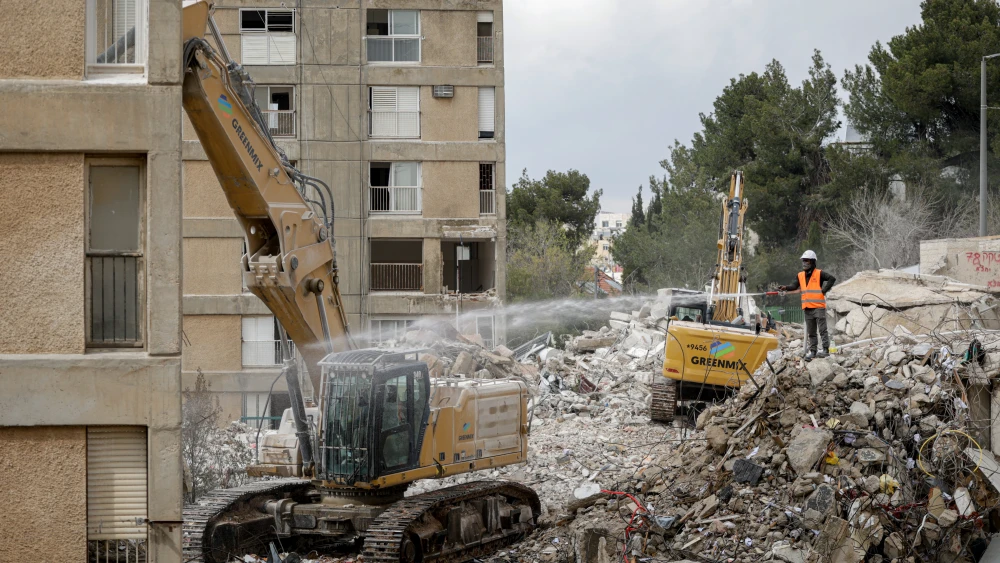

Israel faces a housing problem that is in some ways uniquely its own. Across the country, especially in greater Tel Aviv, thousands of apartment buildings dating from the 1950s through the 1980s are aging, overcrowded and structurally vulnerable. Many were built before modern earthquake standards existed. In a region where security threats are a daily reality, the inability of older buildings to withstand missile strikes or seismic events is not an abstract concern; it is a matter of life and death.
The Israeli government’s answer is a program known as pinui-binui, which translates roughly as “evacuate and build.”
A private developer approaches the owners of an aging building with a deal: Vacate temporarily, and in exchange, the developer demolishes the old structure and builds a modern one in its place—at no cost to residents. Original owners receive new apartments, the developer sells additional units and the neighborhood gains safer housing. In theory, everyone wins.
In practice, these projects are extraordinarily complex. They require agreement from a supermajority of owners—sometimes all of them—giving any holdout enormous leverage. Projects have stalled because one or two residents refused to sign, often believing their deal is less generous than a neighbor’s. That neighbor-envy problem is at the heart of a controversy now roiling Israel’s real-estate and legal communities.
The most common compensation model offers every owner the same physical addition—say, an extra 130 square feet—regardless of whether their current apartment is 400 or 1,100 square feet. The logic is partly practical (simple math, fewer negotiations) and partly philosophical: Every resident bears the same burden of disruption, so every resident deserves the same reward. For years, Israeli courts backed this approach, holding that identical burdens should yield identical benefits.
Earlier this year, the Tel Aviv District Court ruled on a pinui-binui project in Ramat Gan. The building was unusual. Apartments ranged from roughly 380 to more than 1,100 square feet—a spread of nearly 3 to 1. The developer offered all owners the same 130-square-foot addition. The court found this unfair to larger-unit owners and ordered a balancing payment of approximately $38,000 to one of them.
Israeli media treated the ruling as a watershed moment—the death knell of uniform compensation and a potential freeze on the entire sector. Some called for switching immediately to a percentage-based model, in which each owner’s addition is proportional to his/her current apartment size. The alarm, while understandable, is largely unwarranted.
First, the ruling is not final. An appeal to Israel’s Supreme Court remains possible, and treating a single lower-court decision as settled law is premature. Second, the case turned on highly unusual facts: Most pinui-binui buildings do not contain apartments at such extreme ends of the size spectrum. Where sizes cluster in a narrow band, a flat addition treats residents comparably—because their starting points already are. Third, the court issued a narrow fix for one owner in one building. That is a targeted correction, not a systemic overhaul.
The percentage-based alternative creates its own serious problems. Israeli planning regulations require new apartments to meet a minimum size of roughly 700 square feet. An owner of a 430-square-foot apartment must therefore receive a unit at least 270 square feet larger—a 63% increase. Apply that same ratio to the owner of a 1,076-square-foot unit, and the math demands an apartment of over 1,700 square feet. That would make almost any project economically unviable. Set the percentage lower, and the smallest-unit owners may not receive legally compliant apartments at all. Generosity to large-unit owners, legal compliance for small-unit owners and economic viability cannot all be achieved simultaneously.
Pinui-binui also requires social cohesion. Neighbors must collectively agree to upend their lives for years, trusting a developer with their most valuable asset. A percentage model makes disparities between neighbors visible and quantifiable in a new way: The owner of a small apartment will know, in concrete terms, that the upstairs neighbor is receiving a far larger unit—not for bearing a greater burden, but simply for starting with more space. That breeds resentment; resentment produces refusals to sign; and refusals kill projects. The flat-addition model’s practical virtue is precisely that it gives everyone the same tangible benefit, making it harder to calculate exactly how much better a neighbor is doing.
For the vast majority of projects—where apartment sizes fall within a reasonable range—nothing needs to change. The Ramat Gan ruling is simply irrelevant to them. For the rare case of a building with extreme size disparities and no signed contract yet, the right answer is not a percentage formula, but a real-estate appraiser who can design non-monetary balancing mechanisms: better floors, additional storage or parking, higher-quality finishes for larger units.
For projects already signed and underway, the answer is clearest of all: The contracts stand. Reopening legally binding agreements on the basis of a single, not-yet-final ruling would be a recipe for contractual anarchy that could set the sector back a decade.
Israel’s urban-renewal program is not simply a real-estate matter. Housing people in earthquake- and blast-resistant buildings is a national-security imperative. Every pinui-binui project that moves forward is a contribution to national resilience. The Ramat Gan ruling identified a real problem in an unusual case. It did not mandate a revolution—and those who treat it as one risk causing far more harm than the ruling itself ever could.