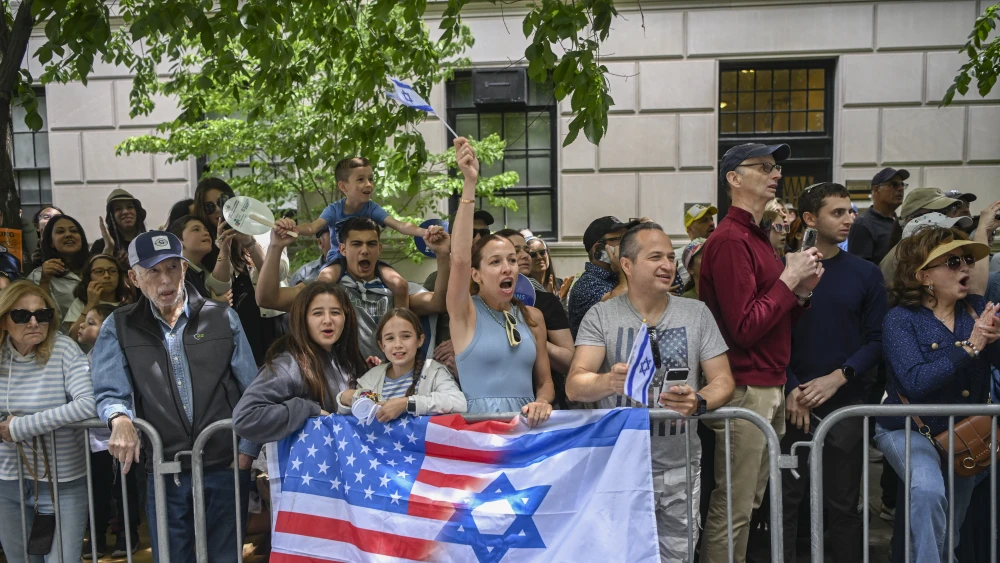
This year’s Israel Day on Fifth parade, held on May 31, was large, joyful and proud after two years of more-somber events focused on freeing Israeli hostages from Gaza.
More than 50,000 people, organizers said, marched slowly up New York’s storied Fifth Avenue, including more than 70 groups from Jewish schools near and far, ranging from Manhattan’s pluralistic Heschel School to Philadelphia’s Modern Orthodox Kohelet Yeshiva and a Baltimore day school.
Who knew that there is a yeshiva with a marching band and pom-pom girls? Brooklyn’s Yeshiva of Flatbush came out in force with students playing drums and brass instruments, and female students waved blue-and-white pom-poms.
There was the Jewish motorcycle club Chai Riders, whose members slowly motored up the avenue. Some wore their leathers, and one biker had a large Israeli flag waving from the back of his kosher hog. Another wrapped around the front.

There was also a large contingent of Mummers, from the Quaker City String Band in Philadelphia, who wore fantastically decorated sequinned outfits, replete with headdresses and full make-up, while playing upbeat tunes on saxophone, banjo and accordion.
The marching contingent from UJA-Federation of New York was very large, as befits a main sponsor of the parade, with marchers wearing the organization’s t-shirts bearing their home location on the back—Manhattan, Queens, Brooklyn and Westchester among them. Many carried signs stating “proud New Yorkers, proud Zionists.”
Jews in uniform led the day’s procession, including the New York City Fire Department’s Ner Tamid Society, and the New York City Police Department’s Shomrim Society, all in formal dress. A little boy sat on his father’s shoulders, wearing his dad’s fire department dress uniform hat.
Detective Joshua Zucker came in from his precinct in Marine Park, Brooklyn, one of about 300 members of the NYPD’s Shomrim Society, he told JNS.
Jordan Natan, a Class 1 special law enforcement officer, came from Hackensack, N.J., with special permission from his higher-ups.

“I wanted to be here with my fellow officers to show my support for Israel,” he told JNS.
Lieutenant Shevach Bercovitz, who goes by the nickname Shevy, is based in Mineola, Long Island, and formerly led the Nassau County Police Department Shomrim Society. He is in charge of pre-arraignment prisoner processing, he said. His uniform had several colorful bars showing his Jewish identity and involvement in crises, including Hurricane Sandy.
New York City Council member Eric Dinowitz, who chairs the body’s Jewish caucus and is co-chair of its bipartisan task force on Jew-hatred, mingled among the day’s marchers.
He has participated for many years—the first time on a float with the Jewish a cappella group 613, of which he was then a member, he told JNS. He’s been marching annually since he was elected to the City Council representing part of the Bronx six years ago.
“Thousands and thousands of New Yorkers are marching to show their solidarity with the very idea of a democratic Jewish state,” Dinowitz told JNS mid-parade. “It is a beautiful sight to behold. We are more than just our traumas of our history and skyrocketing antisemitism.”
“We are joyful and prideful of our heritage and our love of Judaism and our love of Israel,” he said. “The amount of happiness and pride is unmatched.”
Despite much controversy before the parade, centered on the fact that Zohran Mamdani, mayor of New York City and a longtime anti-Israel activist, did not participate this year, protests at the parade seemed to come entirely from Jews.

The New York City Police Department kept the few protesters, including from the anti-Zionist Chassidic group Neturei Karta, a couple of blocks from the parade. Members of the small Chassidic group carried Palestinian flags and banners stating that they represent authentic Judaism. A small group representing Standing Together, which brings Jews and Arabs together in Israel, was not permitted to march in the parade because of what it said were its pro-peace signs.
The parade organizer, Jewish Community Relations Council of New York, approves the t-shirts and signs carried by every group in the parade.
Some 50 college and university teachers marched with a contingent from the Academic Engagement Network. Some were Jewish, some not.
Ruby Aguirre teaches forensic psychology at the John Jay College of Criminal Justice in Manhattan. “I am a Christian,” she told JNS. “It’s important that allyship is put on the forefront of recognizing the hostile environments that students are exposed to on campus now.”
“Standing alongside our colleagues and peers at this difficult time is key,” she said.
Faculty members came to march from as far away as Oregon and California, according to Miriam Elman, executive director of the Academic Engagement Network.
“They don’t have a parade like this in their cities,” she told JNS. “We are the support system for beleaguered faculty.”

Due to a spike in the number of recorded hate crimes against Jews in New York City, the level of security at Sunday’s parade was unprecedented.
Uniformed police officers were on Manhattan streets many blocks away hours before the parade began, and the streets surrounding the parade route were barricaded off for several blocks, with enormous cement cubes, heavy garbage trucks and police barriers preventing anyone dangerous from entering the parade space.
Nevertheless, participating groups appeared to have privately hired security guards marching with them as well.
Academic Engagement Network was among them.
“Paying for extra security—that’s the Jewish tax,” Elman told JNS. “It’s outrageous that we have to have it for our events.”
Brian Feinberg, who came in from Ft. Lee, N.J., grew up marching in the parade with his father, who had been one of the youngest members of the Palmach, the main pre-state paramilitary organization.
He still comes every year. “The logistics this year are a little crazy,” he told JNS. “Security has been very, very tight as it has to be, unfortunately. Otherwise there are people who want to do us harm.”
Feinberg wasn’t really concerned about his personal safety at the parade this year and thought there were fewer spectators, likely out of fear, he told JNS.

Another spectator, who spoke with JNS, would allow herself to be identified by her first initial “R,” concerned about professional repercussions at the investment firm where she works if she used her full name.
“In today’s environment, supporting Israel is a political statement even though it shouldn’t be,” she told JNS. “I am at risk in my field to take that stance, unfortunately.”
Her partner told JNS that he has attended the parade for many years and isn’t fond of the large “frozen zone” that police created. The empty space of about 12 feet, enclosed by metal police barriers, separated spectators from parade marchers.
“It changes the whole vibe,” he told JNS. “I used to be able to high-five the marchers.”
Some posted on social media that they were upset that Bezalel Smotrich, Israeli finance minister, participated in the event.
Rabbi Jill Jacobs, of the progressive organization T’ruah, stated that there should have been more concern about Smotrich, who is right-wing, and “other Kahanists” taking part in the parade than in the New York City mayor, who is anti-Israel, skipping it.
Patrick Gaspard, a former U.S. ambassador to South Africa, stated that he was “proud that my mayor doesn’t parade around with people like Smotrich, who has called for and acted on the ethnic cleansing of Palestinians.”
“Give us a break,” wrote Daniel Rosenthal, vice president of government relations at UJA-Federation of New York. “There were over 50,000-plus people marching in the parade and tens of thousands of spectators. Most New York Jews find Smotrich views repugnant.”
“We all know the mayor’s core objection is Israel’s existence as a Jewish state, not its current government,” Rosenthal wrote. “Shame on you.”
David Greenfield, CEO of Met Council, stated, “Smotrich was not invited, crashed at the last minute, marched in the back of the parade,” and “not one New York public official joined him.”
Dan Diker, president of the Jerusalem Center for Public Affairs, posted a photo of himself marching with Smotrich, and Jesse Arm, vice president of external affairs at the Manhattan Institute, stated that Smotrich marched “because he’s the finance minister of Israel.”

Molly Ruttenberg, who lives in Union Square, came with her friend Allie Levine, who lives on the Upper East Side. The pair is in their early 30s.
“I wanted to show my support to the Jewish community and to Israel, especially in this time of so much divisiveness in the city and just wanted to have a good time,” Ruttenberg told JNS.
It was her first time at the parade. “The current situation definitely made it more of a priority to be here,” she said.
Her friend came to the parade “because of community,” Levine told JNS. “Especially in today’s times, it’s more important than ever to show up, proud and loud.”