The New York City Council passed legislation on Thursday that creates protective perimeters around houses of worship and schools during protests, part of a package designed to combat Jew-hatred and hate crimes across New York City following an uptick of antisemitism and a series of demonstrations outside Jewish institutions.
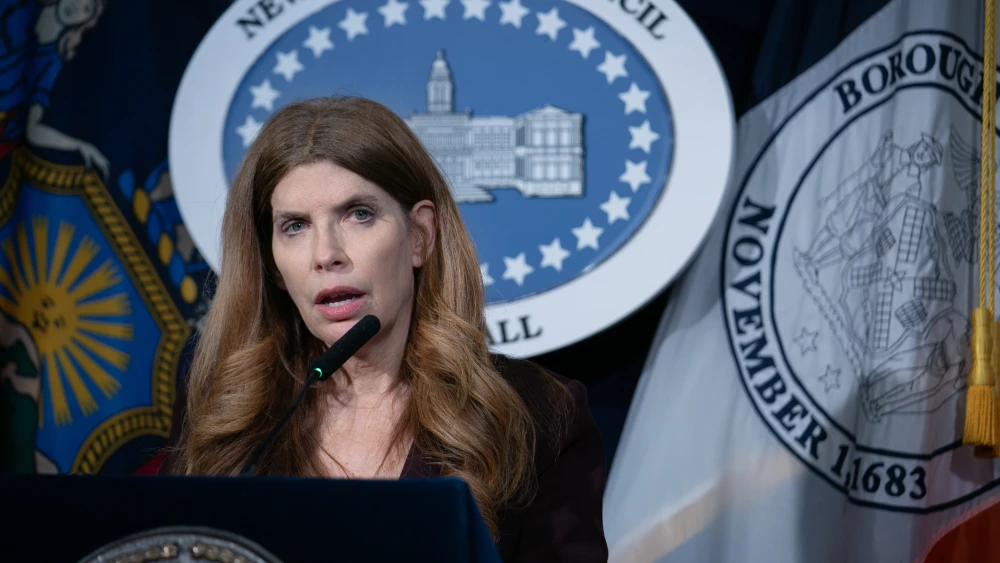
“I am immensely proud of the legislative package the council passed today to combat hate, including my legislation to help protect safe access to houses of worship,” stated Julie Menin, the first Jewish speaker of the New York City Council. “This is an urgently needed and carefully crafted bill that will ensure transparency, accountability and community engagement in NYPD plans to respond to protests—three pillars to protecting both public safety and free speech rights alike.”
Measures 1-B and 175-B, which Menin advanced, empower the New York City Police Department to set limits on how close demonstrators can gather near entrances to synagogues, religious schools and similar institutions to ensure unobstructed and safe access.
1-B passed with a veto-proof majority of 44 out of 51 members, but 175-B, which addresses educational institutions, passed with 30 to 19, making it subject to a veto by the mayor. Members who voted in favor of the package of bills but voted no on 175-B expressed concerns over legal issues and how it would affect student protests on campuses. Zohran Mamdani, the New York City mayor who has been a harsh critic of Israel and who has said, via a spokeswoman, that synagogues violated international law when they host pro-Israel events, has suggested he could be reluctant to sign the bill.
Before the vote, Menin said that there was a 182% increase in antisemitic incidents in the city in January, and that churches had been vandalized and that there was a 69% increase in anti-Muslim hate crimes in 2024. “The increase in hateful acts across the city is absolutely abhorrent and we have to do something about it,” she said in a press conference.
Left-wing groups, including the New York chapter of the Democratic Socialists of America, opposed the measure, encouraging their members to contact city council representatives to “hold the line against this crackdown on our right to protest.” During the vote, the New York Civil Liberties Union and a coalition of anti-Israel advocacy groups protested outside City Hall.
Rabbi Josh Joseph, executive vice president and chief operating officer of the Orthodox Union, told JNS that “with record incidents of antisemitic violence and last week’s targeted attack on preschool children at a temple in Michigan, the threats faced by synagogues and schools are not theoretical.”
“Law enforcement needs the appropriate resources and laws to protect our community and our constitutionally guaranteed right to worship God according to our faith,” he said.
Sydney Altfield, CEO of Teach Coalition, part of the OU that advocated for the legislation, told JNS it has been “inspiring to see faith communities unite in support of this critically needed legislative package.”
“This legislative package reflects the reality that our institutions, synagogues, schools and houses of worship all require protection, ensuring safe access during protests without limiting the fundamental right to peaceful protest,” Altfield said.
Mark Goldfeder, director and CEO of the National Jewish Advocacy Center, told JNS that “religious liberty means more than the theoretical right to pray.”
“It means the practical ability to walk into your synagogue, church, mosque or temple in peace,” he said. “No New Yorker should have to run a gauntlet of intimidation just to enter a house of worship.”
Avi Posnick, executive director StandWithUs Northeast and New England, was present at the council meeting. “These are common sense pieces of legislation, rooted in law, that help protect the Jewish community and all communities while at the same time ensuring First Amendment rights,” Posnick said.
The buffer-zone bill “is another step forward in protecting house of worship and ensuring our community is safe,” he said.
Rabbi Marc Schneier, president of the Foundation for Ethnic Understanding, said that he presented a buffer zone plan to Mamdani shortly after the latter’s election.
“When I first told mayor-elect Mamdani at the time about this idea, he was completely on board,” Schneier told JNS.
The rabbi added that he is proud of Menin “for taking action so quickly, especially as it was clear the mayor once again flip-flopped when it comes to protecting New York’s Jewish community and New Yorkers of all faiths.”
“No one should have to be worried about protesters harassing them when entering a house of worship,” Schneier told JNS.
Rabbi Mark Wildes, founder and director of the Manhattan Jewish Experience on the Upper West Side, said that the measure means houses of worship “can remain safe spaces for people to gather and practice their religion.”
“The fundamental right to free speech must be balanced with the right to exercise one’s religion,” he told JNS. “Both are core constitutional values that deserve protection. Establishing an appropriate buffer zone is the one way to ensure that both rights are respected, allowing worshipers safe access to their places of worship while preserving the ability to protest.”
Legal advocates say protests have crossed from protected speech into targeted intimidation.
Jayne Zirkle, director of communications at the Lawfare Project, told JNS that “what we are seeing outside synagogues, Jewish schools and community spaces is not peaceful protest” and that “it is targeted harassment fueled by dangerous anti-Israel and anti-Jewish rhetoric.”
Stu Smith, an investigative analyst at the Manhattan Institute, called the passage of the legislation “a massive win on so many levels for religious Americans, for constitutional order and for simple human decency.”
“George Washington said the American government should give ‘to bigotry no sanction, to persecution no assistance,’” Smith told JNS. “Thomas Jefferson wrote that no one should be ‘restrained, molested or burthened’ on account of religion.”
“Protecting people from harassment as they worship is squarely in that American tradition,” he said.
The package of measures passed today also included 22-A, which requires the city’s education department to distribute materials to students about the risks of social media and online hate; 297-A, which requires the mayor to establish an agency to provide religious and nonprofit institutions with support in establishing emergency plans; and 388-A, which establishes a hot line for reporting discrimination.