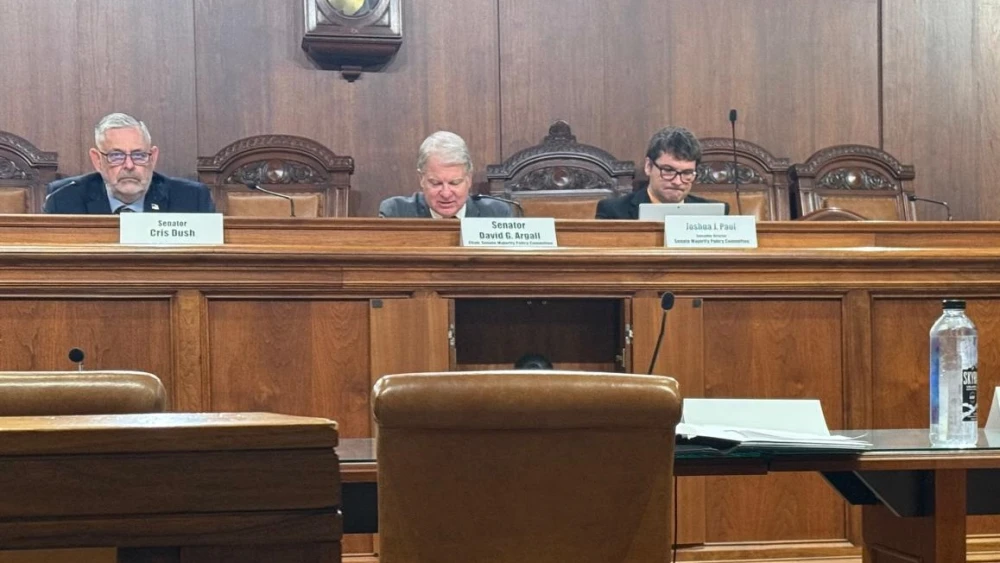
Pennsylvania state senators heard accounts of antisemitic harassment and classroom bias on Wednesday in a hearing that Steve Rosenberg, Pennsylvania director of the North American Values Institute, said could help build an official record needed to press school districts for change.
The Senate Majority Policy Committee, chaired by state senator Dave Argall, held the Sept. 30 hearing with educators, parents and Jewish communal leaders. Rosenberg attended the proceedings in Harrisburg.
“Ultimately, through the continued pressure of legislative action, legal action and strategic communications, we think that we can turn the tide,” Rosenberg told JNS.
His three-part approach depends on putting accounts of Jew-hatred on the public record, as hearings can provide material for parents considering legal action and draw attention to district failures, he said.
Rosenberg said NAVI spent more than a year pursuing the hearing, meeting with lawmakers and providing research about school curricula.
Representatives from the Anti-Defamation League of Philadelphia, the Jewish Federations of Greater Philadelphia and of Greater Pittsburgh and educators testified at the hearing, where they decried “serious allegations of antisemitism in K-12 schools across the commonwealth of Pennsylvania,” Rosenberg told JNS. Andrea Martin, a member of the state’s Human Relations Commission, also testified.
An estimated 350,000 Jews live in Pennsylvania, where enrollment in Jewish schools increased in 2025-26, according to data from Teach Coalition, an Orthodox Union program.
“I’m a huge Jewish day school advocate, but our goal is not to take kids out of public schools and put them into Jewish day school, because we don’t think that’s a win,” Rosenberg told JNS. “If every Jewish kid left public school, public schools would become training grounds for Jew-hatred.”
‘Depoliticizing the classroom’
Testimony at the hearing detailed both harassment and concerns about what students are taught. Julie Webb, a public school history and Spanish teacher, testified that she found a swastika on an eraser and the word “Jew” written on a classroom desk. She said that she reported both incidents but saw no result beyond preliminary questioning.
Webb criticized Philadelphia’s world history curriculum for presenting accusations against Israel without alternative perspectives. “We cannot allow teachers to move from teaching history into swaying students about political issues,” she testified.
Naomi Rodriguez, a Jewish parent and educator, testified that school reporting systems obscure antisemitic incidents by categorizing them as graffiti or general harassment, which makes Jew-hatred harder to track.
Daniel Knoll, associate vice president of public affairs for the Jewish Federation of Greater Pittsburgh, testified about recent reports involving a student who was called a “dirty Jew” and pelted with pennies. Another Jewish child’s face was digitally placed on an image of the body of a concentration camp prisoner, he said.
Andrew Goretsky, senior regional director of the ADL in Philadelphia, told lawmakers at the hearing that there were 25 antisemitic incidents in Pennsylvania’s K-12 schools in 2025, up from 21 the previous year.
Jason Holtzman, chief of the Philadelphia Federation’s Jewish Community Relations Council, testified that institutions sometimes deflect complaints about Jew-hatred into arguments about Israel.
“Condemning antisemitism in Philadelphia should not be contingent upon one’s position on a conflict thousands of miles away,” he said.
The hearing is the start of putting “pressure on the districts,” Rosenberg told JNS. “No district wants to have their name in the paper.”
It’s “much easier” to combat antisemitism legislatively when Republicans hold the majority, as they now do in the Pennsylvania state Senate, but he has met with “wonderful Democrats in the Pennsylvania legislature,” he said.
“They’ve chosen not to do anything,” he told JNS. “It doesn’t mean that they won’t. We don’t care if you have an ‘R’ or a ‘D’ after your name. We just want results.”
“We just want you to care about America,” he said. “We want you to care about depoliticizing the classroom.”
According to Rosenberg, the U.S. Department of Justice is “paying close attention.”
“When they see the Pennsylvania legislature taking action, it also re-shines the light on their potential lawfare actions,” he told JNS.