


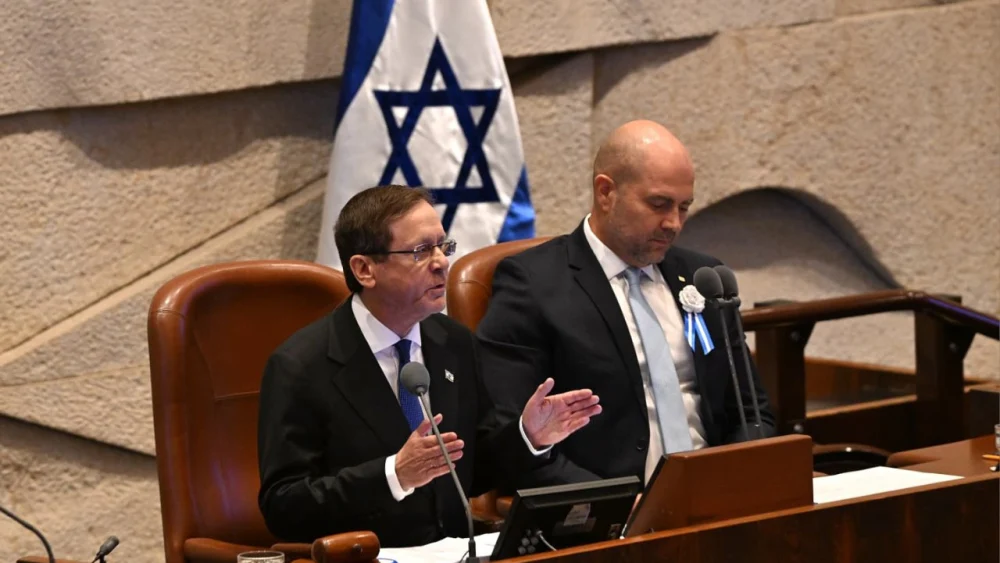
Israeli President Isaac Herzog called for strengthening and expanding Israel’s regional peace agreements, bolstering its alliance with the United States and pursuing national unity in an address to the opening session of the 26th Knesset on Tuesday.
“Alongside the determined and resolute fight against those who seek our harm, we must build a stable diplomatic horizon in the region with our neighbors, including the closest of them,” Herzog said, calling for strengthening the peace agreements with Egypt, Jordan, Morocco, the United Arab Emirates and Bahrain, “and even add to them.”
“We must fortify our alliance with our greatest friend, the United States; strengthen our relations with all our allies; defend Israel’s good name; and fight to the very end against diplomatic sanctions,” he added.
Herzog warned that “Iran’s empire of evil does not cease, not even for a moment, in its schemes and threats, whether directly or through its partners.”
The president urged lawmakers to complete their term and avoid repeat elections.
“This Knesset must serve out its full term; there are many tasks before it,” he said. “You must do everything to avoid a repeat election.”
He appealed for cooperation and compromise, saying the people who elected them longed for “routine, security, and tranquility.”
“I ask of you: be measured toward one another. Reach out a hand for compromise, even between rivals. Look upon one another with generosity,” Herzog said. “There is much work to be done here, and it requires the ability and experience found in every part of this House.”
Reflecting on the upheavals since the Oct. 7 massacre, Herzog urged lawmakers to translate the strengths Israelis demonstrated during the crisis into the foundations of a functioning state.
“A state is not tested only in its hour of heroism. It is tested no less on an ordinary day, in routine times,” he said.
Herzog also called for investigating how the Oct. 7 catastrophe happened and drawing lessons from it.
“We are duty-bound to leave no stone unturned: to investigate and understand how the catastrophe of Oct. 7 happened, and to draw lessons and conclusions,” he said.
He urged the Knesset to address the challenges facing those serving in the regular army and reserves.
“Now is the time to find the right solution for a state that takes pride in its heritage and in the world of Torah study but whose challenges demand that the duty of service be shared by all,” Herzog said.
The president condemned bullying, racism and violence, citing Arab society, the hills of Judea and Samaria, city streets and schools.
“This violence must be eradicated with full force,” he said.
Herzog also reminded lawmakers that their words and decisions affect Jewish communities worldwide.
“Always remember, and be mindful, that the words spoken in this hall, and the decisions made here, directly affect our Jewish sisters and brothers all over the world, who look to the State of Israel, which is also their home,” he said.
Earlier Tuesday, Yashar leader Gadi Eisenkot announced that his opposition bloc had agreed on candidates for senior positions in the incoming Knesset, hours before lawmakers were due to be sworn in.
Eisenkot said he reached the agreement with Naftali Bennett and Yair Lapid’s B’Yachad party, Avigdor Liberman’s Yisrael Beiteinu and The Democrats, led by Yair Golan. The arrangement covers “the period of the mandate to form the government,” he wrote.
The bloc nominated incoming Knesset member Matan Kahana of B’Yachad for Knesset speaker, replacing Likud’s Amir Ohana, and selected Liberman to chair the Foreign Affairs and Defense Committee.
Incoming Yashar Knesset member Roy Folkman is the bloc’s choice to head the Arrangements Committee, while incoming B’Yachad Knesset member Liran Avishar Ben Horin is its pick to lead the Finance Committee.
Eisenkot said committee lineups would be worked out in the Arrangements Committee this week and were expected to go before the Knesset plenum for approval on Wednesday.
Ohana said on Nov. 5 that he would move up the vote to replace him only if at least 61 lawmakers signed a letter requesting it.
“We will respect the Knesset members, and if a majority of them ask to hold such a debate, I will set it for an early date and no later than a week,” he wrote.
On Sunday, Herzog tasked Eisenkot with forming Israel’s next government. Under Israel’s Basic Law: The Government, Eisenkot has 28 days to assemble a coalition, with the president able to grant an extension of up to 14 days.
If Eisenkot fails, the president can task another candidate, who would also have 28 days to form a government.
If that attempt also fails, at least 61 Knesset members have 21 days to request an alternative candidate, who would then receive 14 days to form a government. If that effort fails, another national election would be held in about 90 days.


