Newsletter
Newsletter Support JNS

Trump admin moves to boost THAAD interceptor output amid rising missile threats

The effort is aimed at “ensuring that the nation’s capacity to build and deploy this vital defensive weapon will outpace any adversary’s threat,” the U.S. Defense Department stated.

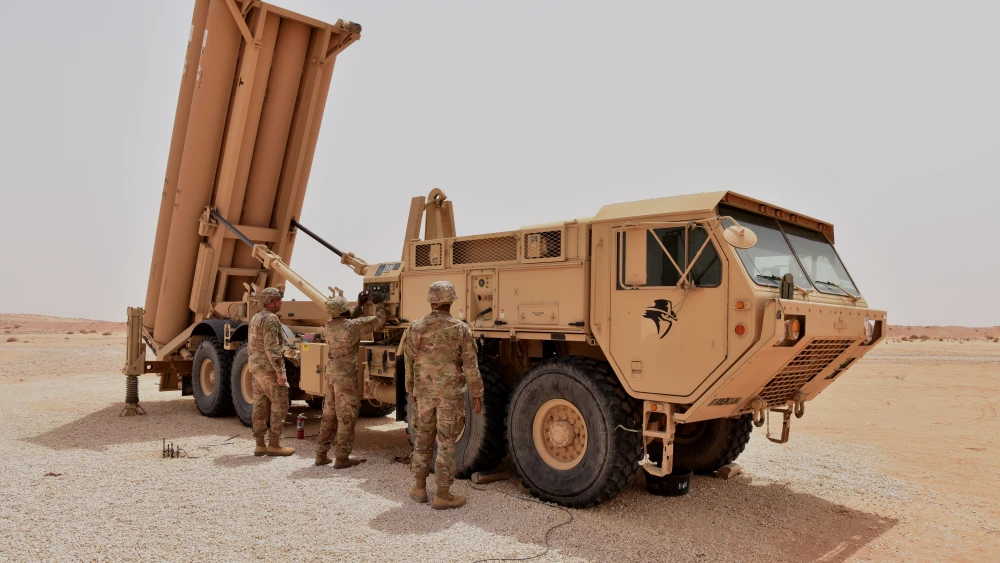
U.S. Army soldiers from Bravo Battery, 2nd Air Defense Artillery Regiment, system checks a Terminal High Altitude Area Defense (THAAD) launcher during routine start-up procedures in the U.S. Central Command’s area of responsibility, June 25, 2020. Credit: Master Sgt. Benjamin Wiseman/U.S. Air Force.
U.S. Army soldiers from Bravo Battery, 2nd Air Defense Artillery Regiment, system checks a Terminal High Altitude Area Defense (THAAD) launcher during routine start-up procedures in the U.S. Central Command’s area of responsibility, June 25, 2020. Credit: Master Sgt Benjamin Wiseman/U.S. Air Force.
Master Sgt. Benjamin Wiseman/378th Air Expeditionary Wing

The U.S. Department of Defense, referred to by the Trump administration as the U.S. Department of War, announced on Wednesday that it reached a framework agreement with BAE Systems and Lockheed Martin to quadruple production of seeker components for the Terminal High Altitude Area Defense interceptor, including seeker systems, as demand for missile defense grows.

Officials said the deal is intended to strengthen the interceptor’s supply chain and support broader efforts to expand U.S. defense-industrial capacity. The agreement follows a recent initiative with Lockheed Martin aimed at increasing overall THAAD interceptor output.

Michael Duffey, undersecretary of war for acquisition and sustainment, said securing critical suppliers is “just as important” as maintaining partnerships with prime contractors, adding that long-term demand commitments are designed to give industry the confidence to invest, expand facilities and hire additional workers.

The department said the arrangement will enable new manufacturing investments to accelerate production of missile-defense systems and ensure the timely delivery of key components needed to counter emerging threats.

“By locking in this critical component, the Department of War is ensuring that the nation’s capacity to build and deploy this vital defensive weapon will outpace any adversary’s threat to the United States or its allies,” the department said. “This is the Arsenal of Freedom in action, built to ensure peace through undeniable strength.”

The designations include Hezbollah-linked institutions that “threaten regional stability, international security, mutual interests and global trade,” the U.S. Treasury Department stated.
Gerard Filitti, of the Lawfare Project, told JNS that “lax immigration policy” has always been the main driver of importing “terrorist ideology” into the United States.
“The teachers we have, we don’t respect and support in the way that they deserve,” Paul Bernstein told JNS. “If we’re successful and we grow enrollment, that problem only gets bigger.”
“The message being sent is that you can get away with attacking someone in broad daylight because you disagree with their opinions, especially if it involves feelings about Israel,” Joshua Burt, of the Anti-Defamation League, told JNS.
“Not identifying Hamas as a terrorist organization is, I think, a failure, Marc Miller told the Canadian Press. “And not clearly stating that, for example, Hamas intended to kill Jews is, I think, an unfortunate error in curation and should be rectified.”
“This is life for Jews under the leadership of Mayor Zohran Mamdani,” advocacy group StopAntisemitism wrote.
