Newsletter
Newsletter Support JNS

Trump postpones planned Iran strike after Gulf leaders urge delay

“Serious negotiations are now taking place,” the U.S. president said, adding that the U.S. military remains prepared to launch a “full, large-scale assault” if talks fail.

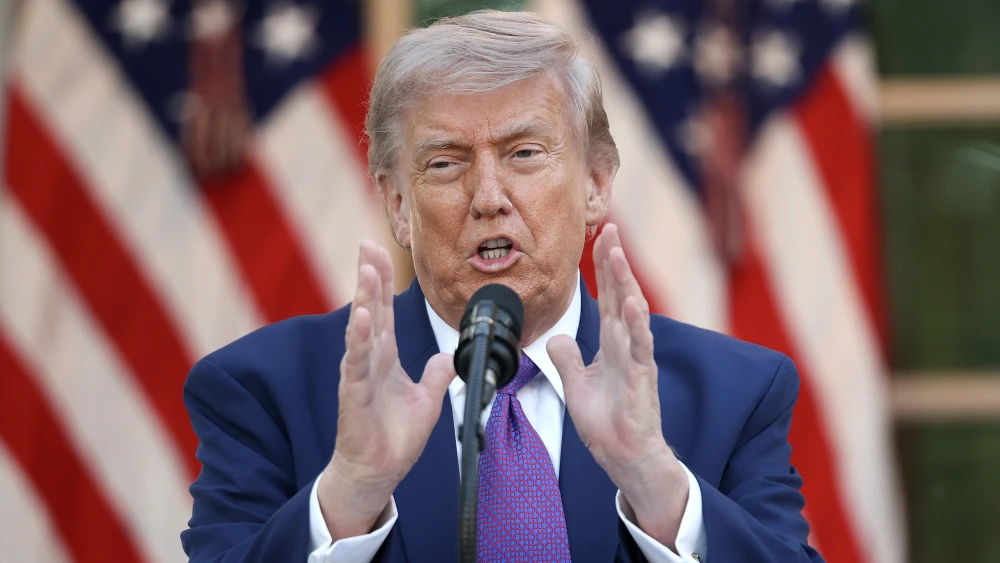
U.S. President Donald Trump delivers remarks at a 'Rose Garden Club' dinner for National Police Week in the Rose Garden at the White House on May 11, 2026, in Washington, D.C. Credit: Kevin Dietsch/Getty Images.
U.S. President Donald Trump delivers remarks at a ‘Rose Garden Club’ dinner for National Police Week in the Rose Garden at the White House on May 11, 2026, in Washington, D.C. Credit: Kevin Dietsch/Getty Images.

U.S. President Donald Trump announced on Monday that he is postponing a planned military attack on the Islamic Republic of Iran, originally scheduled for Tuesday, after leaders of Qatar, Saudi Arabia and the United Arab Emirates urged him to allow more time for negotiations.

Trump stated that Qatari Emir Sheikh Tamim bin Hamad Al Thani, Saudi Crown Prince Mohammed bin Salman and UAE President Sheikh Mohamed bin Zayed Al Nahyan had asked him to “hold off” on the attack because “serious negotiations are now taking place.”

“In their opinion, as great leaders and allies, a deal will be made, which will be very acceptable to the United States of America, as well as all countries in the Middle East, and beyond,” Trump wrote. “This deal will include, importantly, no nuclear weapons for Iran.”

“Based on my respect for the above-mentioned leaders, I have instructed Secretary of Defense Pete Hegseth, Chairman of the Joint Chiefs of Staff Gen. Dan Caine and the United States military that we will not be doing the scheduled attack of Iran tomorrow,” the president wrote.

Trump added that the military had been ordered to remain prepared to launch “prepared to go forward with a full, large-scale assault of Iran, on a moment’s notice, in the event that an acceptable deal is not reached.”


Abdulkadir Al-Jelani, 58, is due in court on July 1 and faces charges of making the threats and three counts of assault with a weapon.
The designations include Hezbollah-linked institutions that “threaten regional stability, international security, mutual interests and global trade,” the U.S. Treasury Department stated.
Gerard Filitti, of the Lawfare Project, told JNS that “lax immigration policy” has always been the main driver of importing “terrorist ideology” into the United States.
“The teachers we have, we don’t respect and support in the way that they deserve,” Paul Bernstein told JNS. “If we’re successful and we grow enrollment, that problem only gets bigger.”
“The message being sent is that you can get away with attacking someone in broad daylight because you disagree with their opinions, especially if it involves feelings about Israel,” Joshua Burt, of the Anti-Defamation League, told JNS.
“Not identifying Hamas as a terrorist organization is, I think, a failure, Marc Miller told the Canadian Press. “And not clearly stating that, for example, Hamas intended to kill Jews is, I think, an unfortunate error in curation and should be rectified.”