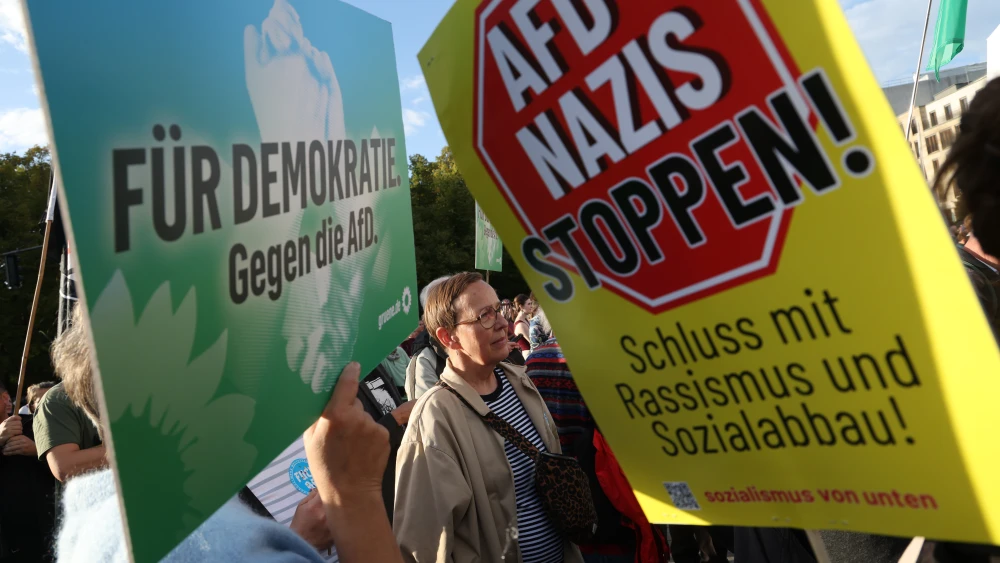
German Chancellor Friedrich Merz said that Alternative für Deutschland’s victory in the Saxony-Anhalt elections on Sunday is “a tectonic upheaval in our party system,” the daily Bild reported.
The far-right party, which has been called antisemitic by German Jewish groups, won 43.8% of the vote in the state election, garnering 39 seats in the local Parliament and falling just shy of being able to unilaterally form a majority government.
Merz’s ruling Christian Democratic Union, Germany’s main center-right party, has long subjected the AfD and other parties of the far-right to a “firewall” of non-cooperation in response to the country’s history of Nazism.
“This shakes our party to its very foundations,” Merz reportedly told a meeting of the CDU’s federal executive committee. “We cannot simply return to business as usual. Neither I nor the federal government can.”
Polls suggest that the AfD is the most popular single party in Germany, with about a quarter of Germans saying that they would vote for the party in national elections. In an exit poll of voters from Sunday’s election, AfD voters said their top concern was the number of immigrants in Germany, followed by cost-of-living issues.
Germany is one of many countries in Europe that have seen increased support for right-wing parties in response to the surge of migration to the continent after the Arab Spring.
Many of those parties view the AfD as extreme and expelled it from the European Parliament’s right-wing Identity and Democracy group after an AfD politician said in a 2024 interview that not all members of the Nazi SS were criminals.
Despite AfD’s landslide victory in Saxony-Anhalt, it’s not clear how or whether it would be able to form a majority coalition given that nearly every other party in Germany has ruled out joining an AfD-led coalition.
Josef Schuster, president of Germany’s Central Council of Jews in Germany, warned on Tuesday that the “damage would be immense” if the AfD was to form a local government, highlighting its ability to influence school curricula.
Education is “the most important foundation for preserving our open society and fighting antisemitism,” Schuster stated.