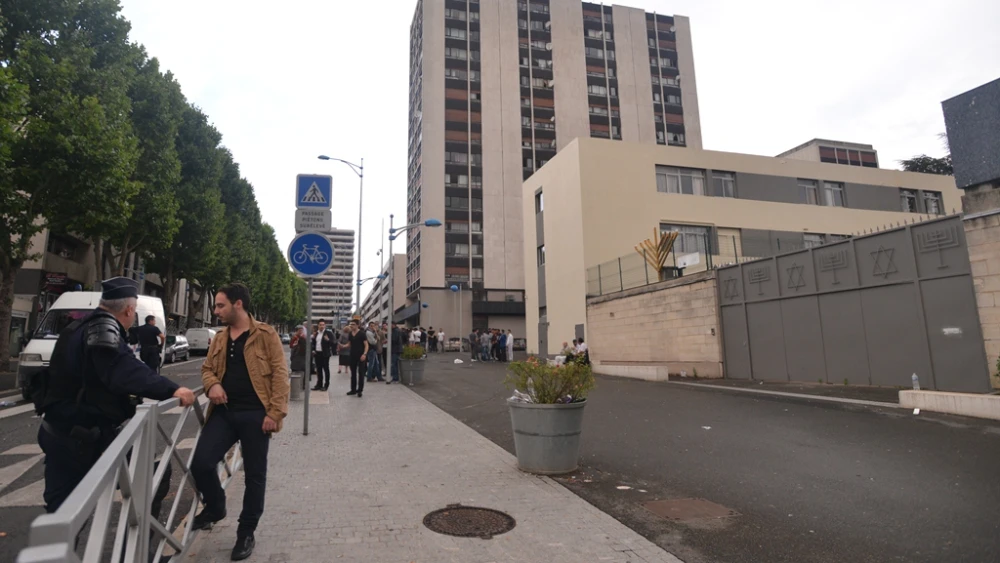
The recent discovery of a weapons cache near two Paris-area synagogues exposed and prevented a major terrorist attack that carried the hallmarks of an Iranian proxy operation, a senior scholar on French Jewry said last week.
The incident in Sarcelles received limited attention in the French media, but its characteristics suggest it was planned to be one of Europe’s deadliest antisemitic attacks in decades, according to an internal analysis written by Dov Maimon, a senior fellow at Israel’s Jewish People Policy Institute.
The analysis, obtained by JNS, builds on information released by French authorities following the discovery on July 12 of a stolen Toyota containing a loaded Kalashnikov-style rifle, multiple magazines and a loaded Beretta pistol parked a few hundred meters from two synagogues in Sarcelles.
French anti-terror prosecutors are investigating the case, which French Interior Minister Laurent Nuñez said had been discovered thanks to intelligence from a foreign partner, which he did not name.
“The 11-12 July events in Sarcelles represent the first attempted mass-casualty attack against a French synagogue since the Hyper Cacher attack of January 2015,” Maimon wrote. Had the attack succeeded, it “would have constituted the largest antisemitic massacre in Europe since World War II,” he added.
French authorities have not publicly identified those behind the apparent plot. Maimon’s report argues that the evidence closely matches the modus operandi of Iranian-backed networks that have targeted Jewish institutions across Europe since March, but French authorities have confirmed only that foreign intelligence played a role in detecting the threat and that the investigation remains ongoing.
Sarcelles has thousands of Jewish residents, many of them belonging to low-income families, who live amid a larger Muslim minority. In 2014, Muslim rioters attacked Jewish-owned businesses in Sarcelles, amid a string of attacks on such establishments and Jewish community buildings. The main synagogue in Sarcelles was targeted then by rioters, who attempted to reach it but were kept at bay by police and local Jews.