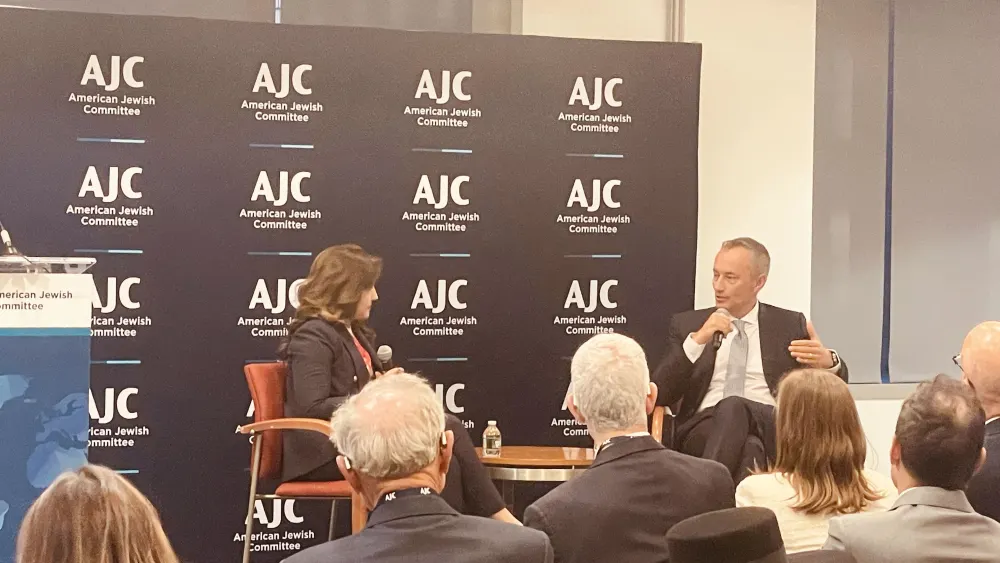
The National Committee for the Administration of Gaza of the U.S.-backed Board of Peace is not in a position to take control of the Strip now, according to Nickolay Mladenov, the board’s high representative for Gaza.
“If you allow the Palestinian committee to go in now and take responsibility in Gaza, I assure you, within a week, they will be eaten up alive by the difficulties they will face,” Mladenov said on Thursday on the sidelines of the United Nations General Assembly in New York City.
The veteran diplomat was explaining the delicate, step-by-step process of advancing the board’s peace and recovery plan for Gaza at an event, where he received the American Jewish Committee’s diplomatic excellence award.
“The biggest risk is that what we have now becomes the permanent situation,” Mladenov said, of current instability in the Strip.
Hamas, which remains in power, hasn’t started giving up its weapons in Gaza, some 60% of which Israel controls and where it still attacks terrorists in a targeted way.
The current situation is like the pre-Oct. 7 era, said Mladenov, who fears that there will be more radicalization in the Strip due to a breakdown in services and foreign military control of large swaths of the territory.
For that to change, the apolitical, transitional Palestinian governance committee for Gaza must take over responsibility and the decommission of Hamas weapons has to start, according to Mladenov.
But it’s not yet time for those steps, he said.
“On one hand, you have Israeli restrictions on what can go into Gaza, so they can’t really show that they’re changing people’s lives,” he said.
That would lead to a devastating loss of credibility, according to the diplomat.
Israeli military operations continue and Hamas remains armed and with its infrastructure still in place, he said.
“We don’t have the Palestinian police ready and trained for them to go in,” Mladenov said, of a new Gaza police force being trained in Egypt under Board of Peace auspices.
“That is why we need to get with our partners in Israel and Egypt and everywhere to finalize these things as quickly as possible,” he said.
This week, the Board of Peace announced a six-month, $2.4 billion recovery program for Gaza, listing 66 projects.
“No donor, not the United Arab Emirates, not Kuwait, Saudi Arabia, nobody, will give us their money to reconstruct anything in Gaza until they know that you know there’s some stability and the likelihood of another war is not around the corner,” Mladenov said.