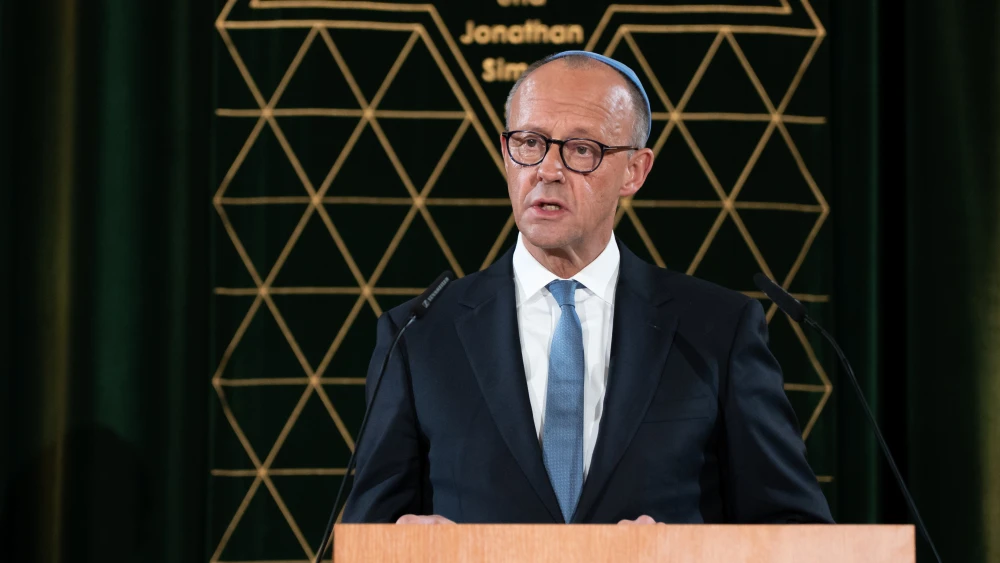
Standing inside Munich’s Ohel Jakob Synagogue, which shares its name with a nearby synagogue burned down by the Nazis during Kristallnacht 88 years earlier, German Chancellor Friedrich Merz warned on Monday that Jew-hatred was once again “omnipresent” in Germany.
“We see it and hear it on our streets, in our cities, in the cities of our European neighbors and throughout the world, in parliaments, in associations and in schools,” Merz said in German.
“Sometimes it is disguised in the language of anti-colonial liberation struggles or criticism of Israel,” he said. “Ladies and gentlemen, from time to time it is justified through the distortion of history.”
Among those listening was Charlotte Knobloch, president of the Jewish Community of Munich and Upper Bavaria, who was 6 years old during the Nazi pogrom of Nov. 9-10, 1938, when synagogues were burned, Jewish homes and businesses were ransacked, and Jews were murdered across Germany and Austria.
Merz quoted the biblical verse “How beautiful are your tents, O Jacob, your dwelling places, O Israel,” from the Book of Numbers, from which the synagogue takes its name.
“I cannot imagine how this psalm must have sounded in the ears of those who, in Munich and other German cities, were awakened on the night of Nov. 9-10, 1938, by armed squads breaking into their businesses, their homes and the centers of Jewish communal life with stones, axes and gasoline canisters,” he said.
“You, dear Mrs. Knobloch, experienced it,” Merz told the 94-year-old, who also serves as vice president of the European Jewish Congress and the World Jewish Congress. “You experienced what no human being—and what no 6-year-old child, no child at all—should ever have to experience.”
He then invoked the millions of Jews who were arrested and deported to concentration camps in the days and years that followed.
“How must this psalm have sounded in the ears of the millions of men, women and children who, in the days and years that followed, were arrested and deported to hell on earth, to the hell of the concentration camps?” he said.
Germany recorded a record 8,725 antisemitic incidents in 2025, up from 8,627 in 2024, according to the Berlin-based Federal Association of Departments for Research and Information on Antisemitism. The figure was more than triple the 2,480 incidents recorded in 2022.
The 2025 total included 178 assaults and 257 cases involving threats. Jew-hatred related to Israel accounted for 68% of all incidents.
‘Visible Jewish life in Germany is still not possible’
Merz addressed Oct. 7, describing the Hamas-led terrorist attacks on the Nova music festival and southern Israeli communities as barbaric. He condemned the need for Jewish institutions in Germany to rely on extensive security measures, including high walls, bulletproof glass and armed guards.
“An institution with police officers standing outside may be secure—yes, probably. But it is also a horrifying sight,” he said.
“High walls, bulletproof glass, armed security personnel outside Jewish institutions: These are constant reminders that normal, open, visible Jewish life in Germany is still not possible,” Merz said.
Jew-hatred in Germany surged after Oct. 7, and the Berlin association documented 2,787 antisemitic incidents between Oct. 7 and the end of 2023—an average of about 33 daily, compared with just over seven daily before the attacks.
Merz questioned if Germany had done enough to understand and combat the causes of Jew-hatred. He urged Germans to speak out against antisemitism, “listen” when Jews report it and take “an interest in Israel’s fate.”
“We know from historical research that antisemitism, hatred of Jews, has flared up particularly in times of crisis, in times of upheaval,” he said. “The long history of Jewish life in Munich has also been marked by cycles of expulsion, persecution and violence.”
“We are living in a time of renewed historical upheaval,” he said. “That is why we are now facing a test of the ‘never again’ that we proclaim so often and on so many occasions.”
“As a federal government, we are doing—and we will continue to do—everything within our power to protect Jewish life in our country and throughout the world,” Merz said.
Germany stands “unwaveringly alongside Israel,” he said.
“The fact that there is a country in the world, a state in which Jewish women and men are not a vulnerable minority in need of protection, where they can find refuge if barbarism once again prevails in their countries of origin—that, too, is part of our historical responsibility,” he said.