


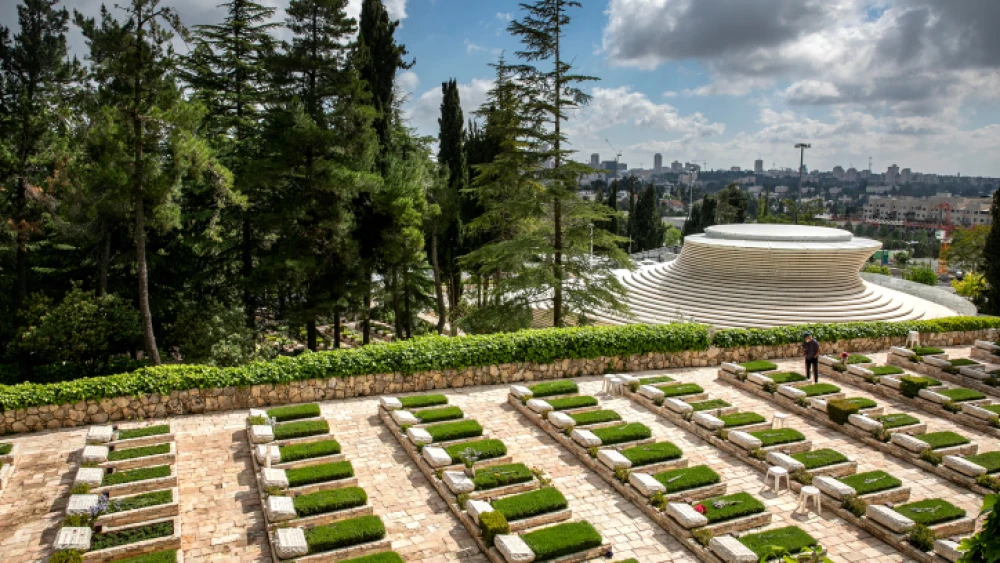
As of Monday, Israel has 23,816 fallen. Memorial Day for Fallen Soldiers and Victims of Terrorism is the most personal of all national days. In tens of thousands of Israeli homes, families spend time with the memories of their loved ones, and Israel Defense Forces soldiers and commanders, past and present, salute their brothers who fell in battle. I served the State of Israel for 38 years, I lost comrades in arms both at my side and under my command, and what pains me most is that I will never be able to comfort their families.
On Memorial Day, we go back to the foundations of our existence, to the Zionism in the name of which we established the country and for the sake of which many were killed in the War of Independence and after it. When we remember the nation’s first dead, we realize what would have happened if there hadn’t been a Jewish state, if there hadn’t been a fairly small group of pioneers who fought for our right to be here only a few years after the horrors of the Holocaust.
The state of Israel’s existence is ensured through its strength, and through our willingness to fight. On the battlefield, in the technological and logistics divisions, on the front and the home front, IDF soldiers and the other branches of the security apparatus protect Israel and give their blood so we can have a Jewish, democratic state. If we are not stronger than our enemies, we will not survive.
On Memorial Day, we sanctify the resilience of Israeli society, which continues to send its sons to the front. If we do not look out for one another, or cannot live with each other, we won’t be strong enough to survive. When I decided to enter politics, I called the party I led “Israel Resilience.” Alongside our tanks and aircraft, Memorial Day is a reminder that our internal resilience is measured in our education, our defense of democracy, our tolerance of others and love for our homeland.
All these are equally important to Israel’s security. Memorial Day in the shadow of the coronavirus pandemic will be one of the hardest we as a nation have experienced. For the sake of Zionism, for the sake of a strong Israel, and especially for the sake of unity in society, we will use the tools at our disposal to ensure that the day is marked without ceremonies attended by an audience and without visits to grave sites.
I will be holding Zoom meetings with the families I meet with every year as part of an important project founded by Eliasaf Peretz, the brother of fallen soldiers Uriel and Eliraz Peretz. I’ll also be reaching out to many other families. I urge all of you to find a way of fulfilling that duty. Call them, text them, meet with them outside on balconies or in parks, in accordance with social-distancing rules. Do everything possible so that the bereaved families won’t be on their own.
This Memorial Day is a test for Israeli society, its strength and its ability to uphold the legacy of the fallen. This time, too, Israeli unity will win—with your help, and if we all pitch in.
May the memory of the fallen be a blessing.
Benny Gantz is the leader of Israel’s Blue and White Party and a former IDF Chief of General Staff.


