
Our director of early-childhood education, Katie Riggs, was supposed to be on a red-eye flight last week to Italy. For her, this would be the trip of a lifetime.
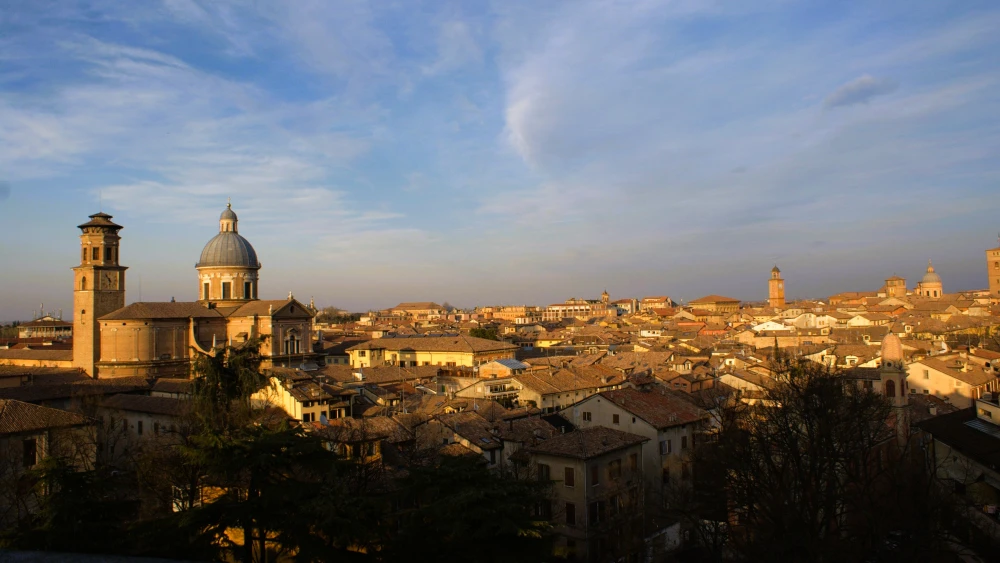
Reggio Emilia is the small northern Italian city whose approach to early-childhood education has shaped classrooms around the world. The Reggio Emilia approach grew out of the years after the Second World War. It treats children as capable of constructing their own understanding.
That emphasis on dignity, observation and care for the natural world has long appealed to Jewish early-childhood educators, as it aligns with many Jewish values: B’tzelem Elohim asks us to recognize the inherent worth of every person; kavod habriyot calls us to honor human dignity; hachnasat orchim reminds us to welcome others; shmirat hateva teaches care for the natural world; and chanoch lana’ar al pi darko asks us to educate each child according to their individual path.
Our 3- and 4-year-olds had recently become absorbed by pinecones; in the Reggio style, their teachers followed the interest, and we built a small atelier so the children could examine, draw and talk about what they found. After 14 years working with young children in Pittsburgh—first as a teacher, then as assistant director and now as director—Katie wanted to sit in the rooms where the philosophy began, watch children follow their own curiosity and bring what she saw back to our school.
Two days before she was due to leave, I noticed that Katie wasn’t herself. I asked if she was nervous about the flight and began reassuring her that we had everything covered at school. She looked at me and said, “No. The trip has been canceled.”
The reason was that anti-Zionists in Reggio Emilia had demanded that the entire Paradigm Project delegation—a U.S.-based professional network of Jewish early-childhood educators—sign a statement declaring, “I distance myself from the occupation of Gaza and the violation of children’s and human beings’ rights in the occupied territories as well as in every place in the world,” as the condition of entry to the study program.
They staged a protest outside the Loris Malaguzzi Centre, called publicly for the delegation’s cancellation, and made clear that Jewish and Israeli teachers alone would be welcome only if they ritually denounced Israel.
The educators refused. The visit was then terminated.
Protesters made it clear that Jewish and Israeli teachers would be welcome only if they denounced Israel.
These litmus tests have a dark history. Anti-Zionism has, for a century, treated the existence of Israel as an inherent crime and used the word “Zionist” to mark Jews for exclusion. In the Soviet Union, campaigns against “Zionism” closed Jewish cultural institutions, restricted Hebrew, and produced the Night of the Murdered Poets and the Doctors’ Plot.
In Poland in 1968, Communist authorities turned the same label into a national purge: Jews were denounced as “Zionists”; forced from their jobs in the party, the army, the universities, and the professions; and subjected to public humiliations at staged rallies. Roughly 13,000 left the country between 1968 and 1972, completing the postwar emptying of Poland’s remaining Jewish population.
Across the Middle East and North Africa, the identical slur was applied to entire communities; Jews who had never lived in Israel were subjected to violence and forced out as “Zionist traitors.”
Today’s anti-Zionist tropes—that Jews are “white colonizers,” that Israel is an “apartheid state,” “genocidal” and a nation of “child killers”—are repeated with increasing frequency to racialize, demonize and exclude Israelis, as well as anyone labeled a “Zionist.” What occurred in Reggio Emilia follows the same logic: anti-Zionists treating Jewish presence as moral contamination. (Ironically, it is anti-Zionist curricula that harm children abroad by teaching hate and dehumanization.)
Katie was not traveling to Italy as a diplomat or a representative of the Israeli government. She was not going there to debate foreign policy or advocate for a political position.
She was going there because, after 14 years of caring for and educating young children, she wanted to become even better at her work. She wanted to sit in classrooms, observe children, study environments, ask questions of other educators and bring what she learned home to children in Pittsburgh.
But because of discrimination, she will not be traveling there. Instead, she will go to Los Angeles to visit three Reggio-inspired Jewish early-childhood centers at Wilshire Boulevard Temple.
Reggio Emilia gave the educational world the beautiful idea of the “hundred languages of children.” It asks us to resist narrowing a child to a single way of thinking, speaking, creating or understanding. It asks us to remain curious about one another and to listen before deciding that we already know what someone has to say.
Yet the very people entrusted with carrying this philosophy forward have betrayed its most basic principles. An educational tradition born in the shadow of fascism has now purged its Jewish delegation.
The shame belongs not to Katie or the other educators who refused to submit to this demand, but to those who imposed it—and to an institution that allowed intolerance to prevail over everything it claims to teach.