


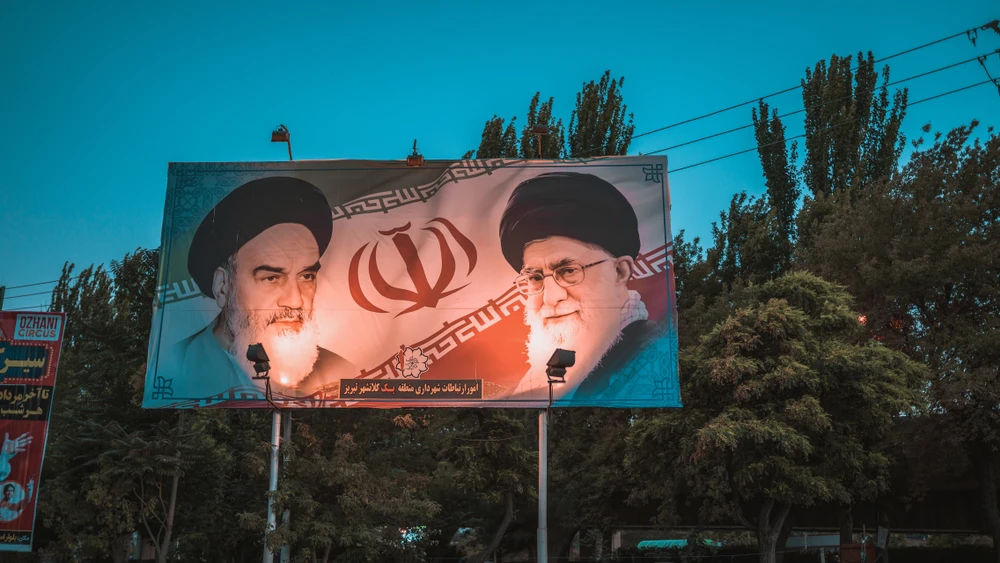

There is a particular genius to successful propaganda. It persuades people that they have arrived, through the independent exercise of reason and moral conscience, at conclusions someone else has spent years preparing for them.
The accomplished propagandist need never demand obedience. He merely arranges the intellectual furniture until certain conclusions appear inevitable.
The Islamic Republic of Iran has made something of a profession of this exercise.
I saw its methods at work in February 2017, when I attended the Sixth International Conference in Support of the Palestinian Intifada in Tehran. Hundreds of delegates gathered to hear then-Supreme Leader Ali Khamenei pronounce upon the Palestinian question during proceedings that owed more to revolutionary strategy than any practical concern for Palestinian welfare.
What interested me was the purpose of the gathering. Tehran was assembling an international audience around a political vocabulary capable of traveling far beyond Iran’s borders, finding sympathetic ears among Islamist organizations, Western activists and those whose hostility toward Israel required little encouragement.
The language was carefully chosen, and it had a history.
When Ayatollah Ruhollah Khomeini seized power over Iran in 1979, he faced an inconvenient theological problem. Iran was overwhelmingly Shiite, while most of the Muslim world was Sunni. Centuries of religious disagreement stood between his revolutionary government and the wider Islamic leadership it aspired to exercise.
One cannot export a revolution terribly far if most of one’s intended converts regard its religious foundations with suspicion.
The Palestinian issue offered Khomeini a solution.
On Aug. 7, 1979, Khomeini issued a declaration establishing International Quds Day, calling upon Muslims everywhere to devote the final Friday of Ramadan to Jerusalem and the Palestinian cause. By elevating the Palestinian issue to a common Islamic obligation, Khomeini offered Sunni and Shiite audiences a shared purpose that could temporarily set aside their doctrinal differences.
The Palestinian question became a bridge across the sectarian divide, and hostility toward Israel provided the common language.
Under Khamenei, that formula became central to Iran’s regional ambitions. Hezbollah, rooted in Shiite Islam, and Hamas, a Sunni Islamist organization, could inhabit the same strategic framework because both served Tehran’s confrontation with Israel. Their theological differences remained, but their political usefulness prevailed.
Within the regime’s discourse, support for the Palestinians became a measure of Islamic solidarity, while opposition to Israel acquired the character of a religious obligation. The distinction between defending Palestinian rights and rejecting Jewish national self-determination was steadily eroded.
Tehran did not invent anti-Zionism. It gave an existing political hostility a revolutionary purpose, institutional backing and an international audience.
By 2017, the next stage was evident. At the Tehran conference, Khamenei insisted that the Palestinians remained the central cause around which Muslim unity was organized. An accompanying multilingual campaign, #All4Palestine, carried the message beyond the conference hall.
Particularly revealing was the effort to revive the accusation that Zionism constituted racism.
The charge was hardly new. In 1975, the United Nations General Assembly adopted Resolution 3379, equating Zionism with racism. The resolution was revoked in 1991, but its poisonous proposition survived.
Tehran understood its usefulness. After all, the language of Islamic revolution is hardly calculated to charm a university seminar in London or a progressive organization in New York. A demand for allegiance to clerical authority tends to lose something in translation when addressed to people who consider themselves secular, feminist and emancipated.
But racism? Colonialism? Liberation? Those words possess an altogether different currency in Western political life.
What I witnessed in Tehran was an effort to translate the regime’s hostility toward Israel into a moral vocabulary familiar to Western audiences. Revolutionary ideology could be repackaged in the respectable language of human rights and anti-colonial resistance.
Once Zionism was presented as racism, Israel as a uniquely illegitimate state and opposition to its existence as an elementary requirement of moral decency, the argument was effectively settled before it began.
Successful propaganda persuades people that they have arrived at conclusions someone else has spent years preparing for them.
Jewish history became inconvenient. The persecution of Jews across the Middle East attracted scant attention. Jewish national aspirations were denied the legitimacy routinely afforded other movements for self-determination.
Naturally, Palestinian suffering requires neither exaggeration nor Tehran’s endorsement to deserve attention. Nor does criticism of Israel establish Iranian influence. Many Western activists hold their convictions independently.
That distinction matters precisely because the Islamic Republic has invested considerable effort in disguising the origins of its own messaging.
A 2024 Microsoft Threat Intelligence investigation documented Iranian influence operations employing fabricated identities, impersonation and coordinated online campaigns intended to weaken international support for Israel.
The political value of such operations is obvious. An apparently independent commentator may possess credibility that an official Iranian propagandist could never hope to acquire. And once an argument circulates widely enough, others may repeat it sincerely, without knowing who first promoted it.
Yet nothing exposes the moral inconsistency of Tehran’s supposed devotion to the Palestinians more clearly than Syria.
For years, former Syrian dictator Bashar al-Assad’s government subjected Palestinian refugees to appalling repression. In Yarmouk, outside Damascus, civilians endured siege, bombardment, starvation and displacement. A 2014 Amnesty International investigation documented war crimes against the besieged population, including deaths from starvation.
And where was the Islamic Republic? Standing behind Assad.
Tehran supplied Assad’s government with military assistance, financing and personnel, helping sustain a dictatorship responsible for the suffering of Palestinians on a devastating scale.
Where was the supposedly uncompromising solidarity? Why should Palestinian suffering demand international mobilization when Israel supposedly bears responsibility, yet become a regrettable footnote when the perpetrator is an Iranian ally? One searches in vain for a coherent moral principle.
The answer, I fear, has rather more to do with political usefulness than humanitarian concern.
For Western audiences, the Palestinian cause has increasingly been framed in some activist circles as an obligation born of historical guilt. Israel is placed within a broader indictment of Western colonialism, inviting Europeans and Americans to regard opposition to Zionism as a form of moral redemption.
The attraction is understandable. Western societies possess histories of empire and discrimination that deserve serious examination. But the language of collective guilt becomes dangerous when every conflict must conform to the same historical pattern.
Israel becomes a convenient scapegoat for the sins of Western imperialism. The complexities of Jewish history disappear, while hostility toward the Jewish state becomes a measure of political virtue.
How curious that the Islamic Republic, which imprisons dissidents, represses women and demands ideological conformity, has managed to present its hostility toward Israel in terms appealing to those who profess an uncompromising devotion to liberty.
I remember Tehran in 2017 because it revealed the ambitions behind this language. Khamenei was addressing an international audience, seeking to preserve the Palestinian issue as a unifying principle while extending Iran’s revolutionary message to foreign political cultures.
The results deserve scrutiny.
One can defend Palestinian rights without excusing Hamas, condemn Israeli policies without denying Jewish nationhood and oppose racism without adopting the ideological preferences of an authoritarian regime. The question worth asking is how often the language of liberation has been made to serve men who have never shown the slightest interest in liberty.
Khomeini recognized the Palestinian issue’s power to cross the Sunni-Shiite divide. Khamenei understood its potential to carry Tehran’s ideology into Western political life.
Therein lies the propagandist’s achievement. He need not persuade you to admire him. Indeed, it may suit him very well that you despise everything he represents.
Provided, of course, that you have learned to talk about the world in the language he prepared for you.


