
Tehran responded to the joint U.S.-Israeli campaign by targeting civilian infrastructure across the region, including firing cluster munitions at Israeli residential areas and striking hotels and energy facilities across the Persian Gulf. It also moved to choke the Strait of Hormuz, seeking to raise political costs for the Trump administration by driving up global oil prices. This has now given way to a fragile truce, with Tehran and Washington negotiating over Hormuz, the nuclear file and proxies, while the regime’s repression at home remains absent from the agenda.
Iran’s primary military leverage—its missile production, launch capacity and stockpiles—has suffered a heavy blow. But airpower alone only becomes existential if it creates space for Iranians to shape outcomes on the ground. Aware of that vulnerability, Tehran has used the ceasefire to tighten its grip at home. With fewer external pressures, authorities have escalated executions, extrajudicial killings and arrests, while deploying Shia terror proxies across Iran to reinforce control and deter potential unrest.
Leaving the people of Iran out of the equation is not just a human-rights concern. It risks alienating the regime’s true existential threat: the largest pro-American and pro-Israeli population in the Middle East, which, if it prevails, could reshape the world order. It also stands in contrast to the messaging that casted the campaign as enabling Iranians to reclaim their country.
In fairness, progress was underway toward those promises, but the timeline was abruptly shortened. Israel struck the infrastructure of the Islamic Revolutionary Guard Corps (IRGC), its subordinate Basij and local law enforcement, all units that have fired on unarmed protesters since 1999. But dismantling repression requires degrading personnel, not just facilities. Even estimates of more than 5,000 killed since Feb. 28 pale against the hundreds of thousands across security forces.
War has long served as a pretext for the regime to intensify domestic repression. During the Iran-Iraq War, repression hardened into a system. Neighborhood-based revolutionary committees set up checkpoints, raided homes and detained suspected dissidents on the spot, feeding a pipeline of arrests that expanded as the war intensified. By the early 1980s, mass sweeps targeted dissidents, with thousands imprisoned and executed on accusations like espionage or ideological deviation.
Authorities arrested some 21,000 people across Iran during and following the 12-day war with Israel and the United States last June, carried out under a near-total internet blackout that cut off communication nationwide. In the weeks that followed, the judiciary called for expedited handling of security cases tied to charges like moharebeh (“waging war against God”), a crime punishable by death. The follow-through was immediate. The regime carried out over 600 executions in the first half of 2025, a figure that surpassed 1,600 by the end of that year.
The more threatened the regime feels, the harsher this pattern becomes. In a chilling message to the population and in clear disdain for Iranian culture, the Islamist regime marked the Persian New Year with the public hanging of three young political prisoners on March 19. Since the start of the war, at least nine political detainees have been executed, and more than 1,000 people arrested. Following the ceasefire, at least four additional political prisoners, including one woman, have been sentenced to death on sham charges, with arrests continuing.
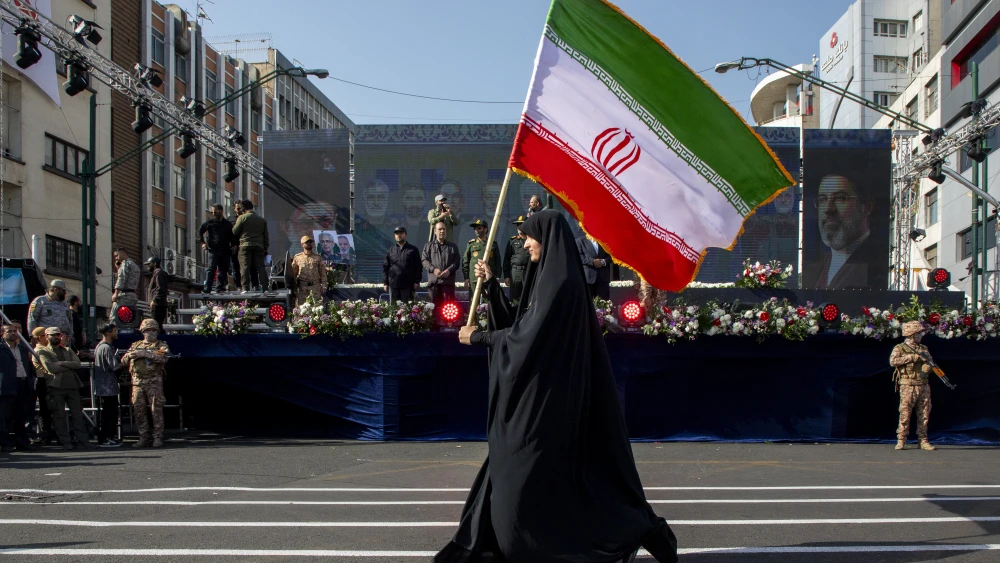
Days before the ceasefire, a caravan of Iraq’s Popular Mobilization Forces entered Iran, a network comprised largely of Tehran-backed militias embedded in Iraq’s security structure, reinforcing a regime that has repeatedly used terror proxies to suppress protests in successive waves. In the days that followed, Iraqi militias alongside Afghan Fatemiyoun fighters, Pakistani Zeynabiyoun units and Lebanese Hezbollah members have been deployed across Iranian cities, running checkpoints, patrolling streets and parading with their flags as a show of force. Iranians are calling into diaspora media saying they feel terrorized and describe the scenes as an occupation of their country.
More than a thousand checkpoints, expanded in the wake of the truce, have turned into extrajudicial killing zones. In central Iran’s Isfahan province, a young man was shot dead at a Basij checkpoint during a stop. In northern Iran’s Mazandaran province, a second young man was killed after a confrontation during an inspection. Across major cities from Tehran and Karaj to Mashhad and Isfahan, nightly roadblocks, vehicle stops, phone searches and intimidation have become routine.
All of this is unfolding under the longest nation-scale internet blackout on record. By April 17, the shutdown had entered its 49th day, with international connectivity still at roughly 2% of normal. Officials have made clear that the restrictions are intentional. A Social Commission lawmaker said restoring access may not be “in the interest” of the public, while a member of parliament’s presiding board noted that any reconnection is contingent on approval by the Supreme National Security Council. At the same time, a tiered system is taking shape, with “internet pro” access being rolled out for select users, while the broader population remains cut off.
The economy is deteriorating further, even after the fighting has paused, adding to pressures that were already severe. The IMF projects inflation at roughly 69%, the highest since World War II, alongside a 6.1% contraction and a drop in nominal GDP to around $300 billion. Petrochemical exports have been halted; supporting utility complexes have been hit; electricity consumption is down 18% with factories closed; and the internet blackout is costing at least $35 million a day, with some estimates as high as $80 million. These same economic grievances have ignited many protest waves, including the anti-regime movement in January.
The ceasefire has not eased pressure inside Iran. It has shifted it onto the population, and Washington is now negotiating as if that dimension does not exist. A state with public backing does not flood its cities with checkpoints, expand executions and shut down the internet. Tehran is bracing for its own people, not standing on their support. That leaves Washington with a narrower but still meaningful opening. The ceasefire need not close off the one arena where the regime remains most vulnerable.