Newsletter
Newsletter Support JNS

Amsterdam Holocaust Museum cancels antisemitism conference

The event, which was organized by a conservative Dutch politician, was moved to a church.

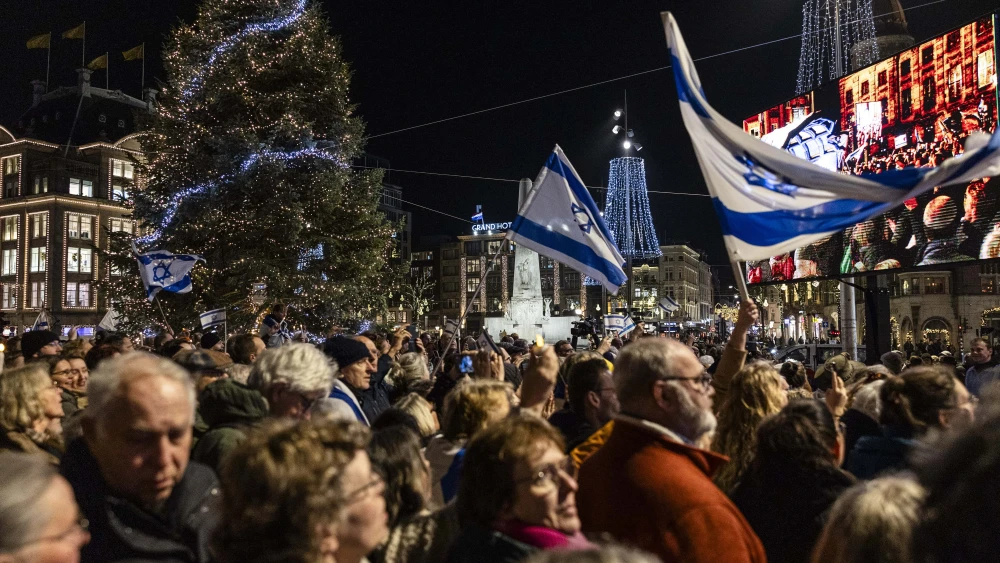
Participants of a rally against antisemitism and in support of Israel in Amsterdam, the Netherlands, on Dec. 17, 2025. Photo by André Dorst/Christenen voor Israel.

The National Holocaust Museum in Amsterdam has canceled a scheduled conference on antisemitism at universities, which was to be held at the museum.

The event, organized by a conservative Dutch politician and member of the European Parliament, was moved to another location last week and took place at a church instead.

“A Holocaust museum is the best place to speak about antisemitism, so I was surprised by the cancellation,” MEP Bert-Jan Ruissen of the Reformed Political Party (SGP) told JNS on Tuesday. “That’s the place to be.”

He said he was informed by the museum’s director that a demonstration was planned in front of the museum against the event and that the director did not want graffiti on the walls shortly before a visit by the Dutch King and the German president.

The staunchly pro-Israel lawmaker who initiated the conference said that about 100 participants ended up attending the advertised event, which the anti-Israel activists had condemned and sought to disrupt.

The Holocaust museum said Wednesday that the antisemitism conference was canceled at its premises because it had become politicized.

“We will not allow the National Holocaust Museum to become the focal point of a political dispute in the context of a rental event,” the Museum’s general director Emile Schrijver said in a written statement. “Protecting the integrity of the National Holocaust Museum should not be a political position; it is our core mandate and one we take seriously.”

The museum’s decision was strongly condemned by the European office of the Israel Allies Foundation, which spearheads faith-based diplomacy around the globe.

“How low can a country sink when even the National Holocaust Museum is no longer a place where the fight against antisemitism on university campuses can be openly discussed?” asked Leo van Doesburg, Europe director of the Israel Allies Foundation.

Etgar Lefkovits, an award-winning international journalist, is an Israel correspondent and a feature news writer for JNS. A native of Chicago, he has two decades of experience in journalism, having served as Jerusalem correspondent in one of the world’s most demanding positions. He is currently based in Tel Aviv.
The designations include Hezbollah-linked institutions that “threaten regional stability, international security, mutual interests and global trade,” the U.S. Treasury Department stated.
Gerard Filitti, of the Lawfare Project, told JNS that “lax immigration policy” has always been the main driver of importing “terrorist ideology” into the United States.
“The teachers we have, we don’t respect and support in the way that they deserve,” Paul Bernstein told JNS. “If we’re successful and we grow enrollment, that problem only gets bigger.”
“The message being sent is that you can get away with attacking someone in broad daylight because you disagree with their opinions, especially if it involves feelings about Israel,” Joshua Burt, of the Anti-Defamation League, told JNS.
“Not identifying Hamas as a terrorist organization is, I think, a failure, Marc Miller told the Canadian Press. “And not clearly stating that, for example, Hamas intended to kill Jews is, I think, an unfortunate error in curation and should be rectified.”
“This is life for Jews under the leadership of Mayor Zohran Mamdani,” advocacy group StopAntisemitism wrote.