


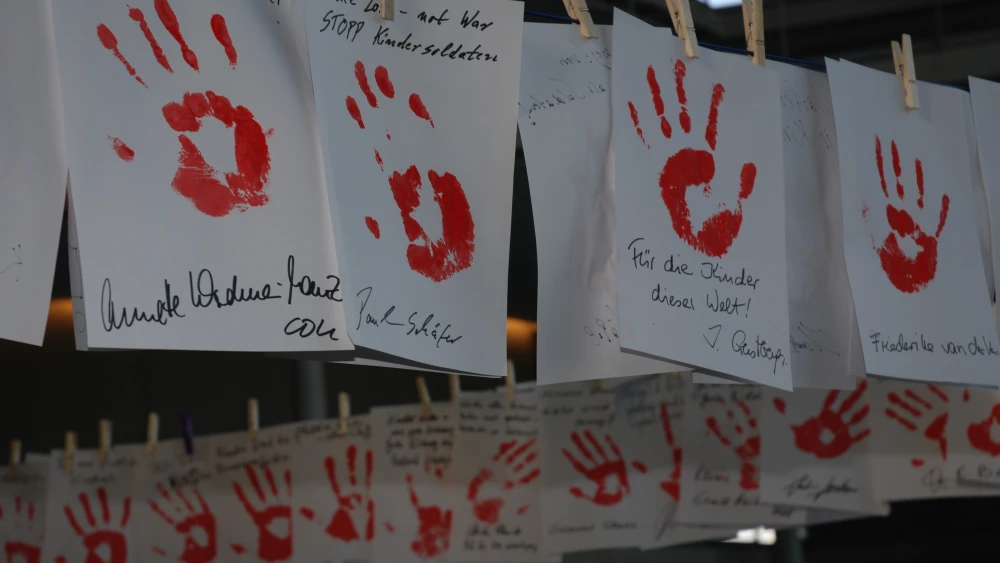

There are moments in history when a regime reveals its true condition—not through speeches or slogans, but through the choices it makes in desperation.
When a regime sends its children to fight, it is no longer projecting strength but confessing failure.
Recent reports indicate that Iran is recruiting boys as young as 12 into what it calls “homeland defense” units. In Gaza, Hamas has long embedded itself among civilians; yet, it has gone further, systematically shaping children into participants in its war. Across parts of Africa, armed groups continue to abduct and conscript children into their ranks.
These are not isolated incidents. They are part of a pattern.
And that pattern tells us something important: regimes and movements that rely on children to sustain their conflicts are not strong. They are weakening.
Consider Gaza. Hamas does not merely hide behind civilians; it cultivates the next generation of fighters. At its summer camps, children are dressed in military-style uniforms, trained in weapons use and taught to simulate battlefield scenarios, including the kidnapping of Israeli soldiers and attacks on civilians.
This is not education. It is indoctrination. It is child abuse.
A society that teaches children to rehearse abduction and violence is not preparing them for life. It’s preparing them for war.
Iran offers an equally chilling example. During the eight-year Iran-Iraq War in the 1980s, thousands of boys were sent to the front lines, in some cases used to clear minefields—human waves advancing across lethal terrain. Today’s reports of 12-year-olds being recruited into paramilitary roles suggest that this mindset has not disappeared. It has simply been revived.
And then there is the broader global picture. In parts of Africa, armed groups continue to kidnap children, force them into combat and strip them of any semblance of childhood. These children are not volunteers. They are victims turned into tools.
History offers a stark precedent. In the final months of Nazi Germany, as Allied forces closed in, the regime mobilized the Hitler Youth, sending teenagers into hopeless battles. It was not resilience. It wreaked desperation.
The same dynamic is visible today.
When a regime turns to children, it is making a grim admission: It lacks the manpower, legitimacy or will to rely on adults. Instead, it reaches for the most vulnerable—those easiest to indoctrinate and least able to resist. This is not merely a tactic. It is a moral collapse.
We should be clear: The use of children in war is not only a violation of international law.
It is a confession. It confesses weakness. It confesses fear.
And it confesses a leadership so bankrupt that it can no longer persuade its own people to fight.
None of this makes these regimes less dangerous. A desperate enemy can still inflict enormous harm. But it does tell us something about their trajectory. They are not advancing with confidence but grasping for survival.
The real divide here is not geographic. It is moral. One side sees children as lives to be protected; the other sees them as weapons to be used.
And history has shown, time and again, how that story ends for any regime that must sacrifice its children to survive has already signed its own obituary.


