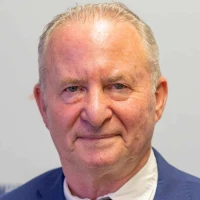
Yitzhak Ben-Hebron, believed to be the last survivor of the 1929 Hebron massacre, died on Thursday at the age of 100.
Born Yitzhak Halali in Hebron on Dec. 1, 1925, he adopted the name Ben-Hebron in honor of the city in which his family had lived for generations and whose Jewish community he helped rebuild after Israel regained control of it in 1967.
He was just 4 years old when Arab rioters murdered 67 Jews and wounded dozens more during attacks that devastated the city’s centuries-old Jewish community and led to its expulsion.
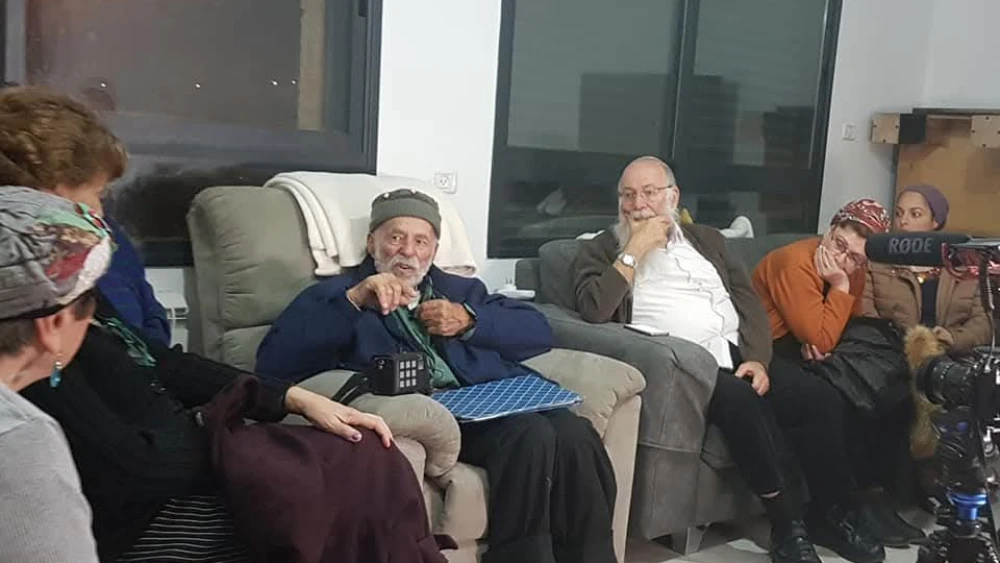
Speaking at a family gathering at his son’s home in Kiryat Arba in 2019, Ben-Hebron recalled how his mother had pushed a heavy sewing machine against the front door of their home near the Avraham Avinu Synagogue to keep the attackers out.
A neighbor urged the family to hide in the synagogue. Once inside, they climbed onto chairs and escaped through upper windows as rioters rampaged through the city.
His 17-year-old sister had taken refuge in the home of Eliezer Dan Slonim, a prominent banker and member of the Hebron City Council, where many Jews sought protection. The attackers murdered those inside, while she survived by hiding under a bed. She later provided testimony about the murders and rapes she witnessed and identified perpetrators in police lineups.
Following the massacre, Ben-Hebron’s family moved temporarily to the Beit Hadassah building, only to face renewed threats after local Arabs recognized his sister as a survivor of the riots. The family fled Hebron that same night.
Return to Hebron
As a young man, Ben-Hebron served in the Haganah and Gadna, taking part in the battle for Israel’s independence. He recalled surviving a fierce firefight during which he vowed that, if he lived, he would one day return to Hebron.
After Israel captured Judea and Samaria in the 1967 Six-Day War, he fulfilled that promise. Ben-Hebron was among the first Jews to return to Hebron after the war and help re-establish the Jewish community there.
He joined Rabbi Moshe Levinger and other pioneers seeking to revive Jewish life in Judaism’s second-holiest city after Jerusalem, among more than 120 people who initially lived in a military compound before the Israeli government authorized Jewish residence in the city. He later became one of the first residents of nearby Kiryat Arba.
“His character and his service in the Gadna and the Haganah helped shape the future of the State of Israel, and thanks to him and many others like him, we built a strong army and an independent state,” his granddaughter, Noya Shafi, wrote in a family history project in 2022.
She added, “I have always admired him and was proud that he was my grandfather. The conversations we had brought us closer together, and I felt as if I had traveled through history alongside him.”

‘We were forced to leave once. It won’t happen again’
In recent years, Ben-Hebron lived in Ashkelon while continuing to share his memories of the massacre.
In a 1988 interview with Maariv during the First Intifada, he reflected on the experiences that shaped his life. When masked Arab youths hurled a rock through the window of his vehicle near Bethlehem, he stopped, fired warning shots into the air and recalled the trauma of his childhood in Hebron.
“I’m already 63 years old,” Ben-Hebron told the newspaper. “I was born in Hebron, and during the riots of 1929, I was a 4-year-old child. We were forced to leave once. It won’t happen again.”
His son, Amishav, believed to be the first Jewish child born in Hebron after the Six-Day War, was traveling with him when the rock struck the vehicle.
“We’re not chasing those youngsters,” Ben-Hebron told his son after firing the warning shots. “The shots into the air were meant to alert the IDF soldiers.”
The interview captured the determination that defined much of Ben-Hebron’s life. Having survived the massacre that ended centuries of continuous Jewish life in Hebron, he dedicated himself to reviving the Jewish presence in the city in which the Jewish patriarchs and matriarchs are buried.
His oft-repeated declaration—“We were forced to leave once. It won’t happen again”—became emblematic of his commitment to Hebron and its Jewish heritage.
Ben-Hebron preserved a unique relic of the community that was destroyed in the 1929 massacre. According to his testimony, recorded by his granddaughter, a Jewish American journalist rescued a Sephardic Megillat Esther (“Scroll of Esther”) while rioters were burning Torah scrolls and Jewish property.
The scroll was entrusted to a Jerusalem resident, who delivered it to Ben-Hebron after the unidentified journalist learned he had survived the massacre. “The journalist asked that he give the Megillah to me after learning that I was a survivor of the 1929 riots,” Ben-Hebron said.
Ben-Hebron treasured the Megillah, viewing it as a tangible connection to the vanished Jewish community of his childhood.
A friend, Avraham Kiryati, who also survived the 1929 Hebron massacre, died at the age of 102 on Jan. 22, 2023.
Ben-Hebron’s death marks the passing of the last known witness to the massacre, one of the deadliest anti-Jewish attacks in Mandatory Palestine and a defining event in the history of Hebron.