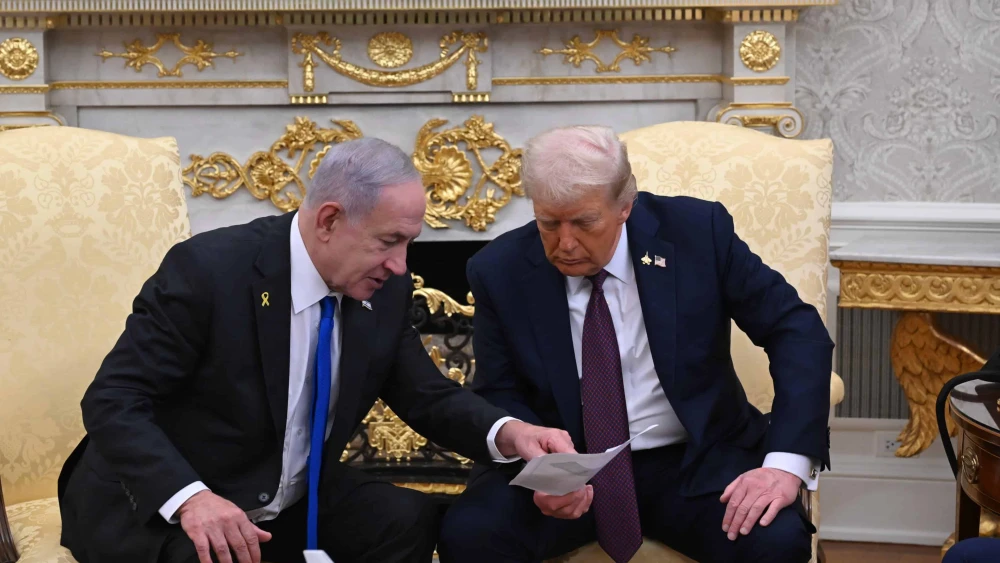

A pat on the back is not always reassuring. Thus, U.S. President Donald Trump’s recent phone call with Israeli Prime Minister Benjamin Netanyahu, in which he reportedly reiterated that Iran’s nuclear program would be dismantled, together with Netanyahu’s confident social media post showing the two leaders united in purpose, has only generated more questions and greater unease: What is really happening?
According to reports, Trump—following the advice of his advisers, Steve Witkoff and Jared Kushner—is retreating toward a memorandum of understanding with Iran, an agreement that would leave the Islamic Republic under the control of the ayatollahs and the Islamic Revolutionary Guard Corps despite months of military pressure and diplomatic effort.
The arrangement could lead to the reopening of the Strait of Hormuz and launch a new negotiating process lasting up to 60 days. Yet little is clear about what such a process would actually achieve, except that Tehran is likely to use the time to advance its own agenda.
Israel’s frustration remains largely restrained, but a giant question mark hangs in the air. Why? If Hormuz reopens and sanctions are eased, billions of dollars—some estimates speak of $25 billion—could flow back into the regime’s coffers. Iran would once again be able to expand its oil exports, injecting fresh resources into an economy weakened by years of sanctions. The regime would have reason to celebrate.
At the same time, Tehran would be granted two months to explain how, when and where it intends to dispose of roughly 460 kilograms of uranium enriched to 60%, material that is only a short technical step away from weapons-grade enrichment. Yet in Middle Eastern diplomacy, 60 days can stretch like chewing gum. Iran has repeatedly demonstrated its ability to exploit negotiations, delays and ambiguities to its advantage.
There is, however, a more fundamental problem. Any genuine negotiation with the regime of the ayatollahs is inherently flawed because the regime’s ideological foundations make a durable agreement impossible. Tehran uses diplomacy as a tactical instrument—to gain time, ease pressure and preserve its strategic ambitions—rather than as a path to lasting compromise. For Israel, which has lived for decades under explicit Iranian threats of destruction, the central question is not the wording of any agreement but whether the regime can ever be trusted to honor one.
Meanwhile, the most dangerous elements of Iran’s military strategy appear largely absent from the discussion. There is little mention of Tehran’s ballistic missile program or the proxy armies that have destabilized the Middle East for decades and made atrocities such as Oct. 7, 2023, possible. Hamas is suddenly treated as a secondary issue. Hezbollah, despite continuing provocations and attacks, seems almost off the agenda.
In Lebanon, Netanyahu is under pressure to preserve the ceasefire and limit Israeli military action to responses against Hezbollah violations. Yet Hezbollah’s aggression drove tens of thousands of Israelis from their homes in the north and continues to claim Israeli lives through Iranian-supplied drones.
Even if Netanyahu insists that Israel retains freedom of action, he understands that American pressure can impose practical constraints on Israeli strategy. It could also weaken efforts within Lebanon to challenge Hezbollah’s dominance and move toward normalization with Israel.
The paradox is striking. If Tehran accepts Trump’s framework, Lebanon could effectively remain within Iran’s sphere of influence. Hamas, which refuses to disarm, would likely draw encouragement from an American accommodation with its principal patron.
Supporters of an agreement point out that securing the removal of the regime’s stockpile of highly enriched uranium would be a significant achievement. It would. But what about the many tons of uranium enriched at lower levels that could quickly be fed through advanced centrifuge cascades?
What becomes of the missile factories? What becomes of the drone production lines whose weapons kill with the sound of a mosquito? How can the Islamofascist regime be prevented from murdering its own people on a mass scale, numbering in the tens of thousands? And how does the international community prevent an Islamist dictatorship from continuing its repression at home while expanding its influence abroad?
These questions have no easy answers. Israel, the Iranian regime’s declared target, understands this reality better than anyone.
Trump has other priorities competing for his attention: the World Cup, celebrations marking the 250th anniversary of the United States, domestic politics and the approaching midterm elections. Iran, however, remains Iran.
The regime’s ideological arrogance, its habit of boasting and threatening, and its determination to project power make surprises almost inevitable.