
According to a nine-column front-page headline in La Repubblica, one of Italy’s leading daily newspapers, the world can witness how difficult life supposedly is for Christians in Israel.
Indeed, the situation is portrayed as a “shock” for Christianity as a whole, especially for Cardinal Pierbattista Pizzaballa, the Latin Patriarch of Jerusalem, who is depicted as a heroic figure “in conflict with [Israeli Prime Minister Benjamin] Netanyahu over the horrors of Gaza,” and allegedly prevented by wicked Jews from going to pray at the Church of the Holy Sepulchre.
Thus, the narrative goes, Christians are prevented from praying and living their faith in the Holy Land.
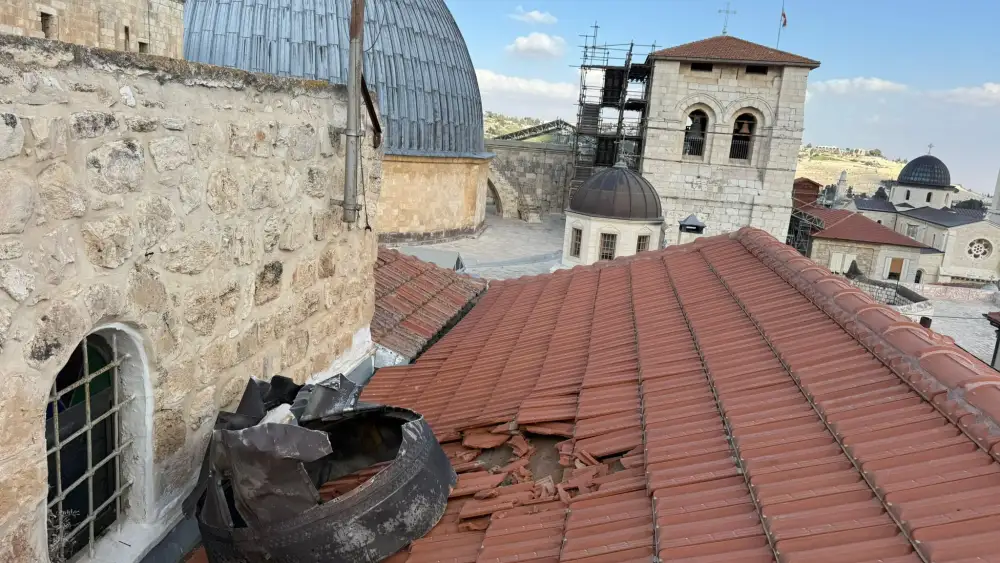
The obvious danger posed by Iranian missiles—frequently aimed at Jerusalem and which have struck the Old City—has led to temporary Israeli security restrictions affecting mosques, synagogues and the Church of the Holy Sepulchre alike. Yet Iran’s aggression is pushed aside in favor of highlighting supposed Israeli cruelty. The implicit suggestion echoed across much of the Italian media is clear: poor Christians in the hands of the Jews.
The facts tell a different story. In 1948, there were approximately 30,000 Christians in Israel; today, the number is close to 200,000. Christians in Israel are flourishing, which is certainly not the case in the Palestinian territories.
Consider Bethlehem, a city of profound importance to Christians as the birthplace of Jesus. In 1993, the year of the Oslo Accords, when control of the city was transferred to the Palestinian Authority and Israel withdrew, Christians constituted approximately 60–65% of the population. Today, that figure has fallen to roughly 15%. Christians have fled Palestinian rule, pushed out by discrimination, intimidation and the erosion of their cultural and religious freedoms.
Media reactions to the recent Jerusalem episode have been paradoxical, reflecting what increasingly appears to be an antisemitic fantasy that has gained traction since Oct. 7, 2023. An imagined defense of vulnerable victims is transformed into an accusation against Jews. In this fictional scenario, Iran and its bombardment disappear, replaced by the caricature of a supposedly anti-Christian Zionist monster.
The reality is that Christians in Israel live with equal rights and full freedom of worship, maintaining access to their holy sites. In contrast, Jewish communities across much of the Arab world have largely disappeared after decades of persecution, expulsion and violence. Yet little is said about this. Nor is much attention given to Christians persecuted and killed in parts of the Islamic world.
Before accusing Jews of persecuting Christians, it would be wise to reflect on history. The role played by elements within the Church in centuries of persecution of Jews—including pogroms and silence during the Holocaust—has not been forgotten.
Iranian missiles pose a real danger. For 47 years, the regime firing them has sought the blood of infidels—all infidels. Even sites considered sacred in Islam, such as Al-Aqsa Mosque, or Christianity’s Church of the Holy Sepulchre, are not immune to the threat posed by the Iranian regime’s aggression.