


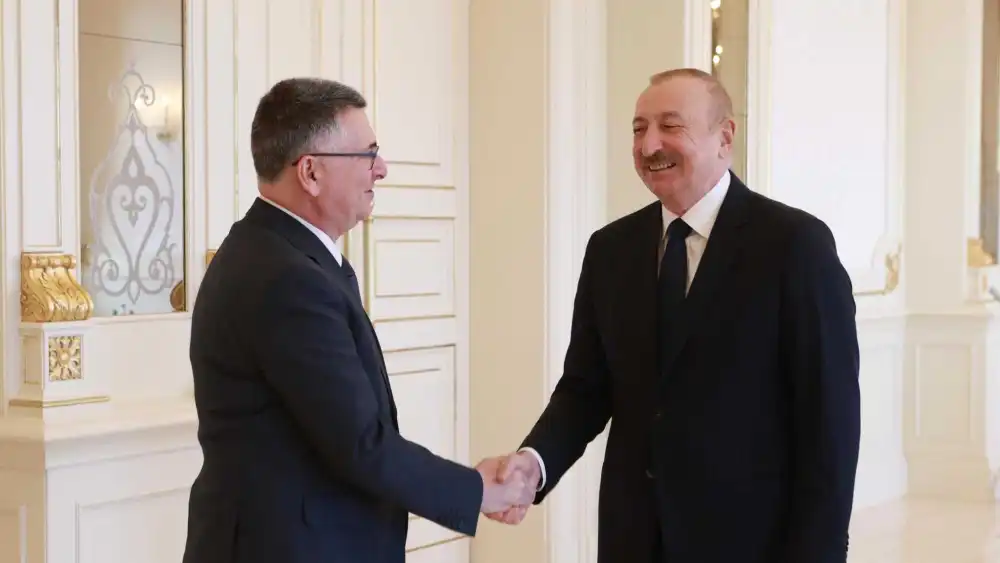

Azerbaijan is a unique country. Though Muslim and Shi’ite, it is a secular state determined to modernize. Nationalist in outlook, it is led by President Ilham Aliyev, who maintains excellent relations with both the United States and Israel, while relations with Iran remain defined largely by mutual distrust.
International media have recently reported what many observers long suspected: Along Azerbaijan’s 700-kilometer border with Iran, clandestine Mossad sites reportedly operate as part of a broader regional intelligence network from which Israel can monitor and potentially launch operations against the Islamic Republic. Such facilities may have played a role in recent actions against senior Iranian figures, including Rahman Moqadam, head of foreign recruitment for the Islamic Revolutionary Guard Corps.
Relations between Azerbaijan and Israel have flourished since the collapse of the Soviet Union in 1991. Israel was among the first countries to recognize the newly independent state, and the two nations have since built a strategic partnership. Azerbaijan provides oil and energy; Israel contributes technology, intelligence, weapons systems and innovation.
Israeli Foreign Minister Gideon Sa’ar met with Aliyev in Baku in January. During the Nagorno-Karabakh wars, much of Azerbaijan’s military capability was based on Israeli technology. The country was also among the first purchasers of Israel’s Iron Dome missile-defense system.
While Azerbaijan’s relationship with Washington cooled during the Biden administration because of growing U.S. ties with Armenia, the return of President Donald Trump has helped revive a strategic axis that could reshape the region’s geopolitical map—provided the Iranian threat is neutralized and Russian influence is contained.
The emerging alignment extends well beyond Azerbaijan. The United Arab Emirates has been a cornerstone of this process since signing the Abraham Accords in 2020. Bahrain shares concerns about Iranian aggression. Morocco has become a reliable Western partner in confronting jihadist extremism. Egypt and Jordan, despite periodic tensions, remain committed to peace. Saudi Arabia continues to pursue its own interests, but ultimately may find that its future lies within a broader Western-oriented alliance.
Trump’s belief that many Muslim countries are prepared to work with Israel against Iran and its violent proxies is not a fantasy. It reflects a strategic reality that has been developing for years.
For years, Iran’s grand strategy was to encircle Israel with a ring of armed proxies. Hezbollah in Lebanon, Hamas in Gaza, Palestinian Islamic Jihad, the Shi’ite militias in Iraq, the Houthis in Yemen and the Assad regime in Syria were meant to form a tightening noose around the Jewish state. Tehran also hoped to draw the Arab world into a united anti-Israel front, isolating Israel diplomatically while threatening it militarily from every direction.
Instead, the opposite has happened.
Hamas has been devastated, Hezbollah has been severely weakened, Assad has fallen, and many Arab states now view Iran—not Israel—as the primary source of regional instability. The Abraham Accords opened a new strategic reality, and cooperation between Israel and key Sunni states has expanded despite the war. Rather than Israel finding itself encircled, it is Iran that increasingly faces strategic containment.
Today, Tehran sees a growing network of countries—from Azerbaijan in the north to the Gulf states and partners in the Red Sea region—that share an interest in limiting Iranian expansionism. Iran’s dream of regional hegemony has collided with a new geopolitical reality.
What remains most dangerous is Hezbollah. The organization no longer serves merely as a military threat to Israel; it has effectively kidnapped Lebanon itself, holding the country hostage to Iran’s interests. Hezbollah’s arsenal, political power and control over key institutions prevent Lebanon from reclaiming full sovereignty and pursuing the future that many Lebanese desire. As long as Hezbollah remains Tehran’s armed instrument on the Mediterranean, Lebanon will continue to pay the price for Iran’s regional ambitions.
Part of this evolving framework includes Israel’s growing relationship with Somaliland at the southern entrance to the Red Sea, one of the world’s most important maritime trade routes. Facing the threat posed by the Iranian-backed Houthis, Somaliland has emerged as a valuable partner in the Horn of Africa.
For Israel, strategic partnerships now extend far beyond its indispensable alliance with the United States. Perhaps the most significant is its growing cooperation with India under Prime Minister Narendra Modi. Together, they are advancing the India-Middle East-Europe Economic Corridor, or IMEC, announced in 2023, which places Israel at the center of a major trade route linking Asia and Europe and offers a long-term alternative to China’s Belt and Road Initiative.
This is the future now taking shape in the Middle East—not the isolation of Israel through boycotts and diplomatic campaigns, but a widening network of strategic partnerships built on shared interests, economic development and resistance to Iranian hegemony.
That, ultimately, is what a durable peace will look like.



