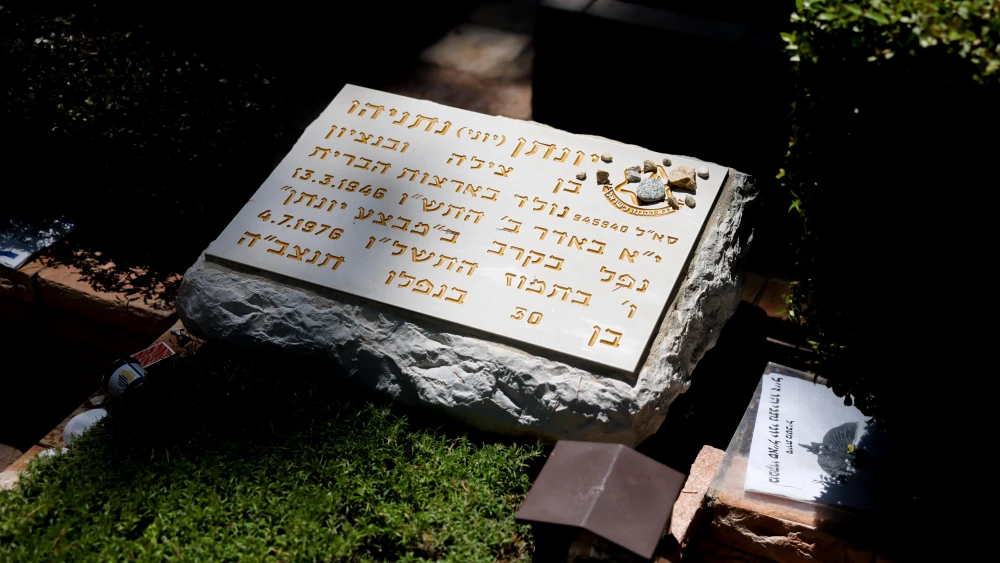

July 1976 was supposed to be a year of celebration as America marked 200 years of independence beneath exploding fireworks and waving flags. But while the world watched the bicentennial festivities, Israeli commandos were preparing for a midnight raid on Entebbe Airport in Uganda. They were on a hostage rescue mission led by Yonatan (“Yoni”) Netanyahu, who would not survive the rescue that he made legendary.
The hero of the Entebbe operation and the older brother of Israeli Prime Minister Benjamin Netanyahu was killed during the rescue 50 years ago this year. He died fighting anti-Israel terrorists just as the world’s oldest democracy celebrated its bicentennial. He fell in a heroic effort against impossible odds that freed more than 100 hostages.
As a result, America’s commemoration of liberty shared world headlines with Israel’s celebration of the liberation of the hostages. The daring of Israel’s commandos captured the world’s imagination like no other anti-terrorist action in history.
While many books and movies recall the Entebbe rescue, there is much more to the story.
It is not widely known that Netanyahu was a hero long before he commanded the Entebbe operation. Some of his early actions are hinted at in the remarkable posthumously published book of letters, Self-Portrait of a Hero: From the Letters of Jonathan Netanyahu, 1963-1976. He played a key role in many crucial Israeli security operations, exhibiting courage and valor in the most dangerous of circumstances.
He was a living example to the world’s statesmen that terrorism can be beaten if the nations of the world have the will to fight back.
Yoni Netanyahu was born in New York to a family of dedicated Revisionist Zionists who greeted the news of the establishment of Israel by packing up and moving there in 1948. He returned to the United States in 1963 when his father, distinguished Jewish Studies scholar Benzion Netanyahu (1910-2012), accepted a professorship in Philadelphia. After graduating high school in a Philadelphia suburb in 1964, he returned to Israel to join the Israel Defense Forces, and it wasn’t long before he had worked his way up to the leadership of an elite paratrooper unit.
The mid-1960s were a time of growing danger for Israel. The Palestine Liberation Organization, established in 1964 for the purpose of “liberating” all of “Palestine” from the Israelis, had begun mounting terrorist attacks across Israel’s borders—precarious borders indeed. In those days, before the 1967 war, Israel was just nine miles wide at its strategic midsection, and all of Israel’s major cities were within striking distance of PLO chief Yasser Arafat’s terrorists.
Netanyahu did not fear the possibility of losing his life in the war to protect Israel from its enemies. “Death does not frighten me,” he wrote to a friend. “I do not fear it because I attribute little to a life without purpose. And if it is necessary for me to lay down my life to attain an important goal, I will do so willingly.”
The path that led to his renown in the ranks of Israel’s commandos may have begun in 1971 in the context of the battle against the Black September Organization, founded by Arafat’s Fatah faction of the PLO.
Among Black September’s first attacks was the assassination of Jordanian Prime Minister Wasfi Tal. One of the assassins earned a permanent place in the history of savagery by drinking their victim’s blood in full view of photographers.
In 1972, a Black September unit carried out the murder of 11 Israeli athletes and coaches during the Summer Olympic Games at Munich’s Olympic Village. Netanyahu was a member of the commando unit sent to Beirut on the night of April 19, 1973, to attack the planners of the massacre.
He had not been originally assigned to the mission. He volunteered for it.
Israeli commandos landed on a Lebanese beach and slipped into Beirut. Netanyahu and his unit made their way to the apartment of Black September leader, Muhammad Youssef Al-Najjar (Abu Youssef), and executed the arch-terrorist.
The last to leave the apartment, Netanyahu grabbed a satchel of papers just as Lebanese police jeeps arrived; they contained operational plans for the PLO’s terrorist network throughout Israel. That discovery undoubtedly saved hundreds of lives.
Details of another example of his heroism are to be found in Moshe Dayan’s autobiography, Story of My Life. Dayan recalls how Netanyahu suffered a serious wound in the 1967 Six-Day War and still returned to his army unit and fought valiantly in the 1973 Yom Kippur War, despite injuries that would plague him for the rest of his life.
Netanyahu and his unit “stalked and killed more than 40 Syrian commandos who had landed behind our lines,” wrote Dayan.
After that, he was responsible for an extraordinary mission that rescued Lt. Col. Yossi Ben Hanan from behind enemy lines, again volunteering. He had overheard a radio transmission about a severely injured tank officer and led his men on foot, braving a non-stop artillery barrage.
Recalling the Ben Hanan rescue, Dayan wrote: “I do not know how many young men there are like Yoni. But I am convinced there are enough to ensure that Israel can meet the grim tests which face her in the future.”
Dayan’s memoirs were published before the Entebbe mission. Netanyahu’s last name is not revealed by Dayan in the book. His portrayal now seems visionary in light of history.
Self-Portrait of a Hero is a must-read. It contains Yoni’ Netanyahu’s letters to family and friends from 1963, when he first entered high school in the Philadelphia suburbs, to just days before the hostage rescue at Entebbe in 1976. His intellect, patriotism, compassion, dedication to duty and leadership are all on full display, amplifying the loss of someone who had just turned 30.
The book has had a profound effect on its readers for decades. If you have not yet read it, do yourself a favor and get a copy. You, too, will be forever changed.