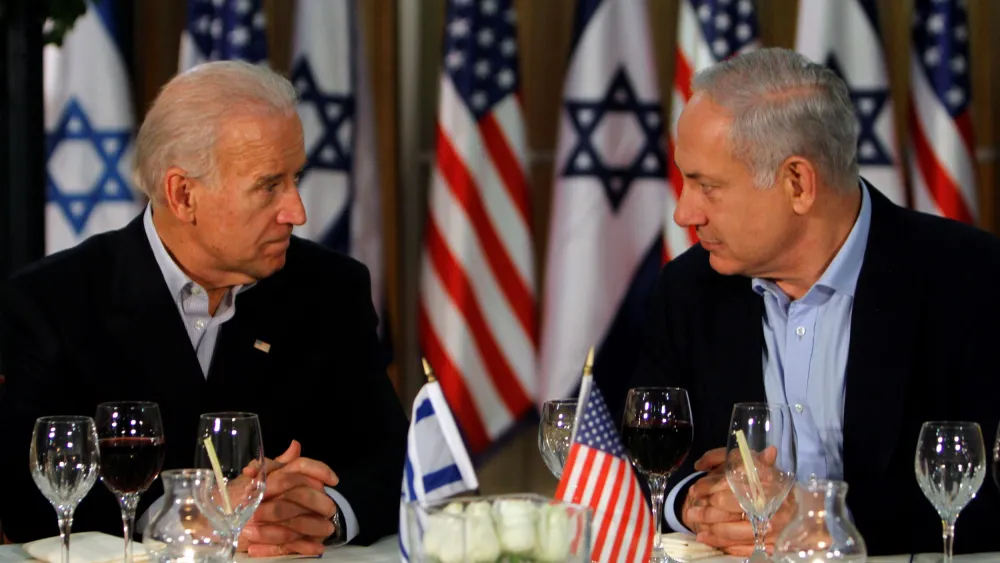

U.S. President Joe Biden is attempting to negotiate a normalization agreement between Israel and Saudi Arabia. However, he may also be negotiating an unwritten understanding with Iran that enriches the clerical regime without meaningful nuclear concessions in return.
Biden seems to be laboring under the misapprehension that an Israel-Saudi agreement would appease Jerusalem and Riyadh as Washington effectively rubber-stamps Iran’s status as a threshold nuclear state. He couldn’t be more wrong, and the Israeli and Saudi governments would be wise to reject the unofficial bargain.
Last week, Biden dispatched his top Middle East staff to Saudi Arabia to begin negotiations on an ambitious deal that, if successful, could effectively end Israel’s conflict with much of the Arab world. According to longtime New York Times columnist Thomas L. Friedman, a frequent guest at Biden’s Oval Office, an agreement would entail major concessions on the part of all three governments.
Saudi Arabia is seeking a NATO-level defense treaty with America, U.S. approval of a civilian nuclear program and advanced missile defense capabilities from the U.S. military. The Biden administration is asking for an end to the Saudis’ involvement in the war in Yemen, a massive Saudi aid package for the Palestinians and the curtailment of Saudi-China relations. If Washington and Riyadh agree to these terms, Saudi Arabia would normalize ties with Israel, while the Jewish state would make concessions to the Palestinians.
To be sure, such an agreement would present major political challenges for Biden and Israeli Prime Minister Benjamin Netanyahu. Both leaders are facing weak poll numbers at home and are highly incentivized to deliver a foreign policy success. But they are also likely to face resistance from within their own governments. In Washington, the Senate would vote on any defense treaty, but approval would remain an open question in light of Riyadh’s unpopularity among the Democratic majority.
Concessions to the Palestinians would be widely unpopular in Israel’s coalition government and thus politically perilous for Netanyahu. The Israeli leader would also have to face off against members of the Knesset opposition. When I visited the Knesset last month, an influential Israeli opposition leader told me that he would oppose a civilian nuclear enrichment program for Saudi Arabia.
Still, with creative thinking and artful diplomacy, Biden and Netanyahu can overcome these myriad but surmountable challenges. A deal between the Jewish state and the custodians of Mecca and Medina would be a boon to regional stability and security. Moreover, it is consistent with U.S. interests.
In stark contrast, the emerging picture of what the Biden administration is negotiating with the mullahs in Tehran—which Netanyahu rightly opposes—threatens both Israel and Saudi Arabia.
The new understanding between Washington and Tehran would reportedly allow the Islamist regime to continue enriching uranium to 60% purity in exchange for billions of dollars in sanctions relief. Yet 60% enriched uranium is only a short turn of the screw to weapons-grade, constituting 99% of the effort needed to reach that threshold.
Iran would undoubtedly channel any sanctions relief to its expeditionary forces in the region, threatening both Israel and the Saudis. Meanwhile, the cash infusion would strengthen Iran’s police state, undermining the protest movement that has pervaded Iran since last September. Moreover, by declining to devise a formal text for the understanding, the Biden administration may hope to bypass statutorily required congressional review of any agreement between the two countries.
The U.S. is the lynchpin of any future normalization agreement between Israel and Saudi Arabia. The Biden administration should doggedly pursue normalization because of the benefits it would bring to America and our regional allies. At the same time, the administration must abandon talks with Iran and apply maximum pressure on the mullahs to halt their race towards nuclear weapons. Above all, Washington should not expect Israel to accept a normalization agreement with the Saudis as a consolation prize for a bad Iran deal.
Our allies in Jerusalem and Riyadh deserve better.