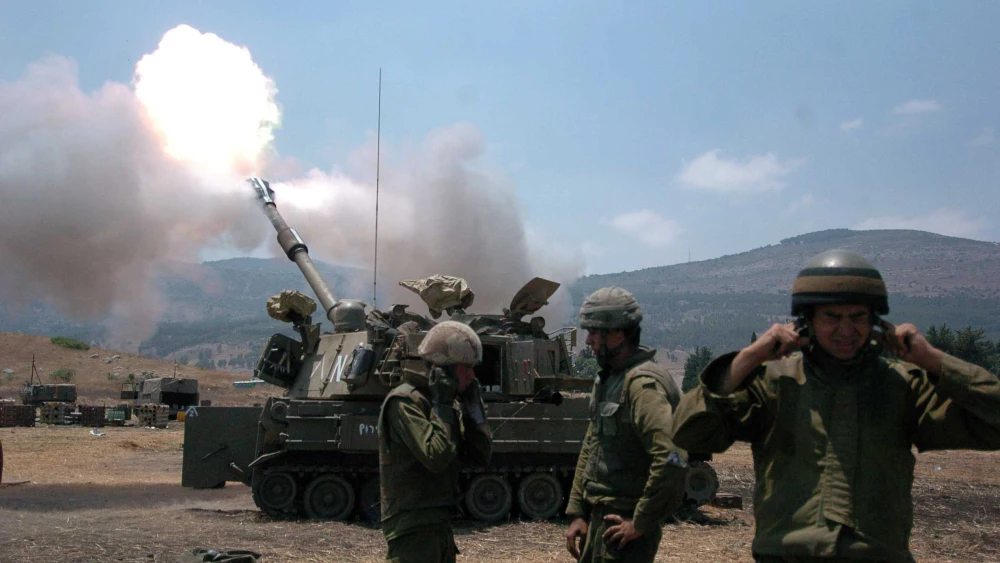

The pastoral quiet that welcomes hikers in northern Israel makes it possible to forget for a moment that this week Israel marks the 13th anniversary of the outbreak of the Second Lebanon War. A few days from now, Hezbollah leader Sheikh Hassan Nasrallah will pop out of the bunker where he has been hiding since the summer of 2006 and once again announce that he won the war.
The quiet along the northern border, as well as the level of caution Hezbollah exhibits in not provoking Israel or dragging it into another round of fighting, testify to the strength of the blow the organization sustained during the war, and the heavy price its Shi’ite supporters paid for their leaders’ adventurism.
It took years for Hezbollah and its sponsor, Iran, to repair the damage the war caused to Shi’ite villages in southern Lebanon, not to mention the thousands of dead and wounded. Indeed, Nasrallah was forced to apologize to his people at the end of the war for his mistake in starting it, and ever since then, in every one of his speeches, he has promised to do everything in his power to avoid another war with Israel.
Israel’s achievements in the Second Lebanon War were greater in many respects than those of past wars; nevertheless, many Israelis feel that something was amiss because of the way the war was handled and the heavy price Israel paid.
It would appear, for instance, that the war achieved what it did thanks to the heroism of the Israeli soldiers and the stalwart northern home front rather than because of any decisions by the leaders in charge of the country and the army at the time.
One of Israel’s mistakes in the war was to draw an artificial distinction between Hezbollah and the Lebanese state in which the organization exists and flourishes.
The political, economic and military systems in Lebanon serve as a respirator for Hezbollah, keeping it alive. And because Hezbollah is effectively dependent on the Lebanese political systems, only by striking a fatal blow to these systems can Israel carry out a major strike against Hezbollah and illustrate the true price of provoking Israel into an open conflict.
In the summer of 2006, Israel refrained from striking Lebanon itself—in a large part because of pressure from the United States, which even now holds the innocent or optimistic belief that there is “another Lebanon” that can, if we help it, defeat Hezbollah.
In many aspects the story of the Second Lebanon War was a repeat of Israel’s unilateral withdrawal from southern Lebanon in 2000, which can be seen as the root of Israel’s current troubles along its northern border.
The way in which the withdrawal was implemented sent a message of Israeli weakness. The hasty pullout encouraged Hezbollah to renew its terrorist attacks Israel and gave the Palestinians a tailwind for the Second Intifada, which erupted a few months later in October 2000.
Nasrallah, justifiably from his point of view, rushed to portray the unilateral withdrawal as a historic turning point in the history of the Israeli-Arab conflict because for the first time, Israel had been compelled to concede territory without demanding or receiving peace in exchange.
Moreover, it turned out that there was no need for peace to show up at the White House and receive economic or any other kind of aid that would allow the Lebanese, including Hezbollah, to flourish.
It also seems as if Hezbollah’s continued activity in Lebanon encouraged the Americans and others to approach Beirut and beg it to cut the Gordian knot that ties the vipers’ nest of Lebanon to the Hezbollah vipers that nest in it.
The deterrence Israel secured in the summer of 2006 still exists, but it won’t last forever. Today as then, an error of judgment could lead to a wide-scale conflict—something no one wants. Beyond that, the understandings reached about Lebanon do not apply to Syria, where Iran is trying to entrench itself like it has in Lebanon.
So Israel is still facing the same challenges, and we can only hope that next time, its response will be different and more successful.
Eyal Zisser is a lecturer in the Middle East History Department at Tel Aviv University.
This article first appeared in Israel Hayom.