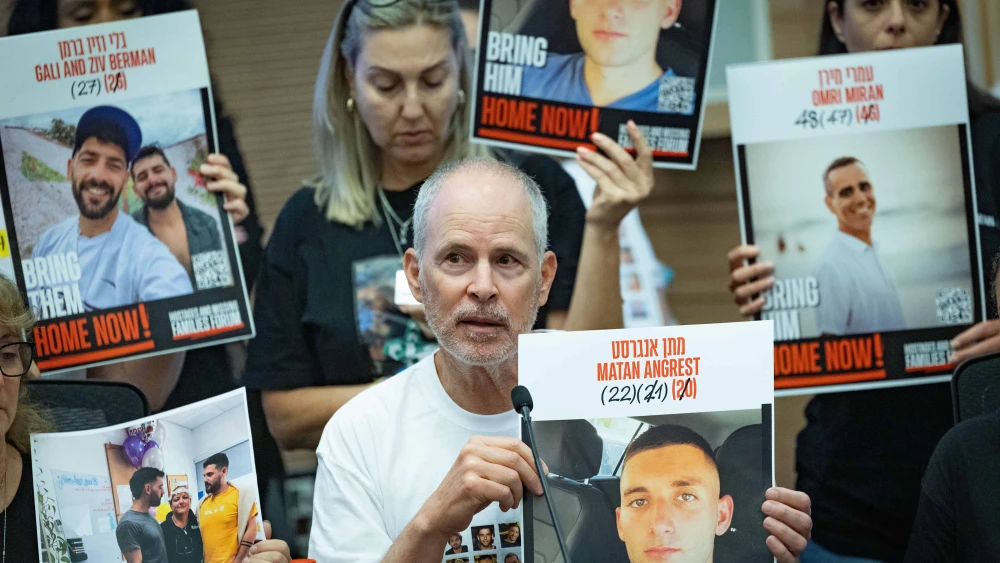

The issue of the Israeli hostages in Gaza is heart-wrenching, and it continues to prevent the Israel Defense Forces, as well as the country’s political echelon, from making a decisive move against the Islamist terrorist group Hamas.
It is abundantly clear that Hamas refuses to disarm and even clearer that Hamas intends to keep some of the hostages as a survival guarantee. This makes an intensive, all-out attack on Hamas and the forcible removal of its presence from the Gaza Strip nearly impossible. The reason is clear: Such an operation might endanger the living hostages.
The IDF’s chief of staff, Lt. Gen. Eyal Zamir, conducted a field visit and operational assessment last week in Khan Yunis in the southern part of the Strip, the heart of the ongoing “Operation Gideon’s Chariots.” He reaffirmed that Gaza remains the IDF’s primary focus at this stage of the conflict. He then said: “We are fully committed to achieving our strategic objectives: The return of the hostages, the dismantling of Hamas and the restoration of security for Israeli communities. We will not compromise on these goals.”
The problem is that the IDF cannot simultaneously accomplish both strategic objectives, and the coalition government must decide which one of the objectives takes priority. Given the condition of the hostages, starved, ill-treated and medically deteriorated, it would seem that the case is clear for saving them first.
Alexander (“Sasha”) Trufanov, 29, was abducted from Kibbutz Nir Oz and held captive by Hamas for 498 days. The only son of a family that immigrated to Israel from Russia, his father was murdered by Hamas on Oct. 7, 2023, and his mother, grandmother and girlfriend, Sapir Cohen, were also abducted to Gaza, but released after 54 days in one of the early exchange deals. In a recent interview, he said that only after all hostages are returned will Israel be able to employ the full force necessary to deal with the threats it faces. (In a bit of good news, Sasha and Sapir became engaged this week.)
A deal with Hamas has wrecked the nerves of the families involved. Out of frustration, they blame Israeli Prime Minister Benjamin Netanyahu and his coalition government. This is unfair. Hamas—not the Israeli government—has rejected every deal presented by mediators and Steve Witkoff, the U.S. special envoy to the Middle East.
Hamas’s demands are unacceptable, even to the Americans. Hamas wants an end to the war in Gaza as a condition for a deal, along with the withdrawal of IDF troops from the entire Strip. They also want to keep their arms, and they demand that massive humanitarian aid entering Gaza be controlled by them. Hamas will then, as they have done before, sell the goods at extortionist rates and thus finance their operational needs. In addition, the food is also being used as a recruitment tool.
The Trump administration’s current proposal is for a ceasefire that would pause the war, free Israeli hostages and send much-needed aid into Gaza. It also aims to open broader talks about ending the conflict. Under the U.S. proposal, Hamas would have to be expelled from the coastal enclave. Hamas does not want to release all 50 hostages: the 20 assumed living and 30 dead, already murdered by terrorists.
If pressed on the issue of expulsion from Gaza, Hamas spokespeople claim that they would agree, under certain conditions, but would insist on holding on to their arms. This is a condition Israel cannot agree to since arms would likely be used, once again, to attack Israel, whether it be from Turkey through a maritime landing on Israel’s shores, randomly murdering Israeli civilians or attacking from Lebanese territory.
In January, the first stage of the U.S.-brokered deal brought out some of the hostages, but the deal fell apart in March as negotiators failed to nail down a second stage of the agreement. Israel then resumed its offensive in Gaza. U.S. President Donald Trump is now optimistic that a deal will be struck by next week. But we have already seen Trump’s optimism evaporate each time Hamas backs out of a deal.
At this point, documents have been submitted by mediators to Hamas outlining a 60-day ceasefire proposal, during which Israel would pull back to a buffer zone on the Gaza border. Aid would pour into Gaza as Hamas returns 10 living and 18 deceased hostages to Israel.
Hamas claims they indicated a “positive” response to the latest iteration of a hostage deal and ceasefire proposal. But Netanyahu’s office pointed out late last week that Hamas had requested “unacceptable” changes to the proposal formulated by Qatar.
If a hostage deal is to be had, it must include all 50 people since experience has shown that Hamas would pull out of the deal soon after the first part is concluded; the remaining living hostages would likely die in captivity, given their poor health condition.
Trump must be true to the promise he made early in his term that “all hell will break loose if the hostages are not returned.” After the success of airstrikes on Iran’s nuclear facilities, Washington must give Hamas a credible warning of military intervention unless all the hostages are returned. Constructing a deal in 60 days is a matter of life and death.
Let us hope that following this week’s White House meetings between Trump and Netanyahu, an unequivocal message will be issued that all the hostages must be released immediately. Israel can then agree to withdraw from Gaza while keeping a presence at the Philadelphi Corridor, while Hamas and Palestinian Islamic Jihad fighters leave the Strip without their weapons. The United States could then boost aid to and start to reconstruct Gaza.