Newsletter
Newsletter Support JNS

My thoughts at the funeral of Bernard Lewis

In Judaism, there are no coincidences, and it came to my mind that Lewis was born on Jerusalem Day (Iyar 28)—exactly 51 years before Israel reunited the capital city of Jerusalem in 1967—and died just days after the 51-year anniversary of Jerusalem Day, the very year the United States officially recognized Jewish sovereignty over its eternal capital.

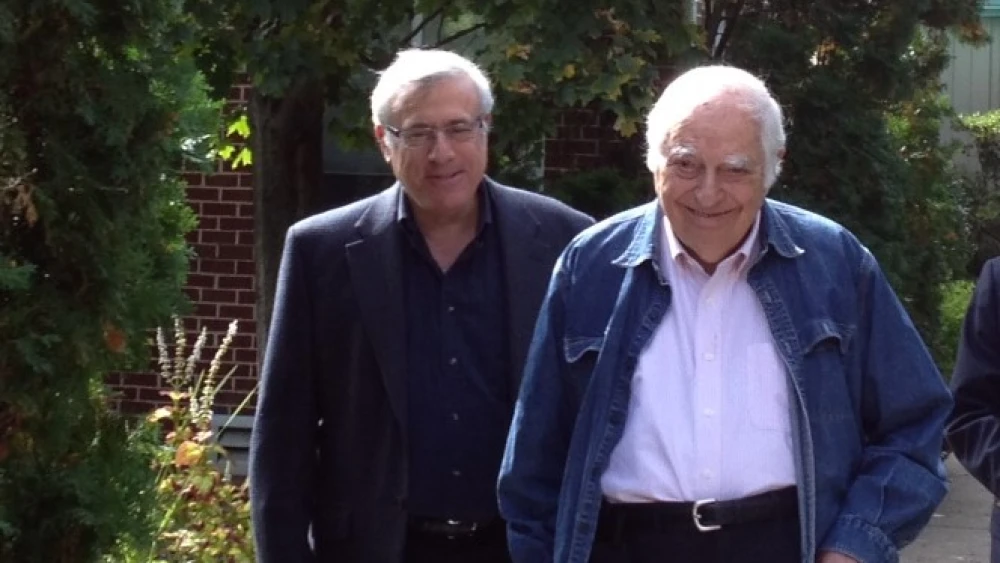
Professor Bernard Lewis with Dr. Harold Rhode. Photo courtesy of Harold Rhode.
Harold Rhode served as a specialist on Islamic culture and the Middle East in the Office of the Secretary of Defense from 1982 to 2010. He studied at a university in Iran during the early and mid-stages of the Islamic Revolution. He is currently a Distinguished Senior Fellow at the Gatestone Institute in New York, as well as a Senior Fellow at the Jerusalem Center for Public Affairs. See his website at: harold-rhode.com.

Bernard Lewis taught us how to think about issues—not what to think, which is common in academia today. He did not shy away from controversy and stood up for what he believed in. He was not impressed with titles, and he was available to talk to anyone open to discussions based on reason.

The stories that surround Bernard Lewis are the best way to understand his character and soul.

In Judaism, there are no coincidences, and it came to my mind that Lewis was born on Jerusalem Day (Iyar 28)—exactly 51 years before Israel reunited the capital city of Jerusalem in 1967—and died just days after the 51-year anniversary of Jerusalem Day, the very year the United States officially recognized Jewish sovereignty over its eternal capital.

Bernard Lewis first came to Israel between 1937-38, and it was one of the most moving moments in his life.

He had let me use his apartment in Israel he so deeply loved. I had arrived at 5 a.m. U.S. time and slept a bit, and then when driving later and knowing that he would still be up, called and thanked him. I said I was so tired, but that my soul was at peace here. He responded, “I know, I feel exactly the same when I’m there.”

He had wished to spend his last years in Israel, but it was not to be because of his poor health. Now, he has taken his last and eternal step into our land, to be buried in the soil he so deeply loved.

Please forgive me for anything that I might have done that upset you. May your soul be bound up among the souls of the living.

Harold Rhode received in Ph.D. in Ottoman history and later served as the Turkish Desk Officer at the U.S. Department of Defense. He is now a Distinguished Senior Fellow at the Gatestone Institute.
“I will be one of the Jewish members of Congress most willing to stand up for Palestinian human rights,” he told the crowd at his victory party in Brooklyn.
“Wikipedia’s administrators showed that they are above trivial details like formal charges, a designated prosecutor, basic decorum, distinction between prosecution and judge, dispassionate adjudication and so forth,” Larry Sanger told JNS.
The Islamic Republic forced Washington to “retreat both on the battlefield and at the negotiating table,” said Mohammad Bagher Ghalibaf.
AIPAC spokeswoman Deryn Sousa told JNS that Adrian Boafo “has made clear his vision to carry forward the strong pro-Israel legacy of Congressman Steny Hoyer, one of Congress’s most steadfast champions of the U.S.-Israel relationship.”
The Associated Press called the race early for the Jewish Democrat, whom the mayor has backed.
Marc Bloch, who was also a veteran and resistance fighter whom the Nazis tortured and killed in 1944, is now interred alongside Voltaire, Alexandre Dumas, Émile Zola and other national French heroes.
Benny Gantz, JNS editor-in-chief Jonathan S. Tobin, Gilad Erdan, Mosab Hassan Yousef, Nissim Black and leading voices in security, diplomacy, media, law and Jewish communal affairs headline the summit’s third day in Jerusalem.