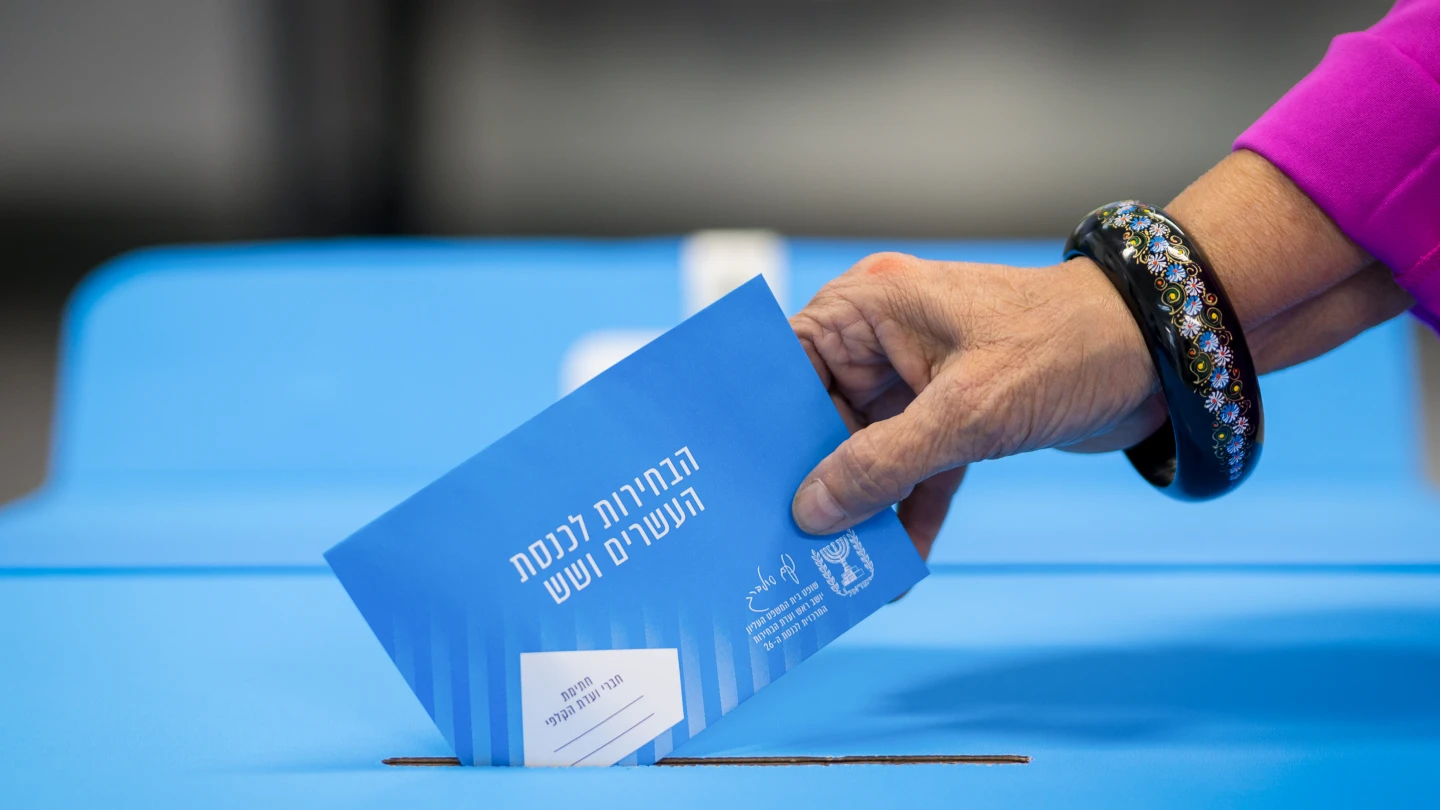
Residents of Gush Etzion in Judea braved long lines under cloudy skies, with rain expected later in the day, as they headed to the polls Tuesday morning to cast their ballots in Israel’s Knesset election.
The Gush Etzion Regional Council told JNS that voting would take place at 15 physical locations, excluding Efrat, which has its own municipality. Separately, JNS’s own tally of polling stations across Judea and Samaria identified a total of 29 ballot boxes in Gush Etzion.
Data suggests that there are a total of 522 ballot boxes across Judea and Samaria, often with more than one box at a voting site.
The only campaign signage, party paraphernalia and volunteers observed at the various Gush Etzion polling stations were associated with Prime Minister Benjamin Netanyahu’s Likud, Finance Minister Bezalel Smotrich’s Religious Zionist Party and National Security Minister Itamar Ben-Gvir’s Otzma Yehudit.

Elazar resident David Schultz, who had just voted alongside his son, an IDF reservist whose name is being withheld, told JNS that he cast his ballot for Smotrich’s party. His son was wounded in the early days of the war but returned to combat and has served more than 400 days in reserve duty over the past two to three years.
Schultz said he chose Smotrich because, as someone who commutes daily to Beersheva along Route 60, the biblical highway, he sees firsthand the minister’s accomplishments in advancing Jewish life in Judea and Samaria, including the establishment of many new communities over the past several years.
“I wanted a party on the right, and we need a party that will implement its policies and get the job done,” Schultz said, citing the Religious Zionist Party’s track record.
He added that drafting haredi (ultra-Orthodox) men into the IDF is an important issue for him, and that he believes only a right-wing government can implement a solution.
“I think they’re also trying to do it gradually and eventually get there. I don’t see the other parties, certainly not the other side, the left, doing a better job of it—or enlisting even a single haredi man,” Schultz said.
A few miles away, in Neve Daniel, Meira Yammer, who was waiting in line to vote, told JNS that she planned to cast her ballot for Ofer Winter’s Amcha Yisrael (“People of Israel”) party, describing herself as a proud right-winger.
Yammer said she could not in good conscience vote for any of the parties represented in the current governing coalition, arguing that they had enabled the ultra-Orthodox parties and their opposition to drafting haredi men into the IDF.
“We really need more soldiers,” she said.
Asked whether she was concerned that Winter’s party might fail to pass the 3.25% electoral threshold, Yammer said, “No, because I vote according to my conscience, not based on polls, which are often inaccurate.”
Ultimately, Yammer expressed pessimism that any of the leading candidates would be able to form a government once the votes are tallied.
“The best option, I feel, would be a national unity government. It would bring the country together,” she said.
500 days’ reserve duty
At another polling station in Gush Etzion, in the nearby community of Alon Shvut, IDF reservist Zev Wiesenthal had just cast his ballot. Originally from Toronto, he made aliyah and spent seven years studying at a yeshivah in Alon Shvut.
Wiesenthal, who has served more than 500 days in IDF reserve duty during the current war, said military service was the most pressing issue for him in this election, leading him to vote for former Prime Minister Naftali Bennett’s B’Yachad (“Together”) party.
Wiesenthal said his education and career had been “completely torpedoed” by his extensive reserve service, but that failing to report for duty would have gone entirely against his values.
“I felt that Naftali Bennett gave me the most hope of passing a draft law that would significantly increase the number of people required to enlist in the IDF,” he said.
Asked whether he was concerned that Bennett might again bring an anti-Zionist Arab party into a governing coalition, as he did with Mansour Abbas’s Ra’am party in the 2021 Lapid-Bennett government, Wiesenthal said he was not, arguing that Israel is in a very different place today.
“I don’t think anyone thinks that between now and the last election, when he was prime minister, the country is in any way the same place,” he said.
Wiesenthal added that even if Bennett were to engage with Abbas again, he did not expect Ra’am to join his coalition. He said outside support for a minority government was a more plausible scenario, but added that he considered that unlikely as well.
“I don’t think we’re heading toward a minority government,” he said.

Amihud Glaser, a sabra who has lived in Alon Shvut for 26 years, was volunteering at the Religious Zionist Party stand, handing out stickers and candy to voters. He explained to JNS why he supports Smotrich’s party.
He praised the minister for establishing over a hundred communities throughout Judea and Samaria, saying his accomplishments were unprecedented in the past 50 years.
“Even Prime Minister Ariel Sharon said he would build in Judea and Samaria, but nobody managed to establish as many settlements as Smotrich. The last three years have been amazing,” Glaser said.
Glaser also credited Smotrich’s work as finance minister, describing Israel’s current financial situation as remarkable.
“Our standing in the OECD and the strength of our currency—who would have believed this would be our situation in the middle of a war?” he asked.