



When I visited Thailand recently, I couldn’t help but notice the abundance of water. The island was lush and green. Palm trees and tropical plants seemed to grow effortlessly, with no visible irrigation systems feeding them.
Living in Israel, I have become accustomed to a different landscape. Here, drip irrigation lines snake across parks, shopping centers, train stations and private gardens. This Israeli innovation has helped transform a dry country into a thriving agricultural success story, fulfilling founding father and first prime minister David Ben-Gurion’s vision of making the desert bloom.
Yet despite our achievements, Israel remains a desert.
Nothing grows here automatically. Every tree, every vineyard, every field requires effort, planning, and often, a carefully managed water system. We in Israel understand that if we do not plant, cultivate and nurture the land, little will flourish on its own.
In Thailand, the greenery fades into the background. It becomes scenery. It doesn’t need man’s effort to thrive naturally and become abundant. Here in Israel, we know what it takes to make things grow.
But there is a part of our landscape that often goes unnoticed—not only by visitors, but by many Israelis themselves.
It’s not the irrigation systems. It is the shepherds.
More specifically, our Jewish shepherds.
For many Jews around the world, the image of a Jewish shepherd belongs to the Bible. Shepherds are Abraham, Moses and David. They are figures from ancient history, not people one expects to encounter in modern life.
Today, roughly half of the world’s Jewish population lives outside Israel, with millions residing in North America. For many of them, the idea of a Jewish shepherd is almost unimaginable. It doesn’t fit the desired image of a contemporary Jew, shaped by the university, leading a professional career and living in an urban community.
Even many Israelis follow this paradigm, and they live in the same geographic region as these shepherds! But geography means little if you stay in your own comfort zone.
When I lived in Tel Aviv, I never ventured beyond the city. Everything seemed to be there: work, culture, entertainment, opportunity. Jerusalem felt distant. Judea and Samaria seemed completely foreign. That place, which I wrongly called “the West Bank,” felt disconnected from me and my life.
Had someone told me then about young Jewish shepherds tending flocks across the hills of Judea, I would not have believed them. I would have dismissed it as romantic mythology.
Yet for the past 20 years, I have lived in Judea and have come to know these shepherds personally. I have watched them grow from children into young adults. I know their families. I am part of their community.
They are not relics of the past. They are part of Israel’s present. And, I believe, a crucial part of its future.
Throughout Jewish history, shepherding was more than an occupation. Abraham was a shepherd. Moses was a shepherd. King David tended sheep before he became king. The role required patience, responsibility, endurance and leadership. It demanded a deep connection to both people and land.
That tradition has not disappeared.
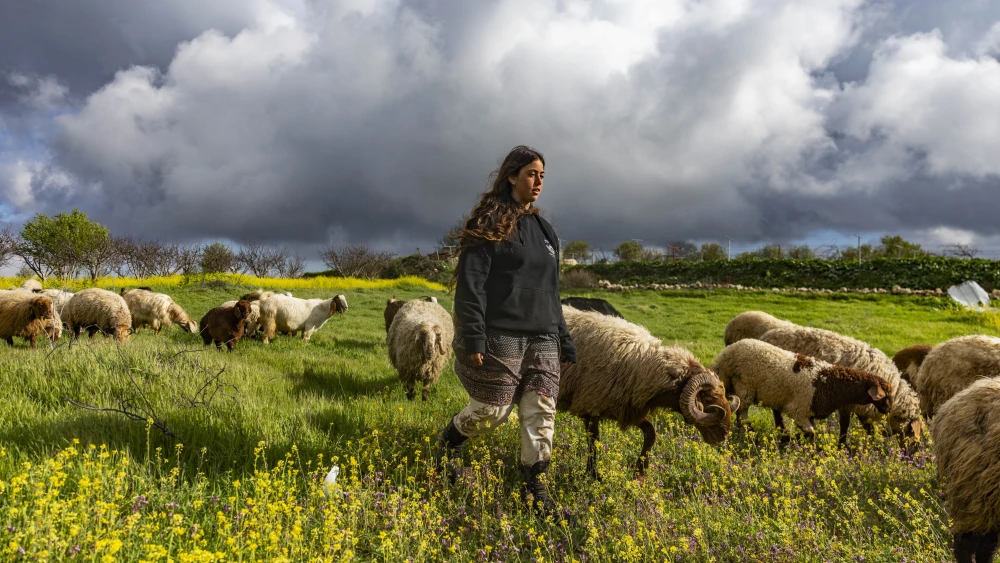
Across the hills of Judea and the Jordan Valley, young Jewish shepherds still rise before dawn. They spend long days outdoors in conditions most people would find difficult. Their work is physically demanding, often isolated and largely invisible to the wider public.
Yet their presence shapes the landscape.
Recent years have also brought increasing challenges. According to the 2025 annual summary of the Hatzalah Judea and Samaria Emergency Hotline, dozens of shepherds were injured in violent incidents while tending their flocks. The report recorded 119 casualties resulting from attacks on shepherds and Jewish farms, including 74 shepherds themselves.
The Jewish shepherds of Judea are not creating something new. They are restoring something very old.
Whatever one’s political views, these numbers highlight a reality unfamiliar to most Israelis and virtually unknown to many Jews abroad. And the shepherds continue their work, despite the risks.
I was reminded of how foreign this world can seem during a conversation at a recent event in Jerusalem. It was already late in the evening when I mentioned that I needed to leave early because I wake up at 5 a.m.
The woman sitting across from me looked surprised.
“What are you,” she asked, “some kind of farmer?”
There was a note of disbelief in her voice.
I explained that while I am not a farmer myself, many of my neighbors are. I told her that I lived in Judea.
“Don’t you miss the city?” she asked.
I told her that I never really lived in one.
Then I said something that seemed to puzzle her even more: “Historically, Jews were farmers and shepherds. We belong to these hills.”
She disagreed.
“We belong in cities,” she said. “Let other people do the farming.”
The exchange stayed with me.
For centuries, exile shaped Jewish life. Most Jews lived in cities because they had little choice. Agricultural life in the land of Israel became a distant memory, preserved in prayers and texts but largely absent from everyday experience.
For generations, Jews were conditioned to believe that our role was to survive on someone else’s land, rather than cultivate our own. Exile taught us how to flourish in foreign capitals, how to build communities in other people’s countries and how to adapt to circumstances beyond our control. We became merchants, professionals, scholars and city dwellers because history often left us no alternative. We weren’t allowed to work the land.
But eventually, reality asserts itself.
A people whose foundational history is rooted in shepherds and harvests cannot permanently forget who they are. A nation that prayed for 2,000 years to return to its homeland cannot forever believe that its destiny lies elsewhere. We know this land is ours not merely because we fought for it, died for it and rebuilt it, but because our history, faith and civilization grew from it.
The Jewish shepherds of Judea are not creating something new. They are restoring something very old.
And they may not attract much attention. They don’t pose for magazine covers or give interviews on podcasts. Most Israelis never meet them. But they are here.
Like the drip irrigation lines that quietly sustain the country’s greenery, they often go unnoticed. Yet without them, the landscape would look very different.



