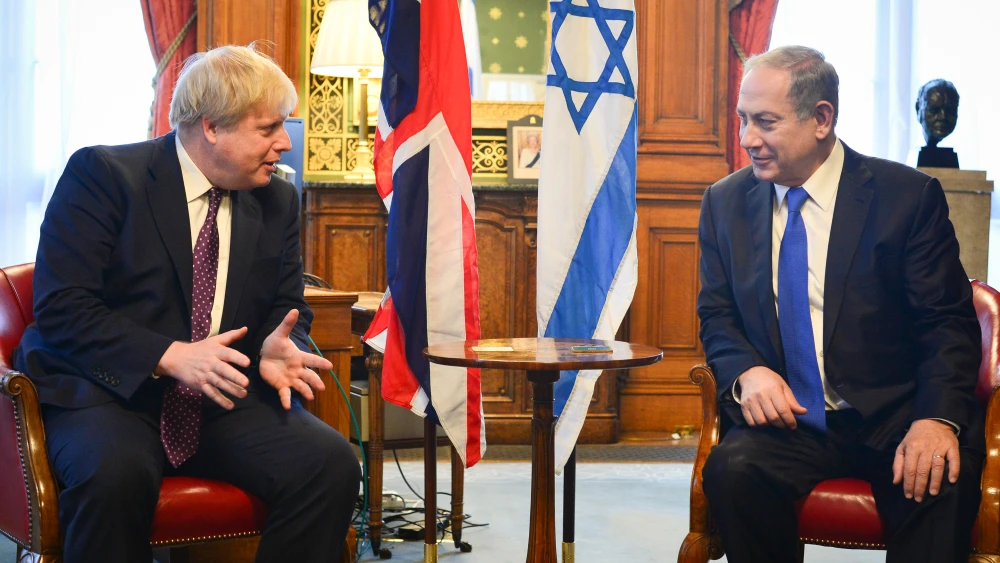
The announcement that Boris Johnson was named Britain’s prime minister on Tuesday brought smiles to many faces in Jerusalem.
Israel may have lost a friend in the form of his predecessor, Theresa May, but it has won an even greater friend in Johnson, whose appointment was hailed as good news for both Israel and British Jews, who now have reason to believe their premier will fight British Labour Party leader Jeremy Corbyn and the anti-Semitism that has ruined his party.
Much has been said in the past 24 hours about Johnson’s brief time as a volunteer at Kibbutz Kfar Hanassi in northern Israel, but I met him quite early in his political career, when he was just a fledgling MP. He visited Israel and I, then the director general of the Foreign Ministry, was his host.
One of the issues that preoccupied him at the time was the Iranian threat to Israel and the world—years before it became a main issue for the West. It was clear even then that for Johnson, the backbenches of parliament would not suffice. He was going all the way.
Our paths crossed again when he was elected mayor of London in 2008, when I served as Israel’s ambassador to the British capital. His commitment to the protection of London’s Jewish community was clear from the get-go, especially vis-à-vis the rise of radical elements in the kingdom.
It would be an understatement to say he cannot look forward to a soft landing at 10 Downing Street—he won’t even have 100 minutes of grace, let alone 100 days. Immediately after his meeting with Queen Elizabeth—as dictated by British protocol—he will have to form a government and prepare for a no-confidence vote that Labour plans to submit this week, before parliament breaks for its summer recess.
Along with domestic affairs, the real problems are waiting beyond Britain’s borders.
He will have to immediately apply his knowledge of the Iranian issue and demonstrate a determination to resolve the tanker crisis in the Persian Gulf.
But the biggest problem he has to deal with has been hovering over Britain and Europe for three years now: Brexit.
Johnson lobbied hard for Britain to divorce from the European Union, but he hoped he could avoid the grime of actually making it happen. Now the responsibility is entirely on his shoulders. Although he declared that Britain would exit the E.U. regardless of a deal, he knew full well that this would be the worst option for the U.K. This is why he will try to charm the heads of European countries into making concessions that he can tout to the British public as achievements.
Brexit has so far proven lethal to the careers of two Conservative prime ministers, May and her predecessor, David Cameron. Johnson may find himself facing elections again before the year’s end so as to win the trust of the British public. Hopefully, he won’t be moving out of 10 Downing St. as swiftly as he moved in.
Ron Prosor is the head of the Abba Eban Institute of International Diplomacy at the Interdisciplinary Center Herzliya and a former Israeli ambassador to the United Nations.
This article first appeared in Israel Hayom.