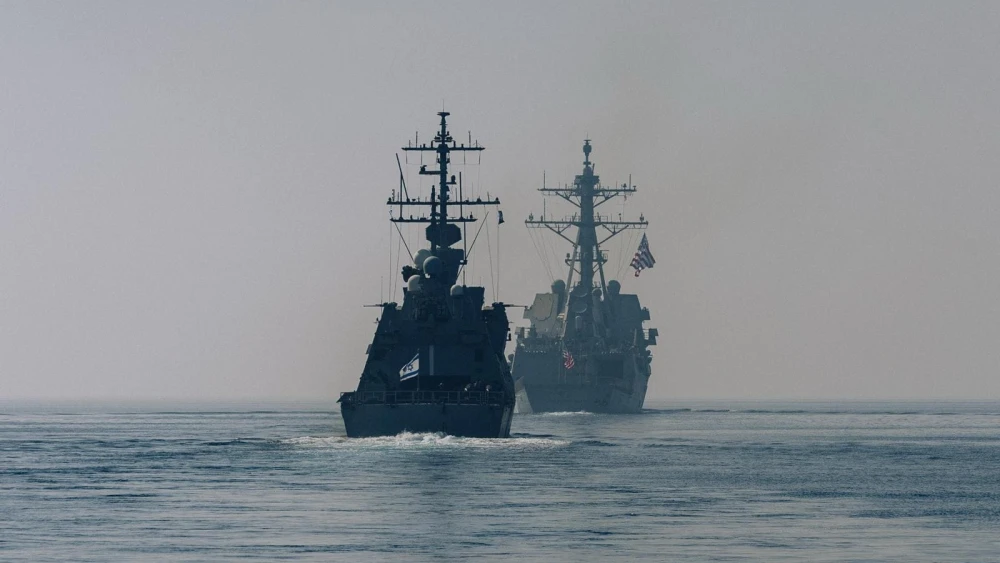

Yemen’s Houthi movement declared a total ban on Israeli maritime navigation in the Red Sea on June 8, warning that enemy movements would be considered legitimate military targets from the moment of the statement’s publication. The declaration was reported as a secondary story to the resumed U.S. strikes on Iran and the Islamic Revolutionary Guard Corps’ formal closure of the Strait of Hormuz.
That framing is wrong. The Houthi announcement and the Hormuz closure are not two separate crises; they are the closing of two jaws of the same vice.
Since Iran throttled the Strait to near-closure following the April 8 ceasefire with the United States and Israel, Saudi Arabia has been routing a significant portion of its oil exports through the Red Sea’s Yanbu port to bypass the Gulf entirely, as the Hormuz crisis has forced key Middle Eastern exporters to find alternative routes to global markets.
Yanbu is the western terminus of the Trans-Arabian Pipeline, which traverses the Arabian Peninsula and allows Saudi crude to reach European and Asian markets without entering the Gulf. For four months, this bypass has been the global energy market’s safety valve. The Houthis’ declaration earlier this month targets that valve directly.
The Bab el-Mandeb, just 26 kilometers wide at its narrowest point, connects the Red Sea to the Gulf of Aden and the wider Indian Ocean, with roughly 12% of global maritime trade passing through it. The Strait of Hormuz carries approximately one-fifth of the world’s seaborne oil and gas. These corridors do not significantly overlap in what they carry or which markets they serve.
Closing both simultaneously cuts off Persian Gulf oil from Europe and Asia via the shortest routes, forces exporters into the vastly longer Cape of Good Hope detour and eliminates the workaround global markets have been using to absorb the Hormuz disruption for months.
Red Sea crossings had already fallen to 1,034 per month, as of March—down from more than 2,000 before the prior campaign.
Major carriers, including Hapag-Lloyd, suspended future Trans-Suez sailings immediately after the announcement by the Houthis. That reaction does not yet reflect an active interdiction campaign; it reflects the announcement alone. If the Houthis move from declaration to action, the pricing and logistical implications of a dual-chokepoint closure are substantially larger than the 4.5% WTI (West Texas Intermediate) crude-oil spike that followed the June 8 statement.
This is not a coincidence. The strategic logic connecting the Hormuz throttle and the Houthis’ declaration is the same logic that has governed Iran’s axis of proxies since Oct. 7: sequential escalation designed to maximize cumulative pressure while minimizing any single flashpoint large enough to trigger a decisive American response.
The Houthis, who nominally joined the Iran war in March, had not announced a missile attack on Israel since the April ceasefire, though warned repeatedly that they would resume if the Iran war escalated. They used that pause to reconstitute. They have resumed at exactly the moment their leverage is maximized, when the Strait of Hormuz is already near-closed, and the Red Sea bypass is the only functioning alternative.
The Houthis’ trench networks around Hodeidah, coastal missile positioning and institutional preparation fit within a broader pattern: the institutionalization of a long-term defensive and deterrent posture along Yemen’s western coastline, combined with the capacity to project maritime force into the Red Sea on demand.
This is not a reactive organization responding to Israeli or American escalation. It is a standing maritime siege capability that was maintained through the pause period and activated the moment the strategic environment made activation optimal.
The policy failure that produced this moment is cumulative.
“Operation Prosperity Guardian,” launched in December 2023, failed to suppress the prior campaign because its rules of engagement did not authorize strikes on Houthi anti-ship launching infrastructure at the scale necessary to degrade the threat. Subsequent American strikes on Yemen in early 2025 damaged Houthi capabilities without dismantling their inventory. The October 2025 pause was attributed to the Gaza ceasefire and treated as a political outcome rather than a military reconstitution window.
Washington should reconstitute “Operation Prosperity Guardian” with explicit authorization to strike Houthi coastal missile batteries, anti-ship drone launch networks and supporting logistics inside Yemen, without the engagement limitations that made the prior campaign insufficient. Conditioning any Yemen peace process on formal Houthi disarmament of anti-ship capability is the minimum threshold for a durable outcome.
The alternative is a synchronized maritime siege of the world’s two most critical energy chokepoints, managed by an axis whose strategic patience has repeatedly exceeded Washington’s willingness to impose costs.