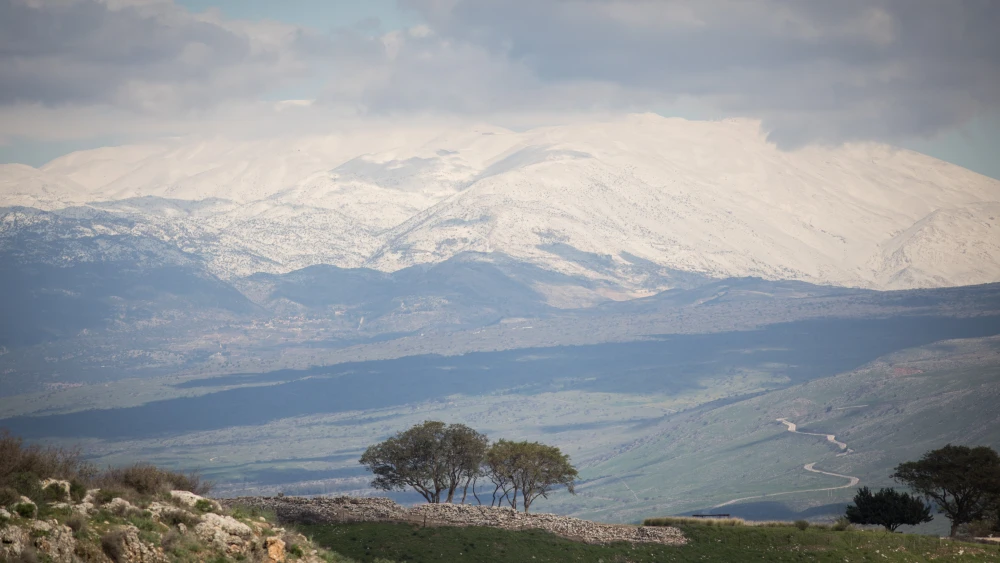
After its success in pushing Iranian forces away from the Israel-Syria border, Israel is stepping up its efforts against Hezbollah’s attempts to further entrench itself in the area.
Wednesday’s airstrike on Tal al-Hara, a strategic hill south of Damascus, was the third to be attributed to Israel by the foreign media. All of the strikes targeted Hezbollah assets, mainly observation posts the Shi’ite terrorist group is trying to form along the border. These posts are intended to help Hezbollah and its Iranian and perhaps Syrian patrons gather intelligence and, in the future, to serve as potential platforms for terrorist activity.
Hezbollah’s efforts in the sector have had their ups and downs. Under the cover of the war in Syria, the Shi’ite terrorist group tried to set up an extensive terrorist grid in the area, but the elimination of two of its leaders, Samir Kuntar and Jihad Mughniyeh, also attributed to Israel, slowed it down considerably.
The end of the Syrian war, and especially the pause placed on Iranian militias’ efforts to establish themselves in the Golan Heights, brought Hezbollah back into the picture. The organization’s activities in the Golan are encouraged and financed by Iran and have the tacit consent of the Syrian regime.
The Israeli daily Israel Hayom has revealed in the past that the organization’s senior commander in the Golan Heights is Munir Ali Naim Shaito, known as Haj Hashem, a veteran of the organization and a key player in Hezbollah’s assistance to the Syrian army during the civil war. Subsequently, the Israel Defense Forces also exposed details on Hezbollah’s secret plan to establish terrorist infrastructure in the Golan using Syrian civilians, mainly Druze.
While these revelations were meant to put pressure on Hezbollah, the terrorist organization has thus far proven resistant, which is presumably why the IDF has resumed its countermeasures against Hezbollah’s plans for the Syrian Golan.
Thus far, these have been low-profile operations as both Israel and Hezbollah wish to avoid triggering a broader escalation. However, past experience shows that everyone is literally playing with fire, as anything can provoke a flare-up or an attack by Hezbollah on Israeli troops.
Israel has no interest in an escalation, but will not relent regarding its principle of not allowing radical forces to establish themselves south of Damascus.
For the time being, the IDF has the upper hand, but given Iran’s determination to continue operating in the region, the struggle in the Golan appears to be in its infancy.
This article first appeared in Israel Hayom.