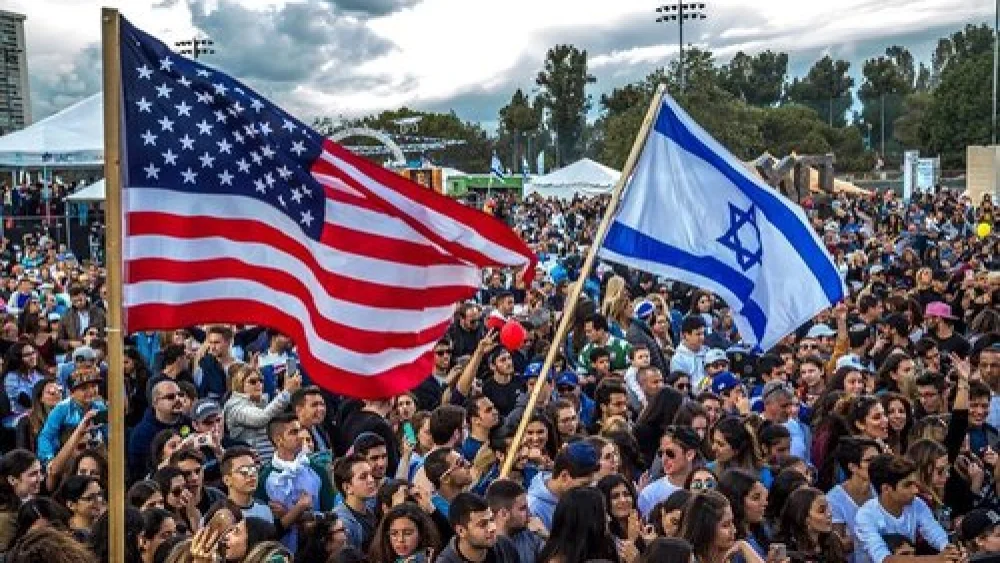
The political and social-religious divide between Israeli and American Jews has widened considerably, according to a poll published by the American Jewish Committee.
Just 46 percent of American Jews supported U.S. President Donald Trump’s relocation of the U.S. embassy in Israel from Tel Aviv to Jerusalem, while 47 percent opposed the move. Within Israel, an overwhelming 85 percent of Israeli Jews supported the embassy’s move to Jerusalem, while only 7 percent disapproved.
Israeli Jews have a favorable view of Trump, with 77 percent approving of his handling of U.S.-Israel relations and only 10 percent disapproving. By contrast, within the United States, 57 percent of American Jews approve of his handling of U.S.-Israel relations and 34 percent disapproving.
Overall, 71 percent of American Jews disapprove of Trump, while only 26 percent have a positive opinion of the president. The figure is has improved since the last poll, in which 77 percent disapproved and 21 percent approved of him.
With regards to settlements in Israel, 54 percent of Israelis said that no Jewish communities in Judea and Samaria should be dismantled to make way for a new Palestinian state, whereas only 35 percent of American Jews said the same. Thirty-five percent of Israelis said that some communities should be razed, whereas 44 percent of American Jews agreed. Only 4 percent of Israeli Jews said all Jewish communities in Judea and Samaria should be dismantled, whereas a more substantial 15 percent of American Jews agreed.
On the contentious social-religious issue of weddings in Israel, 80 percent of American Jews said a non-Orthodox rabbi should be able to officiate at weddings, whereas within Israel, only 49 percent shared that view. Similarly, 81 percent of American Jews expressed support for civil marriage in Israel, whereas just 55 percent of Israelis support civil marriage.
On the issue of brotherhood between the world’s two largest Jewish communities, only 12 percent of American Jews considered Israeli Jews to be their “siblings.” A slightly higher 28 percent of Israeli Jews considered American Jews their “siblings.”