Newsletter
Newsletter Support JNS

White House: Netanyahu to be first Middle East leader Biden will call

“Israel is a country where we have an important strategic security relationship, and our team is fully engaged—not at the head-of-state level yet but very soon,” said White House press secretary Jen Psaki.

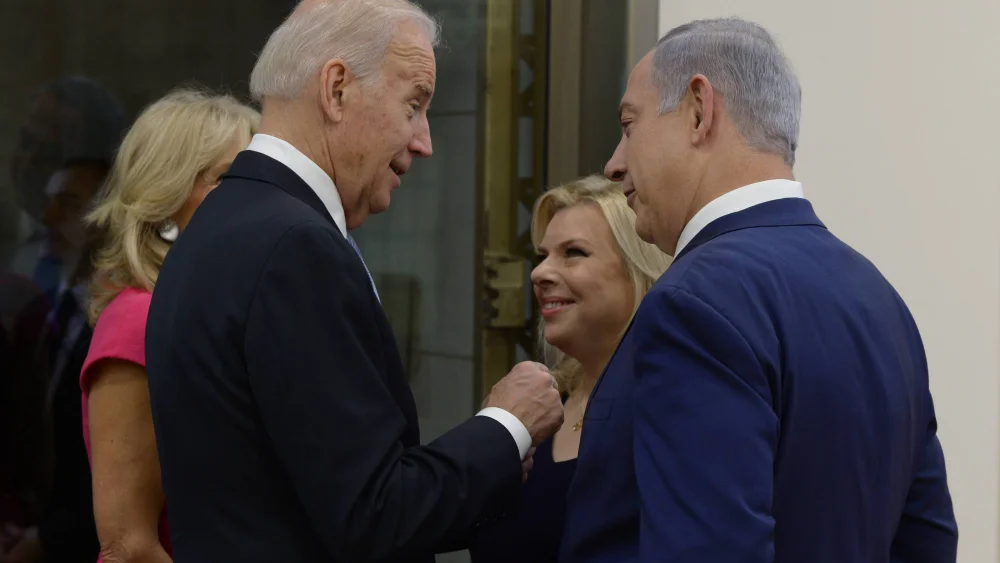
Israeli Prime Minister Benjamin Netanyahu and his wife, Sara, meet with then-U.S. Vice President Joe Biden and his wife, Jill, at the Prime Minister's Office in Jerusalem, on March 9, 2016, during Biden's official visit to Israel and the Palestinian Authority. Photo by Amos Ben Gershom/GPO.
Israeli Prime Minister Benjamin Netanyahu and his wife, Sara, meet with then-U.S. Vice President Joe Biden and his wife, Jill, at the Prime Minister’s Office in Jerusalem, on March 9, 2016, during Biden’s official visit to Israel and the Palestinian Authority. Photo by Amos Ben Gershom/GPO.

Israeli Prime Minister Benjamin Netanyahu will be the first Middle East leader President Joe Biden will call, the White House said on Tuesday.

“His first call with a leader in the region will be with Prime Minister Netanyahu,” White House press secretary Jen Psaki told reporters, adding that she did not have an exact timeline for the call, but that “it will be soon.”

The comments by Psaki come amid mounting speculation, especially by Israeli pundits, on the delay in calling the Israeli leader by Biden, who took office nearly a month ago.

The president has spoken with a number of close U.S. allies, including leaders in Canada, Britain, France, Japan, Mexico, Germany, South Korea, and even some foes, such as China’s Xi Jinping and Russia’s Vladimir Putin. He has not yet spoken with a Mideast leader.

“Israel is, of course, an ally,” Psaki said. “Israel is a country where we have an important strategic security relationship, and our team is fully engaged—not at the head-of-state level quite yet but very soon.”

For his part, Netanyahu has downplayed the fact that he has not received a personal call from Biden.

The president is “making calls to world leaders according to the order he sees fit,” Netanyahu said last week. “The Israel-U.S. alliance is strong and so is our friendship of almost 40 years, though we may not agree on everything.”

Last week, former Israeli ambassador to the United Nations Danny Danon, who now serves as chairman of World Likud, made a much blunter remark on the situation via tweet: “Might it now be time to call the leader of Israel, the closest ally of the U.S.?”

“This amendment is an existential threat to American sovereignty and democracy,” Rep. Alexandria Ocasio-Cortez wrote.
A filing with France’s highest administrative court asked for an order to “prevent trade or investment relations that assist in the maintenance” of a Jewish presence in eastern Jerusalem and Judea and Samaria.
Chris Wright, U.S. energy secretary, stated that the deal upholds the “highest standards of nuclear safety and nonproliferation.”
“She will carry the fight forward and stand unwaveringly with the American Jewish community and strengthen the US-Israel relationship,” Sam Markstein told JNS.
The agreement “should be the standard every school holds itself to before, not after, a student gets hurt,” Kenneth L. Marcus of the Brandeis Center said.
“Tisha B’Av historically has been a day of tragedy for the Jewish people,” Moshe Spern, president of the organization, told JNS. “I’m nervous that the community will face threats specifically on this day.