Over the last two and a half years, life in Israel has been defined by sirens, hostage crises, global isolation and prolonged regional conflicts. And despite this bleak reality, Israel has consistently ranked among the top 10 happiest countries in the world. Just this week, nearly a month into “Operation Roaring Lion,” Israel placed eighth in the 2026 World Happiness Report.
On the surface, this appears almost implausible. How can a society under prolonged and sustained existential threats—and now facing yet again another protracted confrontation with Iran—report such a high level of satisfaction and well-being?
Perhaps beneath the headlines lies a deeper, more enduring truth about the fabric of Israeli society. Happiness here is not the absence of hardship. It is the presence of purpose.
Across the country, from dense urban centers to quieter peripheral areas, a quiet yet powerful force shapes daily life in Israel. This is not found in government agendas or economic indicators alone. This goes to the very core of its “ordinary” citizens who, at a moment’s notice, become extraordinary.
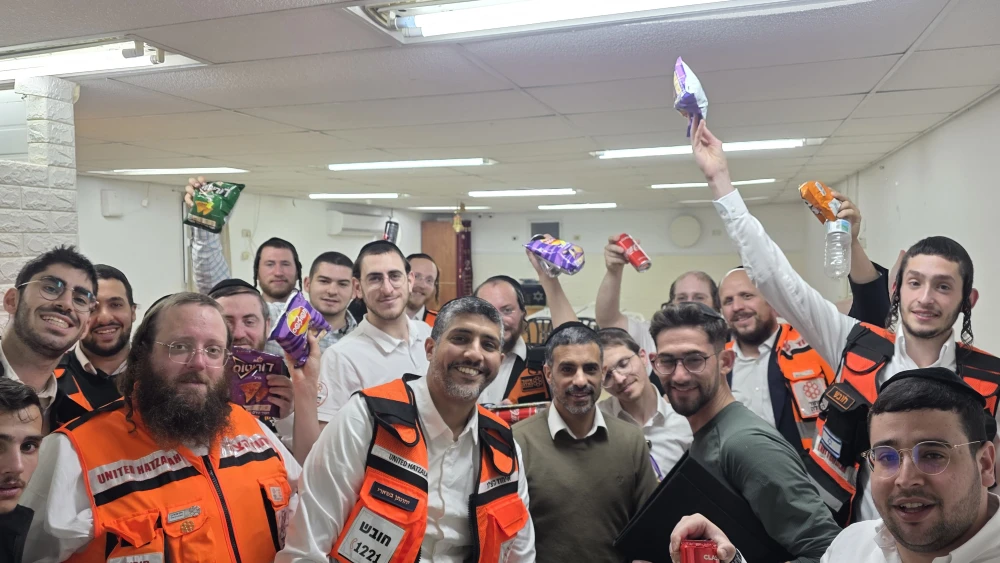
United Hatzalah, with its network of more than 8,100 volunteer medics, paramedics, physicians and mental-health first responders, offers perhaps the clearest expression of this phenomenon. These are individuals who interrupt normalcy at its very definition. Whether during bedtime routines, family dinners, date nights or workplace interactions, these volunteers drop everything mid-task or while sleeping to respond to strangers in distress. They do so without hesitation and without expectation of reward.
This is not merely a system of emergency response. It is a reflection of a society built on mutual responsibility.
There is a tendency to assume that people give when they have excess. That generosity is a byproduct of comfort. In Israel, the opposite often proves true. It is precisely in moments of collective strain that the instinct to give becomes most visible and most profound. At the heart of this dynamic lies a distinctly Jewish ethos. The religious teaching of being content with one’s portion is not a passive acceptance of circumstance but an active attitude toward life. It allows individuals to recognize the true value of even the most mundane routine amid difficulty, and recognize an even superhuman propensity to give back to society.
Volunteerism, in this sense, is not separate from happiness. It becomes one of its primary engines.
Few stories capture this more powerfully than that of Ronit Elimelech. A single mother raising children with special needs, her life was marked by challenges that might have justified retreat. Instead, she chose engagement.
At her son’s encouragement, she joined United Hatzalah and committed herself fully to the demanding path of emergency medical response. Over time, she became known as one of the most active and recognized volunteers in the Beit Shemesh area where she lived. Her life was not defined by what she lacked but by what she had to give.
On the second day of “Operation Roaring Lion,” Ronit was killed together with her mother, Sarah, and eight other people during a missile attack. Her loss was deeply felt not only because of the life that was taken but because of the life that she chose to lead.
This story is not an exception. It is emblematic.
In Israel today, happiness is not measured solely by personal comfort or material stability. It is found in the knowledge that one is part of something larger. That in a moment of crisis, help will come, often within seconds, not from institutions alone but from neighbors, from volunteers, from people who have chosen to care.
This collective resilience creates a feedback loop. The act of giving reinforces a sense of purpose. That sense of purpose fosters emotional strength. And that strength, in turn, sustains a society even under the most trying conditions.
It is a model that challenges conventional definitions of well-being. Israel’s ranking as the eighth-happiest nation in the world, then, is not a contradiction of reality. It is evidence of a different kind of reality. One in which joy is not about the absence of fear but the presence of meaning. One in which resilience is built not only through defense but through compassion. And one in which, even in the midst of war, a society continues to choose life, responsibility and the quiet, enduring work of caring for one another.
The author is the international spokesperson for United Hatzalah. He previously served as the director of international media at Yad Vashem.