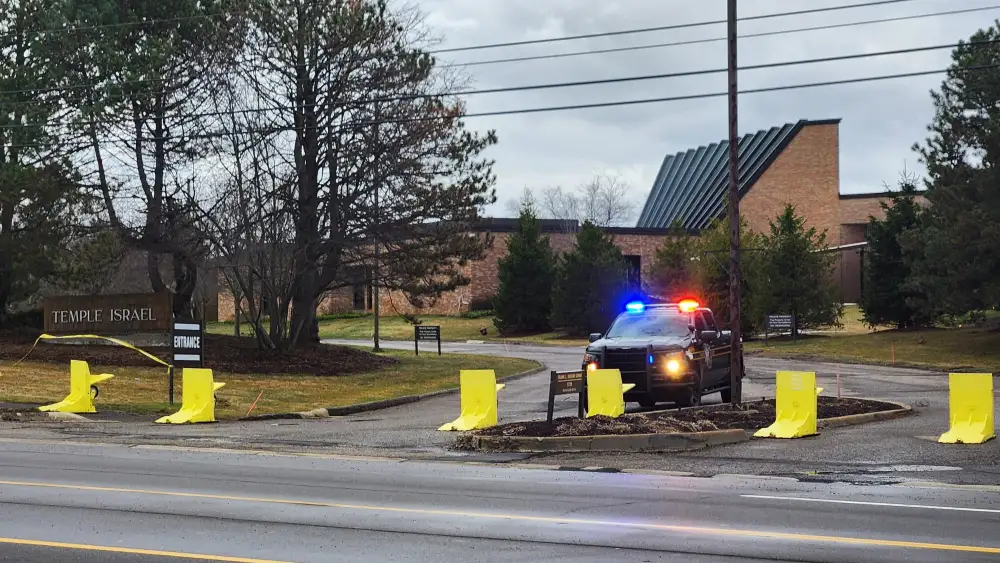
An Islamist terrorist rammed a truck filled with fireworks and chemicals into a Michigan synagogue’s main entrance before exchanging gunfire with security. Armed guards at Temple Israel stopped the attacker from reaching his target: More than 100 toddlers and children who were inside the synagogue’s Early Childhood Center. He killed himself after becoming trapped in the burning vehicle. The attack was designed to cause maximum casualties.
The attempted massacre reveals a harsh reality. Jewish houses of worship increasingly resemble secure facilities more like Fort Knox than places of prayer. Extremists are seizing on global conflicts thousands of miles away to justify attacks on local Jewish communities, a reality that few other religious institutions face. These threats are not theoretical; they are already translating into violence.
No justification for attacking children
There can be no justification—explicit or implied—for targeting a house of worship, especially one filled with children.
Lebanon-born U.S. citizen Ayman Muhammad Ghazali intentionally drove dozens of miles from his home in Dearborn Heights, Mich., past other synagogues before targeting Temple Israel’s Early Childhood Center. The synagogue, located in the Detroit suburb of West Bloomfield, is one of the largest Reform synagogues in the United States, serving 3,500 families. The attacker did not distinguish between political views, party affiliation or levels of observance. He specifically targeted Jews.
Michigan Gov. Gretchen Whitmer condemned the attack as “hate, plain and simple.”
Two of the attacker’s brothers were members of the Iranian-backed terror group Hezbollah, which operates freely in Lebanon. Ghazali was a commander responsible for launching hundreds of rockets at Israeli civilians. The Israel Defense Forces killed the two brothers in a recent military operation. Hezbollah has recently fired hundreds of rockets at northern Israel at Iran’s request since it supplies most of Hezbollah’s funding.
Some media coverage focused on the attacker’s personal grievances or background. The New York Times referred to the terrorist as a “quiet restaurant worker.” NPR wrote a story on the “grief and fear in a small Lebanese town following the synagogue attack.” A CNN headline claimed that “a truck rammed a Michigan synagogue,” as if the vehicle had acted on its own. Any framing that shifts the focus onto the attacker’s personality obscures the reality of the crime and diminishes the severity of what was intended.
Security saves lives
Clergy and staff at a house of worship should not need FBI active-shooter training, yet that is the reality Jewish communities face around the world today. Many Jewish communities intensified their security efforts after a lone gunman murdered 11 Jewish worshippers at Pittsburgh’s Tree of Life Synagogue in 2018, the deadliest attack on Jews in American history.
In an Instagram post on Jan. 29, Temple Israel thanked “the FBI for joining our security director, Danny Phillips, in leading an active shooter prevention and preparedness training for its clergy and staff.” Phillips was the only person injured in the attack. Temple Israel Rabbi Jennifer Kaluzny called it a “terrifying experience and also a miracle” because trained staff followed security protocols.
Oakland County Sheriff Michael Bouchard praised the response of the guards and police: “Everything that was supposed to happen, happened. Security did their job, and then the responders did theirs.”
After the terror attack, the synagogue thanked the police and the Shenandoah Country Club that “welcomed us, fed us and sheltered our staff, teachers, children and parents.” The Catholic organization is located across the road from the synagogue and was founded by the Chaldean Iraqi American Association of Michigan.
Michigan state representative Samantha Steckloff praised their assistance: “Thank you to our Chaldean brothers and sisters for such a warm welcoming, and all your love and support.”
Financial and emotional costs of safety measures
The financial cost, along with the emotional toll, of providing 24/7 protection is enormous. As the Jewish Federations of North America recently emphasized, “$765 million in spending on security for Jewish communities means fewer resources for education, camps and essential programs that cannot be covered by philanthropy alone.” The federal government’s Nonprofit Security Grant Program and state grants provide critical funding to help religious institutions of all faiths improve security. Jewish groups renewed their call for increased federal funding following the truck-ramming attack.
The Conference of Presidents of Major American Jewish Organizations declared that “an attack on a synagogue is an assault on the fundamental right to religious freedom and on the ability of Jews to practice their faith openly and securely.” Its statement echoed the words of U.S. President George Washington’s 1790 letter to the Hebrew Congregation in Newport, R.I., that the “U.S. government would give to bigotry no sanction, to persecution no assistance.”
Worldwide attacks are proliferating
The Michigan terror attack reflects a broader global trend of recent assaults, including:
- Australia: ISIS-affiliated father-and-son terrorists, who murdered 15 people at a “Chanukah by the Sea” event on Bondi Beach
- Netherlands: A Jewish school that was bombed in Amsterdam as well as a synagogue in Rotterdam
- Norway: A shooting outside an Oslo synagogue
In France, two brothers were recently arrested for planning a “deadly antisemitic” attack while operating a drone inside a car that contained a gun, hydrochloric acid and an Islamic State flag. The young Moroccan-Italian adults “aspired to martyrdom,” with one brother having pledged allegiance to ISIS in a video. In Belgium and Greece, an Iranian-backed group claimed responsibility for attacks against Jewish targets.
Points to consider:
1. Blaming Jews for conflicts must be condemned.
The war in the Middle East is not about Jews in America, and it is never a justification for targeting them. Holding Jews responsible for events thousands of miles away is not political criticism; it is anti-Jewish hatred. Blaming Jews for global problems is a centuries-old form of hate and it must be rejected. The idea that the attempted mass murder of more than 100 children could be explained away is morally indefensible.
2. Jewish communities face extraordinary security threats.
Police protection, surveillance systems, controlled access and emergency training are not temporary precautions for Jewish communities but ongoing measures designed to prevent the mass murder of Jews. These measures, rarely seen at most other houses of worship, reflect the persistent threat environment facing Jewish communities. Donell Harvin, the former head of Homeland Security and Intelligence for D.C., noted the contrast: “I’ve worked a lot with houses of worship in DC, and every time I go to a synagogue I’m taken aback by how prepared they are, with armed security that is visible, sometimes law enforcement. This community has been under siege for quite a long time. They’re not new to this.”
3. Security preparedness prevented a larger tragedy in Michigan.
Security measures and emergency preparedness played a decisive role in limiting the impact of the Michigan synagogue attack. Armed guards and trained staff responded immediately when the attacker targeted Temple Israel’s early childhood center, where more than 100 young children were present. Preparedness training, security planning and rapid-response procedures helped prevent the attack from escalating. The incident illustrates how planning, training and physical security measures can mean the difference between a thwarted attack and a mass casualty event.
4. Federal and state security funding helps protect targeted communities.
Federal funds, such as the Nonprofit Security Grant Program, and state grants help religious institutions strengthen physical security and emergency preparedness. While these funds help, Jewish communities are still shouldering enormous security costs to maintain 24/7 protection. They have called for increased funding after recent attacks, stressing that the growing cost of protecting synagogues, schools and community centers places a heavy financial burden on many communities.
5. Violence against Jews is a global threat.
Extremists targeting Jewish schools, synagogues and community institutions across Europe show that antisemitic violence is not confined to any single country. These incidents show that Jewish communities often face similar security concerns, reinforcing the need for funding, vigilance and security to protect Jewish communities worldwide. When anti-Jewish hatred is normalized, someone attacks a preschool.