
Last week, I watched my daughter walk across a stage at Ferkauf Graduate School to receive her doctorate in psychology.
Ferkauf is part of Yeshiva University, and the ceremony reflected that. They sang the national anthem. Then they sang “Hatikvah,” the Israeli national anthem, the song of Jewish hope and return.
I did not expect to be as moved as I was.
Part of it was simple pride. I have been blessed with children and grandchildren, and each milestone still catches me off-guard. But this was something else. After everything that has happened on university campuses since Oct. 7, watching a room full of people rise for “Hatikvah” without disruption, without protest, without ugliness felt like a gift.
Many people cheered when it ended. I was one of them. I was not prepared for what I felt in that moment. Pride, yes. Joy, certainly. But also, something harder to name. A reminder of what Jewish life is supposed to feel like. Openly, proudly Jewish, proudly pro-Israel, without apology or fear.
I carried all of that with me a week later, when I stood at a family wedding watching a badeken.
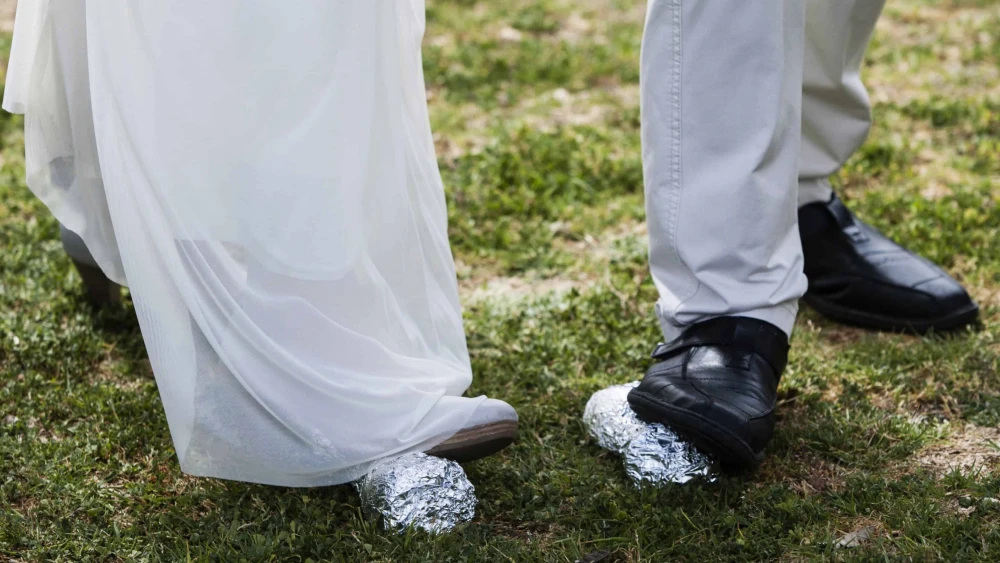
For those unfamiliar, the badeken is one of the most moving parts of a Jewish wedding ceremony. Before the celebration begins, the groom comes to see his bride and gently lowers a veil over her face. It is an ancient ritual with biblical roots—a moment of quiet holiness before all the joy and noise that follows. Families press close. There are often tears. Standing there, it was impossible not to feel the weight of it.
I was standing next to my aunt, one of my mother’s sisters-in-law, though that phrase does not begin to describe what they were to each other. She and my mother were as close as sisters. They did everything together. My mother passed away 23 years ago. And so, standing next to my aunt, I was grateful beyond words to be beside her. And I ached, quietly, for my mother.
The young woman being married was my first cousin’s daughter, the fourth generation of my mother’s family to build a beautiful life in this country.
That number stopped me.
My mother’s family fled Hungary in 1956 during the Hungarian Revolution. But their story of survival began long before that. During the Holocaust, my mother’s family had been loaded onto a deportation train headed to Auschwitz.
Miraculously, a bridge along the route exploded and the train was rerouted. They survived. After the war, they returned to Debrecen and continued their lives as best they could. Then, when the Hungarian Revolution came, they fled again and made their way to the United States.
They built families here. Large ones. My mother was one of 10 siblings. One was lost in Hungary. The rest settled in this incredible country and built lives that their parents could not have imagined. A first-generation planting roots. A second generation growing up American, of which I am one. A third generation, my own children, raising families of their own.
One of our daughters, who is getting married this summer, is part of that third generation of this large, sprawling Hungarian family. The bride at this wedding is part of the fourth generation. What struck me standing there is that these two young women are almost exactly the same age, and yet an entire generation apart. One generation does not sound like much until you understand what my family lived through to cross it.
Our daughter who is getting married this summer was born two weeks before my mother died.
My mother was weak by then, worn down by cancer. Cancer had taken so much from her by then. But she asked for her earrings. And her lipstick. She wanted to look beautiful for the baby.
She held her that day.
Two weeks later, my dear mother was gone.
Our youngest, now in high school, carries her name.
That image has stayed with me for 23 years. A woman summoning whatever she had left, putting on her earrings, waiting to hold and see a child who would never remember her but would somehow carry her forward anyway.
This summer, she is getting married.
I thought about all of that as we moved from the badeken to the chuppah, the wedding canopy, under which the couple would be married.
At the end of the ceremony, as has become common at Jewish weddings since the Hamas-led terrorist attacks in southern Israel on Oct. 7, the prayer for the Israel Defense Forces was recited. It is a practice that has quietly spread across Jewish communities since that terrible day, a way of holding those who defend the Jewish state of Israel close, even in moments of celebration.
When it was over, came the words Jews have carried for centuries, drawn from Psalm 137: “If I forget thee, O Jerusalem.” Just before the end of the ceremony, these ancient words remind us that even at the height of joy, Jerusalem and the Jewish people are never forgotten. We remember the destruction of the two holy Jewish Temples that once stood there, and we long for them still. Even in our happiest moments, we remember.
I had heard the prayer for those who defend the State of Israel at other weddings since Oct. 7, including at the weddings of three of my own children. I knew it was coming. But when it came, something in me gave way anyway. Standing there under the chuppah surrounded by four generations of family, I thought of the brave young men and women defending Israel at this very moment, putting their lives on the line to protect the Jewish people and the land they love. Pride, grief, longing, gratitude, all of it at once.
The same feeling that had caught me off-guard in that auditorium a week earlier, listening to “Hatikvah” rise from a room full of people who knew exactly who they were and took great pride in it.
That is what I kept thinking about as the evening unfolded, standing beside the last person in the room who had known my mother from when she was a young woman until the day she died.
Since Oct. 7, something shifted for many American Jews. Things that once felt settled no longer do. And yet.
There was a young woman standing under a veil, beginning her life.
There was a graduating class rising for “Hatikvah.”
There is a daughter of mine getting married this summer, carrying forward a life my mother started but did not live to see completed.
There are brave young men and women in uniform, defending a people and a country that the Jewish people deserve. A country I love.
Families still press close at the badeken. Older generations still watch younger ones with that particular expression, protective and proud, and a little heartbroken at how fast it all moves. They carry with them everything that the Jewish people have lost, and everything that has been built in its place. And they dream, as I do, of everything that is still to come.
Nobody at that wedding gave speeches about Jewish continuity. Nobody needed to. It was simply there, in the room, in every face.
Jewish life is not only built around surviving difficult periods. It is built around refusing to stop living during them. Around celebrating anyway. Not because the world is safe or simple; it is not. But because joy in the face of hardship is itself an act of faith. It is what has always carried us forward.
There is humor in Jewish families. Noise. Argument. Music. Food. Memory. And a refusal, across every generation, to let the darkness have the last word. Ever.
That is the stubborn optimism that brought my grandparents here. That kept my mother’s family on that rerouted train, alive, when they should not have been. That put earrings on a dying woman who wanted to look beautiful for a baby she would hold and see only once.
My mother would have loved that wedding, as she loved every family celebration, every moment we were all together.
I thanked God for my grandparents, who escaped and found their way here. For the country that took them in and let them build something. For my mother, who did not live to see all of this but whose presence was in that room anyway. For my children and grandchildren, who are the answer to everything her generation survived.
God bless America. And may God bless and protect the State of Israel.