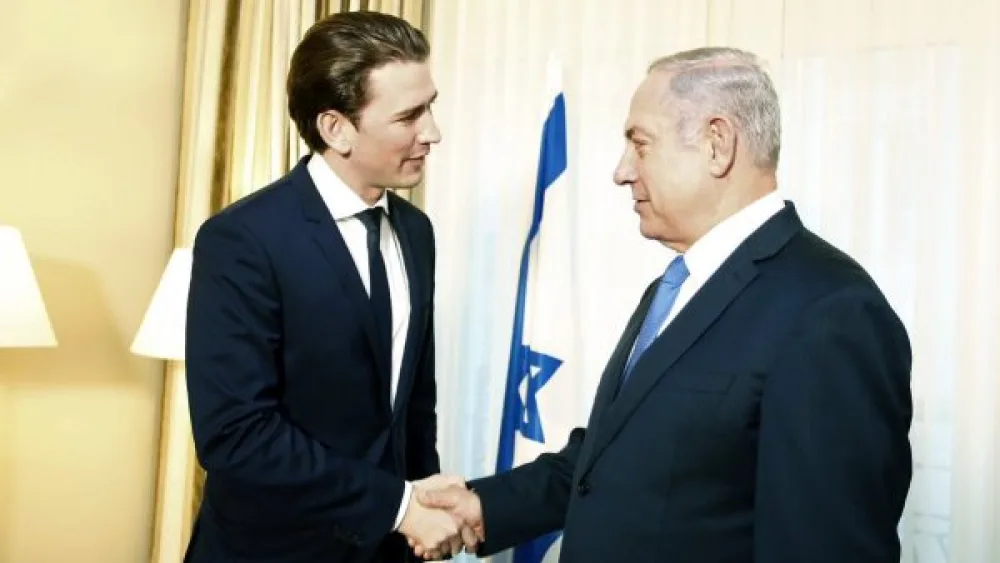
Austrian Chancellor Sebastian Kurz visited the Yad Vashem Holocaust memorial museum and the Western Wall on Sunday as part of a three-day visit to Israel.
Kurz is scheduled to meet with Israeli Prime Minister Benjamin Netanyahu and several other Israeli leaders. He will also address the Global Forum of the American Jewish Committee in Jerusalem.
The Austrian leader’s visit at Yad Vashem included a behind-the-scenes tour of its archives—the world’s largest repository of Holocaust-related documentation. Kurz and Yad Vashem chairman Avner Shalev also signed an “Agreement of Principle” ensuring that Yad Vashem will be granted access to the Austrian State Archives and the Mauthausen Memorial, guaranteeing Israel’s ability to copy documents relating to the Holocaust.
Kurz also announced that the Republic of Austria will contribute to the establishment of the new Shoah Heritage Collections Center at Yad Vashem, providing additional storage and preservation labs for artifacts, artwork and documentation from the Holocaust era.
Shalev presented Kurz with a token of remembrance and appreciation: a facsimile copy of the collection of 99 works of art created by Holocaust victim Carol Deutsch for his daughter, depicting scenes from the Bible. Deutsch was murdered after arriving in Buchenwald camp on a death march.
At a memorial ceremony, Kurz stated, “As the Chancellor of Austria, I have to state that Austria and the Austrian people carry a heavy burden for their horrific and shameful crimes committed during the Shoah. But let me assure you that we Austrians know that we are responsible for our history. It is our duty and obligation to ensure that the Shoah will never happen again, and that my generation and succeeding generations will never forget these horrible crimes.”
Kurz, only 31, became Chancellor of Austria this past December after his Conservative party, the Austrian People’s Party won the general elections. He formed a coalition government with the far-right Freedom Party of Karl-Heinze Strache. The FPO, which was founded by former Nazis in the 1950s, came third in October’s parliamentary election with 26 percent of the vote. The party has stated that it has left its anti-Semitic past behind, yet continues to expel members each year for anti-Semitic or neo-Nazi comments.
After forming his coalition, Kurz said it would focus on fighting anti-Semitism after Israel made it clear it would not work directly with any ministers from the far-right party. But Israeli Prime Minister Benjamin Netanyahu has a direct line of communication with the Austrian chancellor.
“Anti-Semitism has no place in Austria or Europe. We will fight all forms of anti-Semitism with full determination, both those that still exist and those that have been newly imported,” Kurz said in his speech to parliament presenting his coalition. “That will be one of our government’s significant tasks.”
When Strache’s party joined a coalition government in 2000, Israel recalled its ambassador and downgraded relations. Since then, Strache has also visited the Yad Vashem Memorial.
Kurz has previously visited Israel in 2016 as Austria’s Foreign Minister.
In an interview with an Israeli television news program, the Austrian Chancellor said moving his country’s embassy from Tel Aviv to Jerusalem “is not a current topic.”
Austria’s ambassador to Israel Martin Weiss, told the Austrian press agency APA that on this issue his country follows the E.U. policy. Yet Austria was represented at a reception given on the occasion of the inauguration of the U.S. embassy in Jerusalem, along with the Czech Republic, Romania and Hungary.