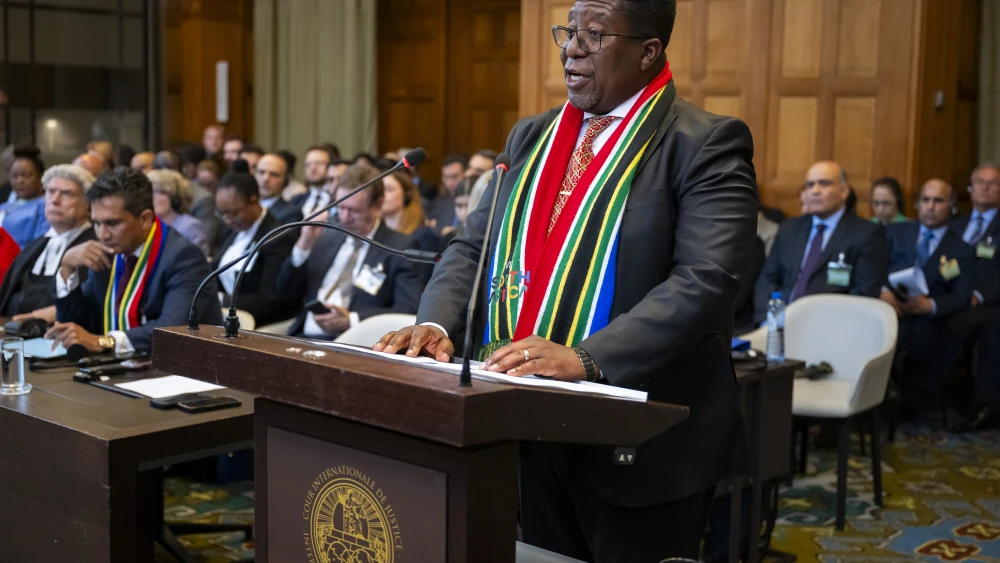
Belgium’s decision to join South Africa’s case before the International Court of Justice, accusing Israel of committing “genocide” in Gaza, is a stunt that could carry important consequences, experts told JNS.
“Belgium’s move to intervene alongside South Africa is akin to putting lipstick on a pig,” Gerard Filitti, senior counsel at the Lawfare Project, told JNS. He added that it is “political theater that weaponizes accusations of genocide in a farcical abuse of the international legal system.”
The country’s arguments, “including that genocidal intent can be inferred and that partial destruction of a group can meet the legal threshold for genocide, bring more confusion than clarity to the law of armed conflict,” Filitti said. “They risk setting a precedent that collapses the line between genocide and war, and destabilizes the legal framework governing armed conflict.”
The result, to Filitti, is the “corrosion of international law, turning genocide from the gravest crime into a weapon of lawfare deployed for political gain.”
The court, which is the principal judicial arm of the United Nations based in The Hague, said on Tuesday that Belgium had opted to join, or “intervene,” in the case.
‘Claim is not particularly meritorious’
Geoffrey Corn, chair of criminal law at Texas Tech University School of Law and director of its military law and policy center, told JNS that it is significant that a European Union member is supporting South Africa’s case. (Ireland and Spain joined the case earlier.)
“The political, or symbolic, significance is that they are making a statement that they believe South Africa’s assertion of a violation of the Genocide Convention is meritorious,” said Corn, a distinguished Jewish Institute for National Security of America fellow.
“The more states that intervene, the more of a statement it is that they have made a determination in their own assessment that Israel engaged in genocide,” Corn told JNS. “It’s discouraging, because I think that the claim is not particularly meritorious.”
Belgium appears to be focusing on the “intent” aspect of allegations of Israeli genocide, according to Corn. “It seems to me that what they’re supporting by intervening is this theory that you can rely on the consequences of combat even if there’s an alternate explanation for the civilian harm to satisfy the intent element, which is the essence of the crime of genocide,” he said.
That approach is “inconsistent with the general notion of proof beyond a reasonable doubt,” he told JNS.
Generally, the standard of proof beyond a reasonable doubt means that evidence must exclude “all alternate rational or reasonable explanations other than the required intent,” according to Corn.
“If we assume, take at face value, 40,000 civilian deaths over a two-year combat campaign, and you have the explanation that that’s a consequence of the nature of hostilities, the urban warfare, the enemy’s illicit tactics, what they want to argue, I think, is that that’s not enough to rebut the specific intent required for genocide,” he said.
“It’s really going to be the decisive question in the case,” he added.
When the case began at the court, it was likely that the U.N. body would find insufficient evidence to show that the Israeli government intended to commit genocide, according to Corn. But the scholar thinks that it’s becoming likelier that the court will find in South Africa’s favor and cite Israel cutting off aid and the rhetoric of some Israeli leaders.
If the court rules that way, it would be “terribly unfortunate not just for Israel but for any country that has to fight an urban war against an enemy that’s trying to generate civilian casualties,” Corn told JNS.
“The intent element from inception was deliberately very, very high,” Corn said. “There was even some commentary when the convention was adopted that civilian casualties do not ipso facto prove that intent.”
“If the court essentially dilutes that intent burden, it’s not going to bode well for those states in the future,” he said.