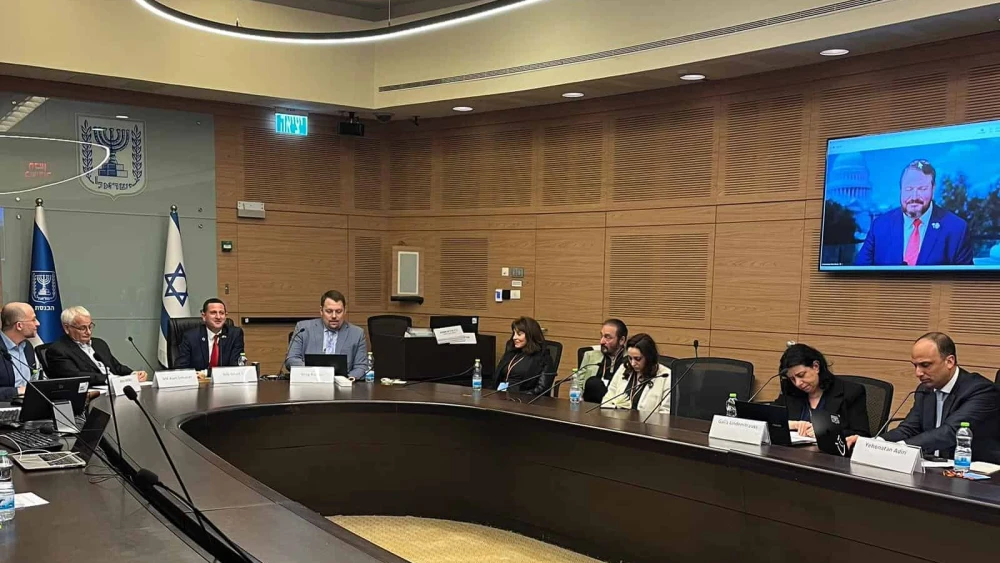
A cross-parliamentary meeting on Tuesday of lawmakers from Israel, Greece, Cyprus and Congress urged the strengthening of the Eastern Mediterranean alliance among the three regional allies through joint cooperation and actions to counter Turkey’s growing regional influence and threat.
The meeting at the Knesset in Jerusalem, in which many participated via video link, comes at a time of heightened uncertainty in the region over a buildup of U.S. military force following the Islamic Republic’s brutal repression of anti-governmental protests.
“Over the two and a half years since October 7, we have witnessed a dramatic weakening of the Iranian Shi’ite axis and its replacement by a Sunni Muslim Brotherhood axis,” said Knesset member Ohad Tal, who serves as co-chair of the Knesset Caucus for the Eastern Mediterranean Alliance.
“Strengthening cooperation between Israel, Cyprus, Greece and the United States—among other things through major infrastructure, natural resources and security projects—is a strategic asset and a response to curbing Turkey’s ambitions,” he continued.
“Precisely after two years of multifront conflict, Israel must take the next step: translating military strength into a diplomatic and civilian anchor,” said Knesset member Alon Schuster, co-chair of the Caucus. “The partnership with Greece and Cyprus is not only a security alliance—it is an opportunity to build regional civilian resilience in the fields of energy, water, agriculture and innovation.”
Israel, Greece and Cyprus have for years been working to advance a long-touted landmark energy deal, with their leaders pledging at a trilateral summit in Jerusalem in December to deepen post-war security and defense cooperation in a volatile region.
The much-discussed deal to link the three countries’ electrical grids—referred to as an “energy highway”—is to be carried out via the world’s longest and deepest underwater electricity cable, crossing the Mediterranean seabed and bridging Asia and Europe.
The countries have also been weighing cooperation on an offshore natural-gas deal that could establish an energy corridor to Europe and beyond, including Arab countries in the region.
“We need to be clear about who our partners are in the Middle East and who our enemies are—who is open to cooperation and who creates obstacles and challenges,” said Rep. Brad Schneider (D-Ill.) on Tuesday.
Rep. Randy Fine (R-Fla.) made it clear that in his view, Turkey was in the latter group.
“Over the past few years—whether it’s rhetoric related to Gaza, influence in Syria or activity in other parts of the world—we have seen that Turkey has gone off the reservation,” he said.
According to Brig. Gen. (res.) Yossi Kuperwasser, an Israeli intelligence and security expert, “Turkey is becoming a bigger military challenge for Israel, and we need to cooperate with everybody else.”
He noted that Ankara was concerned over the Islamic Republic losing control of Iran and the entire Middle East becoming more pragmatic, which, he said, they view as undesirable.
“This event is of the utmost importance, as four parliaments are speaking together and planning joint legislative steps,” said Gregg Roman, CEO of the Middle East Forum, a Philadelphia-based think tank that initiated the event. “These are images that need to be seen in Turkey, Iran and Russia.”