


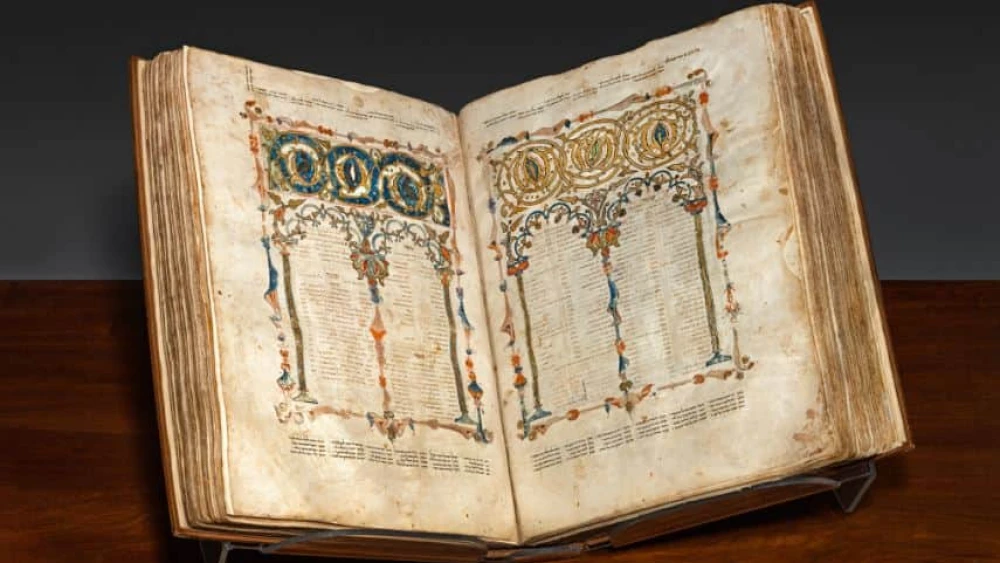
A rare, handsomely illustrated 14th century Hebrew Bible will soon go on public display after being sold at auction for $6.7 million at Sotheby’s New York on Sept. 10.
The Shem Tov Bible is described as “a tour de force of biblical and kabbalistic scholarship and a precious witness to the medieval tradition of Sephardic book art.”
It was completed by Rabbi Shem Tov Ibn Gaon in the northern Spanish city of Soria in 1312.
Sharon Liberman Mintz, Sotheby’s international senior Judaica specialist for books and manuscripts, said the 800-page Bible’s mixture of scholarship, mystical lettering and various artistic influences make it unique.
The book mixes three artistic and architectural traditions: “The architectural features mirror the mudéjar art of the time, while at the same time using artistic vocabulary from French gothic,” said Liberman Mintz.
The Bible sold at the high end of its $5-$7 million estimate.
The Shem Tov Bible also combines various Jewish streams of thought, citing the Hilleli codex, a legendary, lost Hebrew Bible, while containing about 2,000 Kabbalistic letters to which are attributed a secret meaning.
The Bible is considered to have mystical powers. In the late 1860s, its owners didn’t want to part with it “because, aside from being a truly precious object, it is a tried and true talisman, for a woman experiencing a difficult labor will be saved from her birth pains when the book enters her home.”
David Solomon Sassoon, a collector of Hebrew books, acquired it in the early 20th century. It occupied a central place in his collection, The Guardian reported.
Shortly before his death in 1942, he told his son to speak to his Torah scrolls and the Shem Tov Bible and say: “We will return to you, and you will return to us; we will not forget you, neither in this world nor in the world to come.”
Liberman Mintz is most astonished that the Bible survived the centuries as it made its way from Spain to Jerusalem, Baghdad, Tripoli, London and Geneva.
“I think the journey is so exciting because it’s out of Spain by 1315, so it escapes the riots and massacres of 1391 and then the expulsion [of the Jews] from Spain in 1492, when many books were lost,” said Liberman Mintz.
“Then it gets to Israel, which is overrun by the crusaders ... [and] it manages to escape that. It goes to Baghdad, and we know that the Jewish community of Baghdad witnessed all kinds of upheavals. It somehow makes its way to Tripoli. It’s in London during the Second World War—or probably in Letchworth—and it survives the war. It’s had a miraculous journey of survival.”



