Newsletter
Newsletter Support JNS

Abbas rejects tax money from Israel, insists its funds go to terrorists and their families

“We reject the tax; we don’t want it,” Palestinian Authority Mahmoud Abbas told visiting members of the U.S. Congress. “Frankly, if we are left with only 20 or 30 million shekels, which is the sum paid to families of martyrs, then we will pay them to the families of martyrs.”

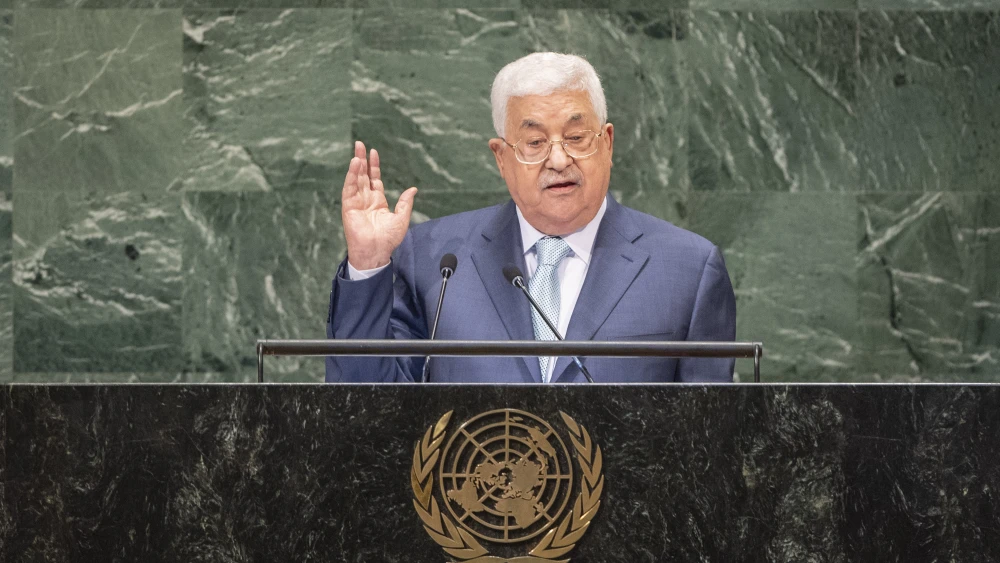
Palestinian Authority leader Mahmoud Abbas addresses the U.N. General Assembly, Sept. 27, 2018. Photo by Cia Pak/U.N. Photo.

Palestinian Authority leader Mahmoud Abbas has rejected tax revenues collected by Israel following the Jewish state’s decision on Sunday to reduce 5 percent of what it gives to the P.A. due to the latter’s support for paying terrorists and their families.

Israel’s finance ministry announced on Wednesday that it collects around $193 million in Palestinian tax revenues and sends around $165.8 million of that to the P.A. after deducting payments for medical treatment services, sewage, water and electricity.

“We reject the tax; we don’t want it,” Abbas told visiting members of the U.S. Congress. “Frankly, if we are left with only 20 or 30 million shekels, which is the sum paid to families of martyrs, then we will pay them to the families of martyrs.”

The United States passed and enacted the Taylor Force Act last year that drastically reduced assistance to the P.A. in response to the latter using American taxpayer funds to reward terrorists and their families.

The United States has subsequently quashed other funding for the P.A.—from ceasing support for the U.N. refugee program for Palestinians, or UNRWA, to cutting U.S. security assistance to the P.A. in accordance with the Anti-Terrorism Clarification Act.

“This fight is far from over. More to come this summer,” Mahmoud Khalil said.
The Israeli firm Gambit Security said that the cyber attack had the hallmarks of prior Iranian attacks.
District leaders ought to be “ashamed of themselves for giving such a dangerous group unfettered access to their schools and students,” Casey Ryan, of Defending Education, told JNS.
“No one stands alone in our city, when one community is targeted by hate, all of Chicago feels the impact,” stated Brandon Johnson, the city mayor.
The public university “inexplicably took no serious action whatsoever” as “Jewish and Israeli students risked physical assault” during the 2024 anti-Israel campus protests.
Police said the suspect repeatedly slapped the woman on her upper back from behind, though authorities are not investigating the incident as a hate crime.