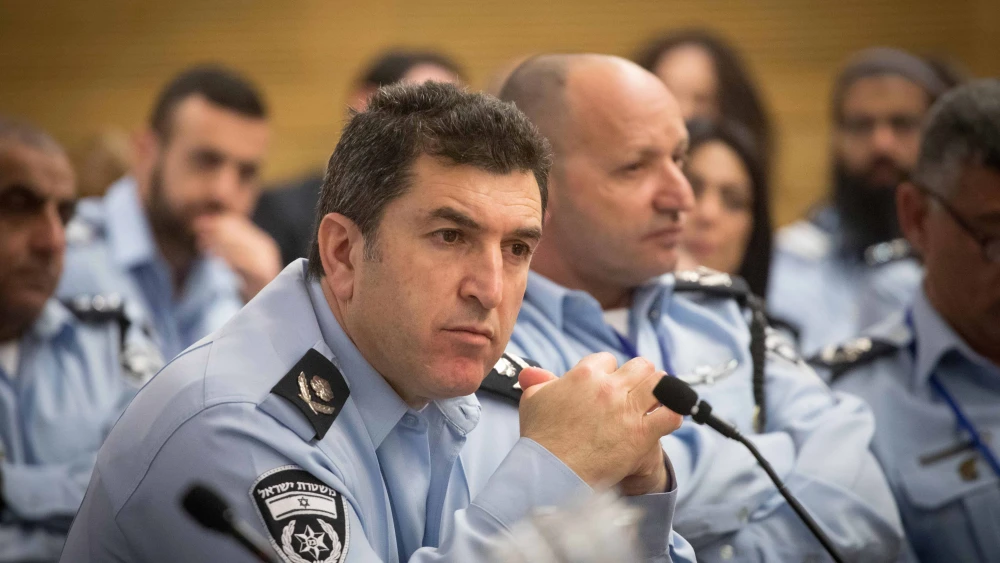

The recent appointment of retired Israel Police Commander Yoram Halevi as the next Coordinator of Government Activities in the Territories (COGAT) has ignited a fierce debate within Israel, which also touches on the very nature and role of the influential body he is set to lead.
The appointment, which was announced on Sept. 7, reportedly followed a significant disagreement between Defense Minister Israel Katz, who championed Halevi, and IDF Chief of Staff Lt. Gen. Eyal Zamir, who had recommended a career IDF officer for the position. Katz ultimately imposed his choice, a move that coincided with his veto of two other promotions for brigadier generals, citing their roles on Oct. 7, 2023.
Halevi brings an extensive professional background to the role—having commanded the elite Counter-Terrorism Unit and the Jerusalem Police District, as well as the major serious crime and international police 433 Unit, among other senior posts.
Professor Kobi Michael, a senior researcher at the Misgav Institute for National Security and Zionist Strategy and at the Institute for National Security Studies in Tel Aviv, who previously served as head of the Palestinian desk at Israel’s Ministry for Strategic Affairs, told JNS in recent days, “I see no problem with Halevi’s appointment to the position. I think he has the background and the skills that can be suitable, certainly no less than another general in the army or a brigadier general who would be promoted to the rank of major general,” Michael stated.
“The problem is not in the appointment, but in the decision to place him in an IDF uniform with the rank of major general. I did not understand this move, as there have already been civilian heads of COGAT. COGAT is part of the Ministry of Defense and is subordinate to the Minister of Defense. Why could he not have been appointed to the position as a civilian?”
The larger problem, Michael argued, is the evolution of COGAT into an integral part of the IDF General Staff. “The fact that COGAT has over the years become an inseparable part of the army, and the head of COGAT a part of the General Staff, is the problematic issue in my view. The essence of COGAT is civilian, and its entire reason for existence is in the connection and cooperation with the PA on a very wide range of civilian issues,” he said.
“Security coordination can be separated from COGAT as was the case until 2001, leaving that part in the military, while the whole of COGAT can become a civilian body,” Michael argued.
This integration of a civilian-focused body into the military’s highest echelons has had a corrosive effect on the IDF’s strategic doctrine, Michael stated. In an analysis entitled Generals in Suits published at the Open University of Israel, Michael detailed how this process, which accelerated after the Oslo Accords, contributed to the development of the failed “conception” that collapsed on October 7.
“The COGAT way of thinking disrupts the military’s thinking, in my view,” he told JNS. “The processes the army has undergone since the beginning of the Oslo process ultimately led to the development of a conception that was the basis of a doctrine that changed the army and turned it from an army of decisive victory, into an army of containment and deterrence, and into an entity that sees the political process with the Palestinians and the strengthening of the PA and the cultivation of the connection and cooperation with it as almost its top priority.”
Yoni Ben Menachem, a senior Middle East analyst for the Jerusalem Center for Security and Foreign Affairs and a veteran Arab affairs and diplomatic commentator, stated, “Yoram Halevi is a very talented officer, he has many merits, and he also has experience in fighting terrorism.”
Ben Menachem, a former director general of the Israel Broadcasting Authority, added, “But the question that is asked here is whether you can put a police officer as a major general in the IDF. After all, these are two different domains. The coordination of activities in the territories is indeed mostly a system that deals with the civilian affairs of the Palestinians, both in Judea and Samaria and in Gaza, but his subordinates are soldiers.”
Like Michael, Ben Menachem argued that Halevi should have been appointed as a civilian, assessing that the military rank may have been an insistence by the Chief of Staff to ensure Halevi was directly subordinate to him.