


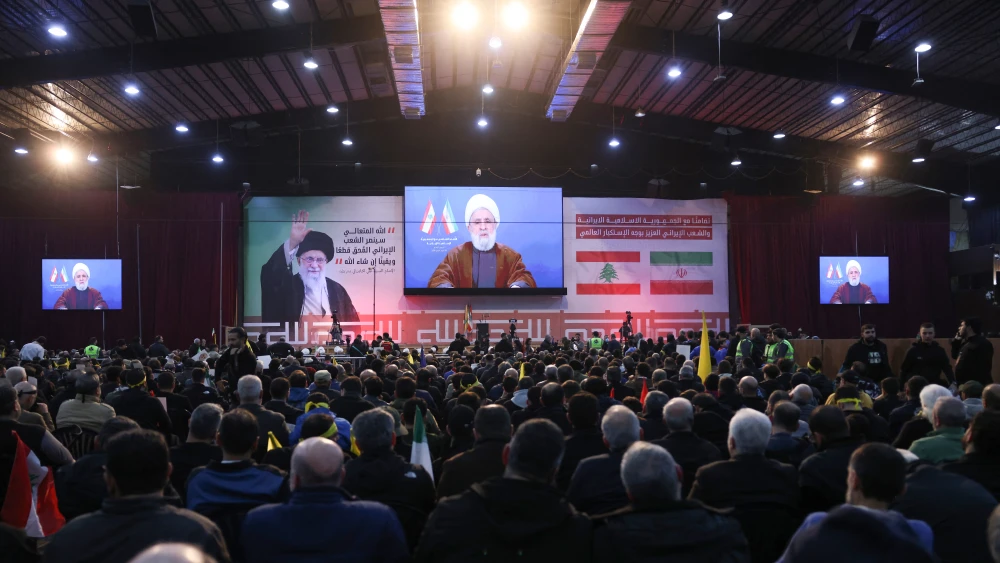

As Israel and Lebanon prepare for direct negotiations, with Israeli and Lebanese ambassadors scheduled to meet this week in Washington, Israeli forces continue aggressive operations to push Hezbollah north of the Litani River. Israeli Prime Minister Benjamin Netanyahu has stated that the talks will focus on disarming Hezbollah and establishing peace, while Israel has made clear it will not negotiate directly with the terror group. Israeli troops are expanding a security buffer zone in southern Lebanon, striking Hezbollah infrastructure, demolishing key bridges over the Litani, and advancing to create a de facto zone free of Hezbollah presence. These military actions run parallel to the diplomatic track, reflecting Jerusalem’s insistence on tangible security gains rather than paper agreements.
At the same time, Hezbollah’s recent moves inside Beirut are further inflaming tensions. The terror group has been systematically renting apartments and offices under fictitious names for its operatives and Iranian Revolutionary Guard Corps (IRGC) officers—a tactic exposed by Israeli strikes.
According to a recent Israeli media report citing Saudi channel Al-Hadath, the group is taking steps that many Lebanese interpret as preparation for greater control over Beirut, evoking memories of Hezbollah’s 2008 takeover of parts of the city. Lebanese residents voiced sharp criticism, accusing the organization of endangering civilians while the country grapples with economic collapse and mass displacement.
These developments come as Hezbollah has issued open threats against the Lebanese government, further stripping away its longstanding pretense of being a purely Lebanese “resistance” movement. Analysts say the group is increasingly viewed as an Iranian proxy launching wars on Tehran’s behalf, with significant implications for its political standing, financial networks and military capabilities.
Expert consensus points to a notable shift in how Hezbollah is perceived both inside Lebanon and internationally.
Hussain Abdul-Hussain, a research fellow at the Foundation for Defense of Democracies (FDD) focused on Arab-Israeli and U.S.-Arab relations, told JNS that Hezbollah’s mask has come off.
“There are not many ways to do this. There’s only one way for the Lebanese government to act like any other normal sovereign government,” he said, referring to the need to confront Hezbollah directly.
David Daoud, FDD Senior Fellow and Lebanon-Hezbollah specialist, told JNS that the group’s actions have accelerated public disillusionment.
“Everywhere that Iran has ever gone, Hezbollah is the tip of the spear,” Daoud explained, highlighting how the organization’s decision to open a “support war” for Iran after Oct. 7, 2023, has been devastating for Lebanon.
Public sentiment in Lebanon has shifted markedly. Lebanese citizens, facing electricity shortages, economic ruin, and chaos from over a million displaced people in Beirut, now openly criticize Hezbollah on social media for dragging the country into conflict. The rental of civilian properties under fake names has further fueled resentment, with residents warning of a potential “new May 7,” a larger-scale takeover that could endanger civilians.
While Hezbollah retains significant military infrastructure despite heavy losses, its political and financial position has deteriorated.
Jonathan Schanzer, FDD Executive Director and former U.S. Treasury terrorism finance analyst, told JNS that the current juncture represents “a rare moment... an unbelievable generational opportunity for Lebanon to take its country back.”
He noted indirect coordination between Israel and the Lebanese government during the fighting, saying these were “the only two countries that truly cared about the sovereignty of Lebanon.”
Daoud told JNS that Iran is desperately trying to preserve Hezbollah through ceasefire maneuvers. “They’re trying to help Hezbollah get away with it so they can resume the activities that they were doing prior to this conflict,” he said.
He warned that without real enforcement, any ceasefire would simply allow rearmament.
Regarding Israel’s objectives, experts assess that Jerusalem is pursuing more than just pushing Hezbollah north of the Litani River.
A recent policy paper by Alma Research and Education Center (“What Is Israel’s ‘Endgame’ in the Campaign in Lebanon?”) by Sarit Zehavi and Tal Beeri argues for a comprehensive strategy of strategic weakening, including financial measures, repeated strikes on rebuilding efforts across Lebanon, and full disarmament south of the Litani. Israel is targeting not only military assets but also Hezbollah’s civilian infrastructure (Dahiya fuel depots, solar networks, etc.) while avoiding Lebanese state targets.
According to Zehavi, Hezbollah has been hit “significantly, though not fatally yet.”
Zehavi told JNS the Lebanese government has taken unprecedented steps, such as removing language that legitimized Hezbollah’s armed role and declaring its military activities illegal. However, implementation remains weak due to the Lebanese Armed Forces’ limited capacity, fear of civil war, and sectarian politics.
Abdul-Hussain told JNS he does not want the war to end merely for “a ceasefire because this has been recurrent over and over again.” He stressed the need for Lebanon to assert a true monopoly on force.
According to Schanzer, despite symbolic progress, the gap between rhetoric and action remains dangerous. “The symbolic is important... but what we need to see... is that type of action that ensures that this will be the last Lebanon war,” he said.
Hezbollah’s financial empire, including Qard al-Hassan bank, global criminal networks and parallel service systems, is a key vulnerability. The Alma paper recommended that the Lebanese government ban these activities and replace Hezbollah’s social services with state alternatives, supported by international pressure on Iranian funding routes.
Experts agree that sustained Israeli military pressure combined with Lebanese and international financial measures could erode Hezbollah’s ability to operate as a state-within-a-state.
Daoud, Schanzer and Abdul-Hussain all described the current situation as a potential turning point, driven by Iran’s weakened position, Hezbollah’s leadership losses, and growing Lebanese fatigue.
However, they cautioned that without decisive action by Beirut, backed by external support, the cycle of ceasefire, rearmament and war will continue.
As Schanzer told JNS, Lebanon stands at a crossroads: it can either reclaim its sovereignty or remain trapped under Iranian influence through Hezbollah. The coming months, these analysts agreed, will determine which path the country takes.



